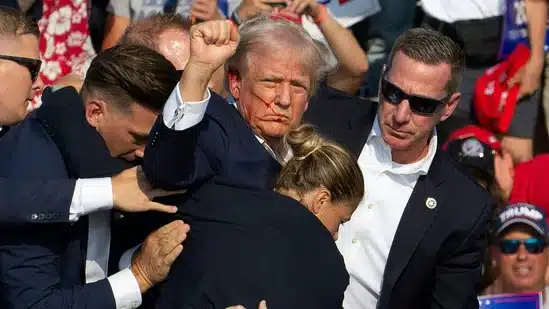















In an event that shook the nation, former President Donald Trump narrowly escaped an assassination attempt on July 13, 2024, at a campaign rally in Butler, Pennsylvania. While Trump survived with a minor injury-one bullet grazing his ear-the attack claimed the life of Corey Comperatore, an innocent rally attendee. The shooting raised serious questions about the lapses in security, with many pointing fingers at the Secret Service and local law enforcement. The fallout from the incident led to congressional hearings and the resignation of Kimberly Cheatle, the now-former director of the Secret Service.
On September 20, the Secret Service released a detailed report on the assassination attempt, providing an in-depth look at what went wrong and where the responsibility lies.
The Secret Service’s five-page report highlights major flaws in the handling of security for the event, revealing both federal and local law enforcement agencies failed to properly coordinate their efforts. The report underscores a cascading series of errors that culminated in the near-fatal attack.
The primary issue, according to the report, was a breakdown in communication between federal and local authorities. While the Secret Service had acknowledged the challenges the rally venue posed, they underestimated the gravity of the situation. “Communications deficiencies,” as noted by the Associated Press, played a central role in the mismanagement. These gaps in coordination were further complicated by the fact that local police were unaware of two key communication posts established by the Secret Service, and different agencies were using disparate communication methods-radios for the Secret Service and cell phones for local police.
This lack of a unified communication system made interagency cooperation unnecessarily complex, leading to confusion and delays in crucial moments. The failure to establish a streamlined communication protocol severely hindered the ability of law enforcement agencies to respond effectively to emerging threats during the rally.
Another significant flaw highlighted in the report was the failure to secure key vantage points at the rally venue. The Secret Service acknowledged that they did not secure some of the buildings surrounding the fairgrounds where the rally was held. These oversights left Trump vulnerable to attack from elevated positions, such as rooftops, and provided the shooter, identified as Christopher Crooks, with an optimal vantage point to carry out the assassination attempt.
The report also pointed to the absence of a local sniper team on top of the AGR building, a decision that was never properly discussed with the Secret Service advance team. According to ABC News, the “lack of due diligence” in constructing a secure perimeter around the venue proved to be a critical oversight. If more attention had been paid to securing these high-risk locations, the attack might have been prevented or mitigated.
Despite being aware of these security risks, the report suggests that there was a disconnect between law enforcement agencies and the Secret Service’s planning team, leading to an incomplete security strategy.
Another failure outlined in the Secret Service report involved technical issues with the agency’s drone system. Drones, which could have provided an aerial perspective of the venue and surrounding areas, were rendered ineffective due to technical malfunctions. This was a major setback for the Secret Service, as the drones could have helped identify suspicious individuals or activities in real-time.
Without the drones, the Secret Service and local police were forced to rely on traditional surveillance methods. But here too, coordination broke down. Local police were primarily using cell phones to relay information, while Secret Service personnel were communicating via radio. The inability to integrate these two communication systems hampered real-time information-sharing, which might have prevented the shooter from gaining the upper hand.
The report reveals that local law enforcement did identify a suspicious individual on the roof of the AGR building, but this information was not broadcasted to all federal personnel on the ground. This failure to disseminate critical information allowed the assailant to position himself and execute the attack without immediate interference.
Perhaps one of the most concerning revelations from the report is that Trump’s security detail was unaware of the heightened threat level in the minutes leading up to the attack. The report states that federal personnel responsible for Trump’s protection “were not apprised of how focused state and local law enforcement were in the minutes leading up to the attack on locating the suspicious subject.”
Had Trump’s security team been properly informed of the ongoing threat, they might have made the decision to relocate the former president to a safer location. This failure to communicate crucial security updates to Trump’s protective detail put him in unnecessary danger.
The report also highlights that a local tactical team was stationed in the complex from which the shots were fired. Multiple law enforcement agencies had questioned the effectiveness of the team’s positioning before the attack, yet no follow-up discussions occurred. Additionally, the potential use of the AGR rooftop for sniper coverage was never explored, even though local snipers reportedly had no objections to being stationed there.
While the Secret Service report highlights numerous operational failures, it stops short of blaming specific individuals for the breakdown in security. The report does not address whether any disciplinary actions have been taken against those responsible for the failures, a detail that has left some critics unsatisfied. The lack of individual accountability, combined with the resignation of former Secret Service Director Kimberly Cheatle, suggests that the agency may be trying to move past the incident without directly addressing the root causes of the failure.
This is not the only security breach that has raised red flags in recent months. A foiled assassination attempt in Florida last week further emphasizes the need for the Secret Service to reassess its approach to protecting high-profile figures. Acting Secret Service Director Ronald Rowe Jr. acknowledged the agency’s shortcomings, stating, “It’s important that we hold ourselves to account for the failures of July 13th and that we use the lessons learned to make sure that we do not have another mission failure like this again.”
The report’s findings, combined with public scrutiny and pressure from Congress, will likely prompt a comprehensive review of the Secret Service’s protocols. Moving forward, the agency must improve its interagency communication strategies, enhance its technical capabilities, and ensure that all potential vantage points are secured during high-risk events.
As the nation continues to grapple with the implications of the assassination attempt, one thing is clear: the Secret Service must take decisive action to prevent another such failure in the future. Only time will tell whether the lessons from Butler, Pennsylvania, will result in tangible improvements in the agency’s operational capabilities.
Please follow Blitz on Google News Channel
The post Secret Service report reveals major failures in Trump rally security appeared first on BLiTZ.