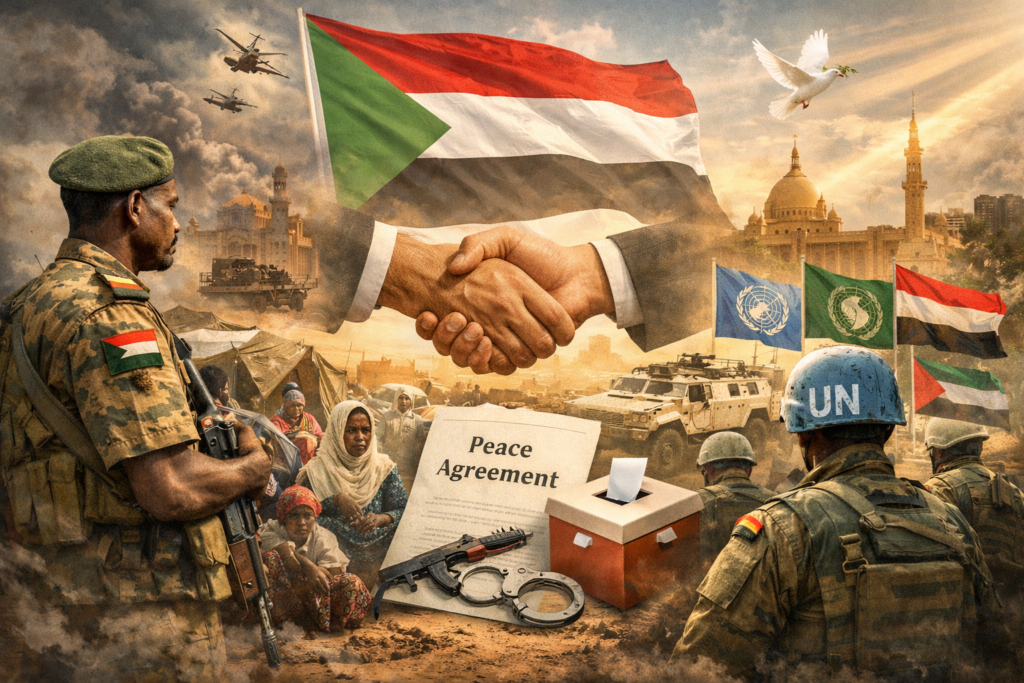














The Government of the Republic of Sudan has formally unveiled a wide-ranging peace initiative aimed at ending the devastating war that has plunged the country into an unprecedented humanitarian, political, and security crisis. The initiative presents a structured roadmap to halt hostilities, dismantle armed militias, protect civilians, and revive Sudan’s stalled transition toward democratic governance.
The proposal comes amid continuing fighting between the Sudanese Armed Forces and the rebel militia formerly known as the Rapid Support Forces (RSF), a conflict that has displaced millions, collapsed state institutions, and destabilised neighbouring countries. Sudanese authorities describe the war as an existential threat to the state, warning that continued violence risks permanent fragmentation and prolonged regional instability.
A framework aligned with international efforts
According to the government, the initiative builds on Sudan’s previously submitted roadmap to the UN Security Council and complements the Saudi-American peace efforts launched in Jeddah in May 2023. It reflects the vision of a transitional civilian “Government of Hope” that seeks to end the conflict through a combination of military de-escalation, political reconciliation, and socioeconomic recovery.
At its core, the initiative emphasises Sudanese national ownership of the peace process, in line with relevant Security Council resolutions, while recognising the need for strong international oversight and support.
Key pillars of the peace initiative
1. Comprehensive ceasefire
The first and most urgent step calls for a nationwide ceasefire under joint monitoring by the United Nations, the African Union, and the League of Arab States.
The ceasefire would be synchronised with the full withdrawal of rebel militia forces from all occupied areas, in accordance with the Declaration of Principles signed in Jeddah on 11 May 2023.
Sudanese officials stress that any truce must be verifiable and enforceable, warning that previous ceasefires collapsed due to a lack of monitoring and accountability.
2. Assembly and registration of militia fighters
The initiative proposes the withdrawal and assembly of militia fighters into designated camps agreed upon by all parties and supervised internationally. Fighters would be registered, screened, and biometrically documented to prevent re-mobilisation, infiltration, or the recycling of combatants under new armed formations.
This step is presented as a prerequisite for meaningful disarmament and long-term security reform.
3. Displacement, refugees, and humanitarian access
With millions internally displaced and large refugee flows into neighbouring states, the plan prioritises:
- The safe and voluntary return of internally displaced persons to their areas of origin
- The voluntary repatriation of refugees
- Unimpeded humanitarian access to all war-affected regions
The government acknowledges that humanitarian organisations face severe operational challenges and pledges to guarantee their safety and freedom of movement.
4. Disarmament of the rebel militia
A comprehensive disarmament process would follow, conducted under agreed international monitoring mechanisms. Authorities insist on firm guarantees against the recycling or re-export of weapons, describing uncontrolled arms proliferation as one of the greatest threats to Sudan’s future stability.
Confidence-building measures
Political measures
The initiative outlines a dual approach to accountability and reconciliation. Individuals not implicated in war crimes, genocide, or grave human rights violations would be eligible for legal review and reintegration, while perpetrators of serious crimes would be subject to transitional justice mechanisms.
Additionally, the government commits to:
- Ensuring no Sudanese citizen is denied identity documents
- Reviewing criminal complaints linked to the conflict
- Regularising the status of Sudanese wishing to return home
These steps are intended to create a conducive environment for inclusive Sudanese-Sudanese dialogue.
Security measures
Security reform is anchored in:
- Integrating eligible individuals into Sudan’s regular armed forces
- Implementing Disarmament, Demobilisation, and Reintegration (DDR) programmes for those returning to civilian life
- International and regional support for rehabilitating former fighters and reintegrating them into society
Officials describe this as essential to dismantling parallel armed structures and restoring state authority.
Economic measures and reparations
Recognising the deep economic scars of the war, the initiative prioritises reparative development, particularly in Darfur, Kordofan, and other heavily affected regions. Proposed measures include:
- Reconstruction and development projects funded by national and international resources
- Establishment of microfinance funds to support livelihoods
- Job creation and civilian training programmes for former fighters
Non-convicted militia members may participate in these projects as part of their reintegration.
Social measures and community reconciliation
The social dimension focuses on rebuilding trust within fractured communities. Non-implicated former fighters and traditional community leaders would be involved in:
- Community reconciliation and reparations programmes
- Support for schools and hospitals in war-affected areas
The aim is to transform former combatants from agents of conflict into contributors to recovery.
Reconciliation conferences and national healing
The government proposes convening inclusive national and international reconciliation conferences, in cooperation with the UN, regional organisations, donors, and partner states. These forums would address the long-term social and psychological impacts of the war, mend Sudan’s torn social fabric, and promote collective healing.
The political transition
During the transitional period, Sudanese political forces would engage in a comprehensive national dialogue to agree on governance arrangements and state management. This process would culminate in free and fair elections under international supervision, completing what the government describes as a “comprehensive democratic transformation”.
A fragile but consequential proposal
While the initiative outlines an ambitious and detailed framework, its success depends on compliance by armed actors, sustained international engagement, and genuine political will. With Sudan’s humanitarian situation worsening and regional spill-over risks growing, diplomats and observers note that the initiative may represent one of the last opportunities to prevent prolonged state collapse.
For millions of Sudanese civilians trapped between violence, displacement, and hunger, the proposal offers a vision of peace—but one that must quickly move from paper to practice.