













Reading in English | Read in العربية (Arabic)
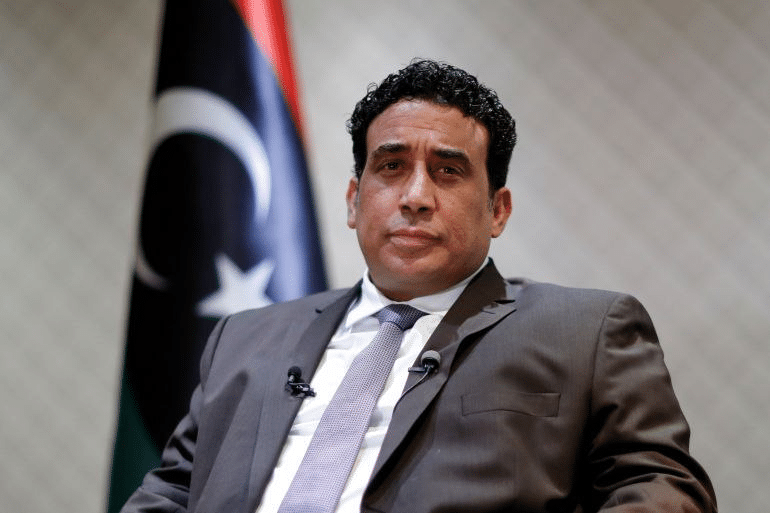
More than a decade after the fall of Muammar Gaddafi’s regime following the February 17, 2011 revolution, Libya was expected to embark on a journey to build a modern state based on institutions and the rule of law. However, the reality has been quite different. A new political class has emerged, more skilled at staying in power than at building a nation. At the forefront of this class is Mohammed al-Menfi, the President of the Libyan Presidential Council, who often appears to have discovered a simple political formula: speak frequently about nationalism, and people will forget to ask what you have done for the country.
Al-Menfi tirelessly advocates for national reconciliation. In almost every speech, the same phrase recurs as if Libya suffers from a shortage of words rather than a lack of decisions. Reconciliation here, reconciliation there, reconciliation in every direction… to the point that Libyans almost believe he has a unique compass that constantly points to the term “reconciliation.” However, the problem lies not in the word itself but in the direction that compass is pointing.
If Libyans were to examine the scene more closely, they would realize that al-Menfi’s compass does not always point to national reconciliation as he claims. Instead, it often points toward what resembles a reconciliation of interests. This type of politics prioritizes balance over truth, courtesy over state, and deals over principles.
Here, the scene takes on a satirical tone. The man speaks of transparency while political decisions grow increasingly opaque. He professes nationalism, yet politics often resembles an open market for personal gains. Ironically, the rhetoric rises higher as the reality drifts further away from those slogans.
In politics, there is usually one compass for a statesman: the interest of the state. Yet in Libya, it seems that some politicians have discovered more flexible compasses. These might point to balance at times, to personal calculations at others, and sometimes— as the Libyans wryly put it— to the kiss of the dollar, where interests align and deals are settled.
The issue is that this compass does not lead to state-building but rather prolongs the crisis. A state needs clear decisions and explicit positions, while a strategy of managing balances only produces further stagnation. The longer this stagnation persists, the more politicians thrive, having learned how to navigate the crisis without addressing its resolution.
Today, the Libyan scene resembles a political theater with repetitive acts: speeches about the nation, statements on transparency, declarations of reconciliation… yet hardly anything happens. It’s as if the state is always a project postponed until the next speech.
However, history is not written by speeches but by decisions. Nations are not built on slogans but on the capacity to bear the responsibilities of power. Herein lies the distinction between a politician who manages balances and a statesman who changes realities.
The politician seeks ways to remain in position for as long as possible, while the statesman pursues decisions that serve his country even if this costs him his position. Thus, leadership should not be measured by the number of speeches delivered but by the distance the state travels during his tenure.
If the measure of leadership were solely rhetoric, Mohammed al-Menfi would be one of the most successful leaders in Libya’s history. However, if the criterion involves state-building, the questions become significantly more challenging.
Conversely, a completely different generation is emerging within Libyan society, distinct from the elites that managed the previous phase. This is a young, national elite that no longer views politics as a means of influence but rather as a historical responsibility. This generation clearly understands that a state cannot be built with a mentality of political niceties and that true reconciliation is not about pleasing everyone but about establishing a just state for all.
This generation is not looking for new speeches about nationalism; they seek practices that demonstrate that nationalism. They aren’t searching for slogans about transparency but for clear policies that the public can hold officials accountable for.
Therefore, the question facing Mohammed al-Menfi today is not a fleeting media inquiry but a harsh political one: To which direction does his compass truly point? Is it the direction of a statesman who places Libya’s interests above all other considerations, or that of a politician skilled at discussing the nation while operating based on different calculations?
History pays little attention to what politicians say about themselves. What matters is the direction in which the country has traveled under their leadership. Today, Libya does not need a new compass for words but a genuine compass that leads to a state.