Reading in English | Read in العربية (Arabic)
Kazem Al-Saher rarely disappoints his audience. The relationship he shares with them has never been just that of a listener to a singer; it is a connection between an Iraqi and a piece of his memory.
His voice and music, since the 1980s, have transcended mere singing, constantly striving to heal the soul through creativity. For me personally, and for many who have experienced his refined, committed art, he embodies melancholy with dignity. He illustrates how we narrate and conceal our pain within a song.
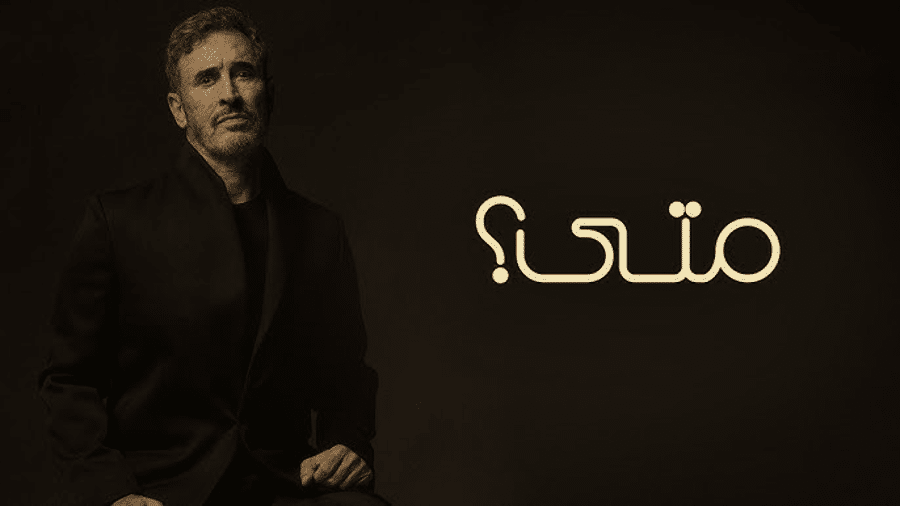
“Mata,” which he wrote and composed for himself, showcases a series of “AbouDhiyah” verses that form the backbone and details of the song. Listening to it felt like a postponed reconciliation with Kazem’s 1980s era.
The Iraqi “AbouDhiyah” is not just a fleeting popular form; it is one of the most emotionally rich poetic structures in Iraq, characterized by its authenticity of pain and its eloquent brevity. It represents a deep emotional state rooted in the southern geography and heritage, born from the South, the marshes, and the Euphrates—a place marked by absence and long nights. The words of AbouDhiyah carry the weight of loss, the scent of water, and the voices of men skilled at hiding their brokenness.
However, the poetic essence of “Mata” does not reach the depth of the AbouDhiyah verses that Iraqis cherish by heart, nor do Kazem’s AbouDhiyah pieces rise to match his artistic stature—an artist who has uniquely transformed Iraqi sorrow into timeless music. The AbouDhiyah verses in this song felt hesitant and simplistic, hinting at the Southern identity from a distance but failing to capture its true pain.
As for the music of “Mata,” it was the biggest disappointment for me in this piece.
Kazem Al-Saher, the genius musician, possesses a unique trait that sets him apart from his predecessors and successors among the great musicians of the East: the dramatic structure of his songs. In his major works, the melody does not merely complement the lyrics; it becomes the lyrics transformed into music. Through a musical phrase played on a violin, oud, or saxophone, we grasp the theme of the segment within that musical piece, understanding it as a story being told. At times, it feels like a narrative from which I could watch Kazem’s music as a dramatic scene unfolding a complete tale, even in the absence of words or traditional melodies—what singers often refer to as “Arap” (a term for certain lyrical expressions). His dramatic construction evokes a feeling of disappointment when the rhythm falters, allowing me to sense moments of longing or loss through the tremor of the flute.
This is Al-Saher’s genius: to utilize instruments in melodies inspired by our rich Sumerian, Akkadian, Babylonian, and Assyrian culture, creating a unique artistry that brings poetry to life with comprehensive dramatic scenes.
However, “Mata” this time came with a light, danceable melody that sat awkwardly on the shoulders of AbouDhiyah lyrics that should be dripping with mud and sorrow.
The song seemed unable to determine its identity: did it want to be a Southern Iraqi lament or a contemporary Arabic rhythmic song?
The musical arrangement also appeared confused; the instruments clashed with the song’s mood instead of uniting within it. The “safgah” disrupted the internal harmony, dressing the sorrowful lyrics in a rhythm that did not resemble its tears.
Only in the final measure did a glimmer of that old Kazem return—the one who knows how to lift the listener from the lull of the melody with a single phrase, and how to restore the fading majesty with a late conclusion that salvaged the ending… yet it did not rescue the journey towards it.