












Reading in English | Read in العربية (Arabic)
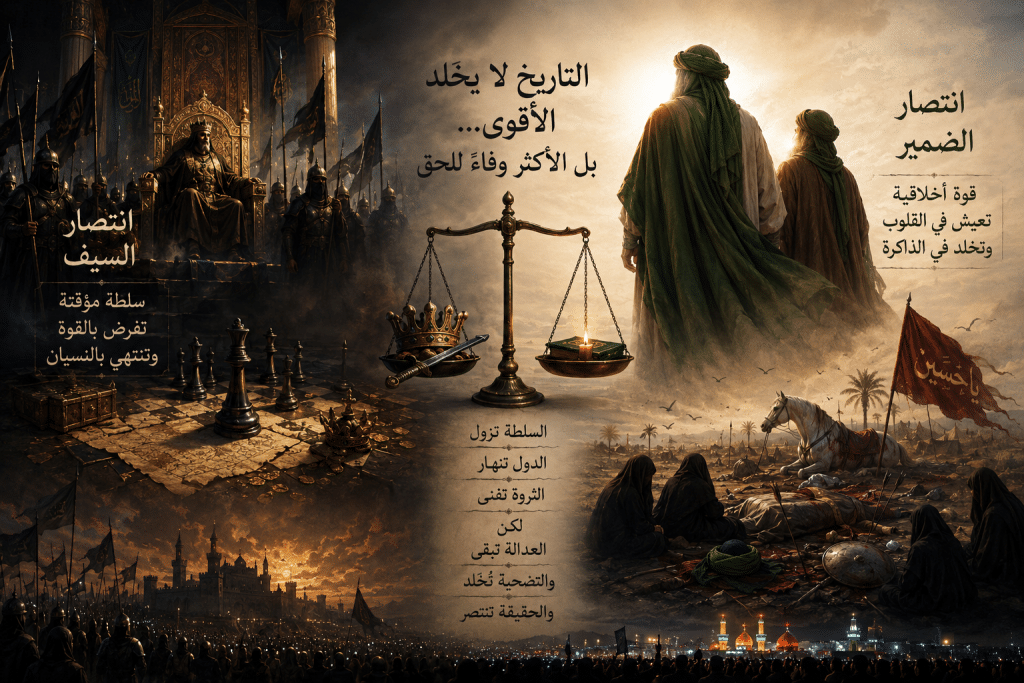
History is often written by the victors, but there are exceptional moments when the military defeated become the true victors in the memory of humanity. Power can impose its authority on the land, but it cannot enforce its legitimacy on the conscience. From this standpoint, we can understand the unique status of Ali ibn Abi Talib and Hussein ibn Ali within Islamic consciousness. They are not only viewed as religious figures but also as symbols of a deeper struggle between authority and truth, and between moral superiority and political dominance.
Many traditional readings of Islamic history, particularly within the Salafi school, have treated the conflicts following the death of the Prophet Muhammad as mere political disagreements among great historical figures who either succeeded or failed in their endeavors. However, this seemingly neutral description raises a fundamental issue: can the greatest divisions in Islamic history be reduced to mere political disputes? Can we understand the martyrdom of Ali and Hussein without addressing the very nature of authority in Islam?
The official narrative that has prevailed for centuries has focused more on the legitimacy of the state and its stability than on the legitimacy of moral opposition. For this reason, victors are seen as the makers of history, while victims are viewed merely as painful chapters in the construction of the state. However, a deeper examination reveals that the issue was not just a struggle for power, but a struggle to define Islam itself.
Ali ibn Abi Talib represented a direct extension of the prophetic school in understanding religion. He was not merely a relative of the Prophet or one of his prominent companions; he was a figure associated with religious knowledge, justice, asceticism, and a commitment to principles even under the most complex circumstances. Thus, the dispute surrounding him was not a personal conflict but rather a disagreement over which model should lead the nation: a model of authority grounded in principles or a political model based on the balance of power.
Ultimately, Ali’s opponents triumphed militarily, but the question that remains after fourteen centuries is: why does Ali persist as a global symbol of justice while many of his adversaries have faded into mere historical figures? The answer lies in the fact that human memory does not always immortalize the strongest, but rather those who embody values that transcend their era.
The same applies even more clearly to Hussein ibn Ali. Militarily, Karbala was a complete defeat. A small group of men, women, and children was besieged in the desert and annihilated before the army of a state possessing wealth, power, and weaponry. If we were to view the event through the lens of pure politics, we would conclude that the state triumphed and the revolution failed.
However, history did not judge it that way.
After many centuries, no one remembers Karbala as a victory for the state; it is remembered as a victory for human conscience over the logic of power. Hussein has transformed into a global symbol of moral resistance, and Karbala has become a classic example of the ability of principle to overcome the sword, even after its companions fell on the battlefield.
This raises a profound philosophical question: what if Ali had won from the beginning? What if Hussein had managed to defeat his opponents militarily?
While this question may seem strange, it unveils an important aspect of understanding history. If Ali or Hussein had achieved complete political victory, it would have been easy for many to join their cause out of power, self-interest, or fear. History would have witnessed a wide wave of new allegiances, much like the large numbers that converted to Islam in the Arabian Peninsula after it became the dominant political force.
But what would have revealed the true nature of hearts in this scenario?
The significant value in the experiences of Ali and Hussein lies in the fact that they presented people with an unforgeable test. Supporting them became costly, and defending them meant confronting authority rather than benefiting from it. Here lies the difference between faith that stems from conviction and faith that is borne amidst political dominance.
Thus, their martyrdom cannot be seen merely as a historical tragedy. They transformed into a lasting moral standard. Just as Prophet Muhammad was a measure that distinguished between faith and disbelief during his time, Ali and Hussein became standards that reveal positions on justice and truth when the nation enters a phase of struggle for power.
This creates an ongoing intellectual dilemma for some traditional Salafi readings. They affirm the virtue and great status of the People of the House, yet hesitate to draw the ethical and political conclusions that follow from what happened to them. Acknowledging the virtues of Ali and Hussein is not sufficient if it is not accompanied by a critique of the political structures that ultimately led to the opposition against one and the killing of the other.
The problem does not lie in respecting or attacking historical figures, but rather in how we read history itself. There is a difference between a reading that considers political stability the highest value and one that views justice as the highest value. There is a difference between a narrative asking how the victors succeeded and one asking why those committed to principles stood with the defeated.
Civilizations advance when they have the courage to review their history, not when they turn that history into a forbidden zone for criticism. It is not a coincidence that the greatest intellectual transformations in the world began when nations revisited their official narratives and asked questions that were previously prohibited.
Today, centuries after those events, the issues surrounding Ali and Hussein remain alive because they transcend individuals and eras. They represent the relationship between religion and authority, between conscience and power, and between truth and self-interest. These questions are not solely relevant to Muslims; they concern every society seeking justice in the face of hegemony.
Ali and Hussein’s opponents may have triumphed in specific battles, but Ali and Hussein won the battle of memory. They succeeded because they exemplified the kind of person who refuses to compromise on principle even when he knows the price may be his life. For this reason, their names remain a source of inspiration for millions throughout the centuries.
True history is not measured by the number of armies or the size of states, but by humanity’s ability to defend the truth when it stands alone. From this perspective, the martyrdom of Ali and Hussein was not the end of a project, but the beginning of an ethical question that the Islamic world continues to seek answers to even today.