











Reading in English | Read in العربية (Arabic)
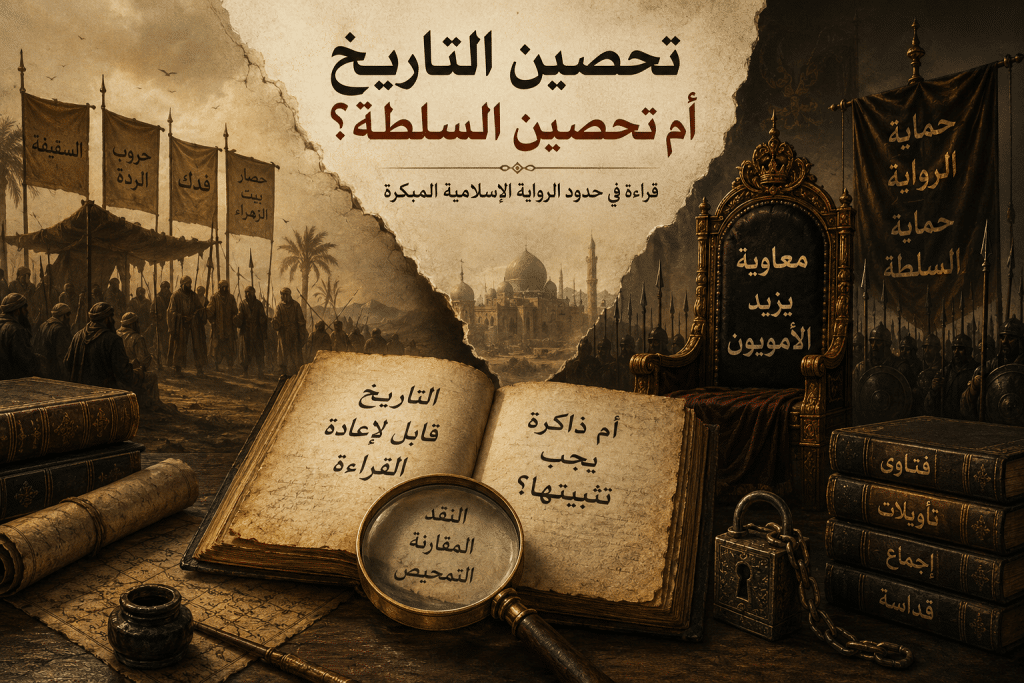
The radical Salafi movement defends Muawiya, Yazid, and the Umayyad state as the first line of defense regarding the events at Saqifah. If this line is breached, it opens up files that have remained closed and protected for many years, fortified by human fatwas and interpretations, cloaked in a semblance of human sanctity.
At its core, this perspective does not treat history as an open domain for critique, but rather as a closed structure that must be safeguarded through layers of religious interpretation and jurisprudential reasoning. In this context, the past transforms from a subject of inquiry to a system needing “protection,” rather than scrutiny.
If these files were to be opened, much of the religious authority that has thrived at the expense of religion and Islam would crumble. This critical view posits that part of the historical religious authority was not solely built on texts, but on monopolizing the interpretation of history and preventing any examination of its sensitive foundational moments.
In this perspective, the collapse of such a protective line implies not merely a reevaluation of figures or events, but necessarily the unearthing of entire layers of the foundational narrative. This would include the files concerning Saqifah, the Wars of Apostasy, the case of Malik ibn Nuwayra, the siege of Fatima’s house, the stories told with fervor, the confiscation of Fadak land, the seizure of the caliphate, and the files related to those charged with affairs in the Levant who were given free rein, as well as the files concerning Marwan ibn al-Hakam and al-Walid ibn al-Mughirah, along with the actions of the Umayyads during the time of the third caliph, Uthman ibn Affan.
What is being proposed here is not merely a re-reading of disparate events, but a deconstruction of a connected chain of occurrences that collectively form the foundational structure of political authority in Islam. Thus, any disruption in interpreting one link in this chain may automatically reflect on the reevaluation of the other links, making this area one of the most sensitive and contentious in historical discourse.
The fortification of this line would not have succeeded without a strong defense represented by figures like Muawiya, Yazid, and the Umayyads. These names are not presented as isolated historical figures but as crucial components within a larger narrative structure, utilized to maintain a comprehensive balance between religion, politics, and history. Therefore, defending them is inseparable from defending a specific approach to reading history itself, rather than just defending particular events.
However, the real issue, according to this view, lies not in the existence of differing narratives or varying interpretations, but in the transformation of one such interpretation into a “final version” of history, effectively closing the door on any subsequent questioning. When history is encircled by an unspoken network of sanctification, criticism becomes a threat, revision turns into a deviation from consensus, and re-examination is seen as an affront to the sacred.
Conversely, another trend within historical studies contends that this period, despite its sensitivity, should not be subjected to the logic of doctrinal protection; rather, it must be treated as an open field for critique, where narratives coexist and contend, and where each text is subject to scrutiny and comparison, without assuming the existence of one definitive or sacred narrative.
The crisis here is not in the diversity of narratives, but in the nature of the relationship between society and its history: Is it a history open to re-reading, or a memory that must be solidified? And was authority in the past merely a political event, or did it later become part of the very structure of religious interpretation?
Early Islamic history remains one of the most complex and intertwined fields, not only due to the density of its events but also because of the symbolic weight it has accumulated over centuries. Every attempt to re-read it must confront a deeper question: Where does history end and where does doctrine begin?