
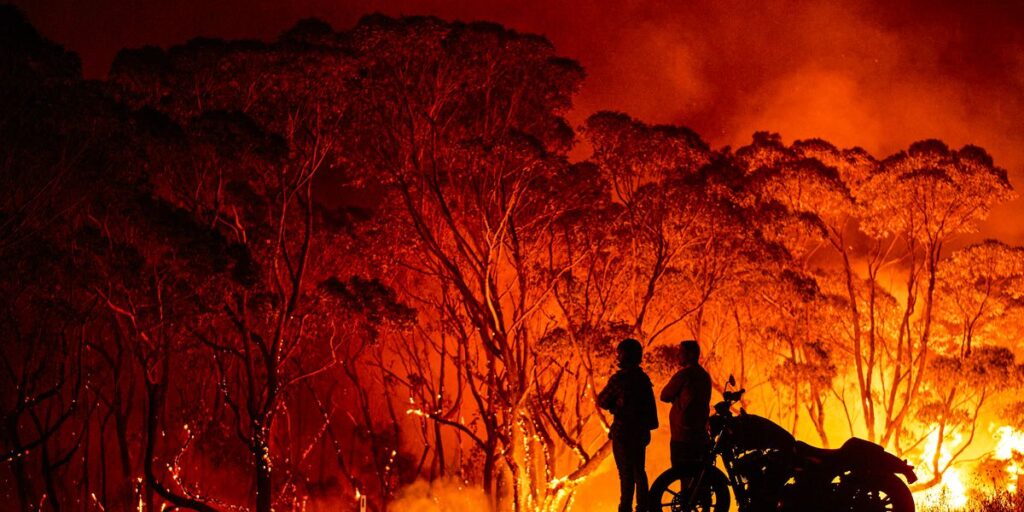












A grassfire north of Melbourne remained at an emergency level early on Wednesday, with authorities warning residents it is too late to leave.
It came as severe storms and strong winds lashed Sydney and the NSW Central Coast, causing flash flooding, felling trees and leaving hundreds of homes powerless, and South Australia braced for some of its hottest weather in four years.
Victorian authorities issued their latest warning to residents of Flowerdale and Yea just after 2am Wednesday, for an uncontrolled fire at Spring Valley Road travelling north.
“The grassfire is travelling in a northerly direction from Spring Valley Road, Flowerdale. The fire has now crossed Carver Creek moving towards Yea Spur Road,” the Country Fire Authority said.
“If you have not already left, the time to safely evacuate has now passed. Take shelter indoors immediately. It is now too dangerous to leave.”
More than 40 fire truck crews and several aircraft are fighting the fire.
Temperatures are forecast to top 30 degrees in Melbourne until Saturday, and are likely to be closer to 40 in northern Victoria.
Wild storms cause emergency in NSW
Victoria’s fire emergency came hours after parts of NSW were again battered by wild weather.
The State Emergency Service received hundreds of calls for help on Tuesday night and several roads are closed.
An SES spokesman said 400 volunteers responded to 370 incidents and performed 12 flood rescues, mostly in Sydney’s north and on the central coast but also on the state’s central-west and southern tablelands.
“The main type of jobs that we saw were trees and branches down due to the strong winds, followed by roofs damaged and leaking, and the heavy rain also caused localised flooding in a number of areas as well as road closures,” spokesman Neil Wiblin said.
The SES was also called to help after an internal roof collapsed in a nursing home in Sydney’s inner-west.
The wild weather also brought a water spout off Dee Why, on Sydney’s northern beaches. Locals posted footage of the massive waterspout.
“Bro there’s a f—ing tornado off the coast from my house. What the f—?” wrote one wary resident.
The deluge hit Orange in the central tablelands and Queanbeyan near Canberra, late on Tuesday afternoon before advancing on Sydney and surrounds as night approached.
SES co-ordinator Duty Operations Neil Wiblin said Sydney’s north shore, northern beaches and eastern suburbs copped the worst of the weather.
“The main type of jobs that we saw were trees and branches down due to the strong winds followed by roofs damaged and leaking and the heavy rain also caused localised flooding in a number of areas as well as road closures,” he told ABC radio on Wednesday.
Some places got more than 100 millimetres of rain, with Terry Hills in Sydney’s north getting 121 millimetres.
Ausgrid said on Wednesday power remained out in the southern suburbs of Caringbah, Miranda, Sylvania Waters and surrounds. It had been restored to properties in Allambie, Allambie Heights, Manly Vale, Killara, Lindfield, Asquith, Eastwood, Hornsby and surrounding suburbs.
Watch the latest SA weather update Source: Bureau of Meteorology |
South Australia swelters
SA authorities have issued a “code red” heatwave warning as the state endures some of its hottest weather in four years.
After two days in the mid-30s, the Bureau of Meteorology has forecast the mercury to hit 38 degrees in Adelaide on Wednesday, 40 degrees on Thursday and 39 degrees on Friday ahead of a cool change.
That will make it the longest string of days of 35 degrees or more since December 2019.
The conditions have prompted authorities to activate heatwave emergency plans, with the State Emergency Service urging people in the hottest regions to stay indoors if possible. The code red warning is effective from 1pm (local time) on Wednesday.
Community centres in Adelaide have been opened for rough sleepers and homelessness services are conducting outreach programs around the city.
The Red Cross will also provide free healthcare checks by phone.
The Royal Automobile Association has called on people to take extra care in coming days. Senior manager Charles Mountain said cars could quickly heat up to more than double the outside temperature.
“Don’t be tempted under any circumstances to leave children or animals unattended in a parked vehicle, especially not in this weather,” Mr Mountain said.
“During heat waves like the one we’re experiencing this week, the temperature inside a locked car will climb to dangerous levels within minutes.”
The RAA said its service data showed 284 children and 230 pets were freed from locked cars last year.
It said a recent experiment it conducted showed in-car temperatures could rise to more than 80 degrees in 20 minutes in full sun.
Just a few minutes of exposure to this kind of heat can cause significant harm to a child, Mr Mountain said.
Human Services Minister Nat Cook said South Australians were lucky to live in a community that looked out for and supported the vulnerable, isolated and elderly.
“This is the first significant heatwave in more than three years and it’s critical that people stay safe,” she said.
“Extreme heat during days is bad but, when it doesn’t cool down overnight, people’s bodies don’t get a chance to recover and they can be at risk.”
-with AAP
The post Fire alarm for Victoria, as Sydney mops up from wild storms appeared first on The New Daily.