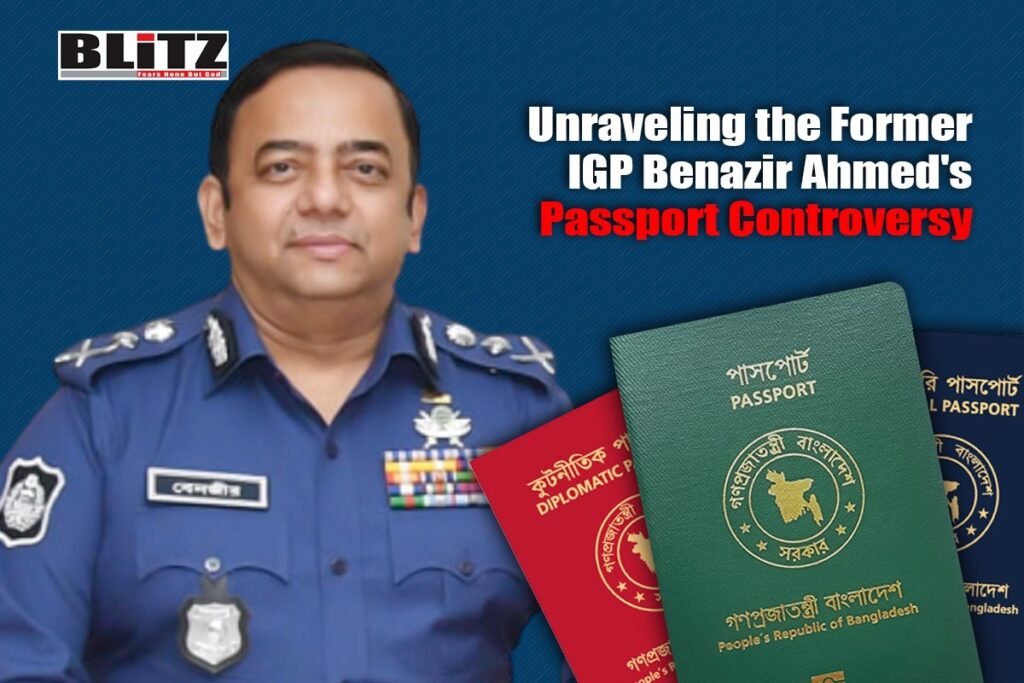













Bangladesh’s public discourse has been roiled by the recent revelations surrounding former Inspector General of Police (IGP) Benazir Ahmed’s passport history. The details paint a picture of a meticulously constructed web of deception, allegedly built upon misrepresentation, abuse of power, and a calculated effort to circumvent established procedures. This article delves into the known facts, explores potential motives, and highlights the broader implications of this unfolding controversy.
At the heart of the controversy lies Benazir Ahmed’s consistent avoidance of official passports designated for government employees. Throughout his illustrious career, which saw him hold positions like Commissioner of Dhaka Metropolitan Police, Director General of Rapid Action Battalion (RAB), and ultimately IGP, Benazir Ahmed opted for ordinary passports. This, in itself, wouldn’t be inherently suspicious. However, the manner in which he allegedly obtained these passports and the lengths he went to in order to conceal his true identity paint a disturbing picture.
Investigations suggest a deliberate pattern of misrepresentation. In 2010, while renewing his passport, Benazir Ahmed reportedly bypassed the blue official passport and instead secured an ordinary one, declaring himself as someone employed in the “private service” sector. This pattern continued through subsequent renewals in 2014 and 2016, even while he served as the Director General of RAB, a highly sensitive position within Bangladesh’s law enforcement apparatus.
The situation took a more concerning turn in 2016. When Benazir Ahmed, then RAB Director General, applied for a renewed private passport, it triggered suspicion at the Passport Department. Authorities, understandably wary of a high-ranking official seeking a passport that did not reflect his true position, blocked the application and requested a departmental no-objection letter (NOC). However, according to sources, Benazir Ahmed allegedly bypassed proper channels and exerted undue influence on RAB headquarters. This resulted in a letter favoring his application, effectively forcing the Passport Department to issue the passport despite the irregularity.
This incident raises serious questions about the alleged collusion between Benazir Ahmed and RAB headquarters. The proper functioning of any government institution hinges on adherence to established procedures and a clear chain of command. If these allegations hold true, they suggest a worrying disregard for the rules and a willingness to bend them for personal gain.
The controversy doesn’t end there. Upon becoming IGP in 2020, Benazir Ahmed reportedly continued to avoid the red diplomatic passport typically issued to officers of his rank. He allegedly resorted to even more audacious measures. Citing a fabricated illness, Benazir Ahmed reportedly had a mobile passport unit dispatched to his residence, where officials completed the formalities for a 10-year e-passport in complete secrecy.
Transparency International Bangladesh (TIB), a leading anti-corruption watchdog, has condemned this entire episode as a blatant abuse of power and a “multidimensional crime” encompassing corruption, abuse of authority, and forgery. Experts point out that such actions not only undermine the integrity of the passport system but also raise serious questions about Benazir Ahmed’s motives for going to such extraordinary lengths.
Several theories have emerged to explain Benazir Ahmed’s aversion to official passports. One possibility is a desire to conceal potential plans for acquiring citizenship in another country, something that becomes more complicated with a government-issued passport. Another theory suggests Benazir Ahmed might have sought a normal passport for the freedom of unfettered travel and the ability to leave the country quickly if necessary.
The potential consequences of Benazir Ahmed’s actions are far-reaching. Passport officials highlight the blatant violation of established procedures. The rules are clear: government employees seeking ordinary passports require approval from their respective ministries or departments, and their profession must be accurately stated – “government employee,” not “private service.” Benazir Ahmed’s alleged actions represent a clear violation of these regulations.
This scandal extends beyond a single individual’s actions. The alleged involvement of RAB headquarters in pressuring the Passport Department raises concerns about a potential culture of impunity within some government institutions. Furthermore, the case of Haris Ahmed and Tofail Ahmed Joseph, brothers of former army chief General Aziz Ahmed, reportedly obtaining passports through similar means suggests a potentially wider pattern of abuse that demands immediate investigation.
The Benazir Ahmed passport controversy demands a swift and thorough investigation. Transparency and accountability are paramount in ensuring the integrity of Bangladesh’s passport system. This case also raises questions about the potential vulnerabilities within government institutions that could be exploited for personal gain. A comprehensive response is necessary to restore public trust, uphold the law, and ensure that such blatant disregard for protocol and procedure does not become a recurring theme within Bangladesh’s esteemed institutions.
The post Former IGP Benazir Ahmed resorted to passport forgery appeared first on BLiTZ.