














Reading in English | Read in العربية (Arabic)
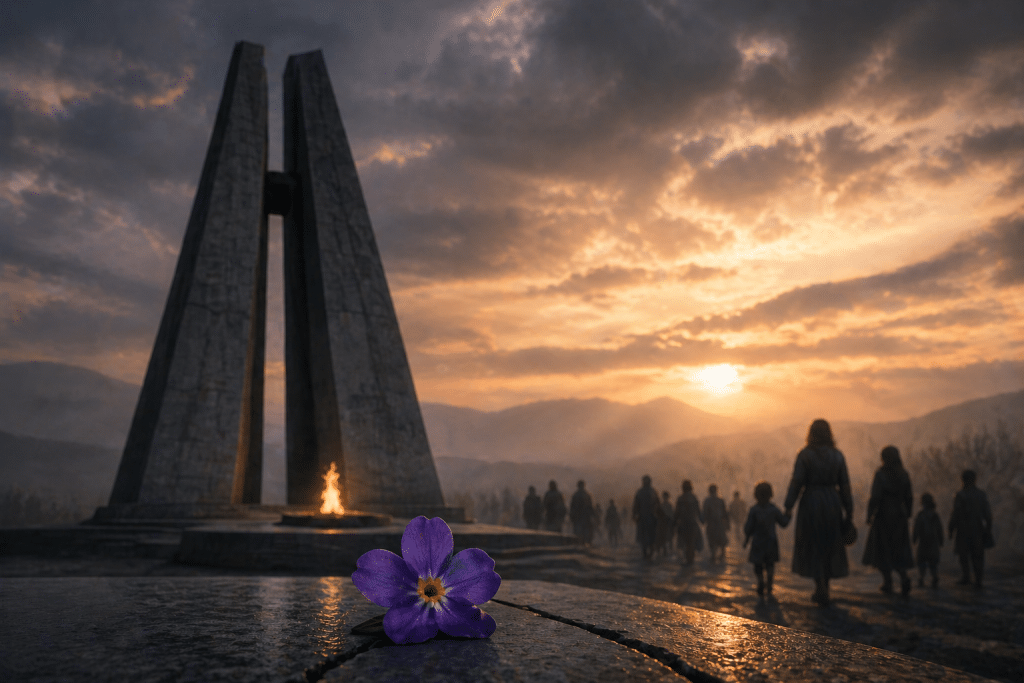
On April 24th of each year, Armenians reflect on the painful and sorrowful events related to the Armenian Genocide that they have read about, witnessed, or heard from their ancestors, which deeply wounds their hearts. The violent massacres have created scars that do not heal, remaining an open wound in the collective memory, a fundamental part of Armenian life to this day. The resilient Armenian people, who never forget their history and roots, express that “this wound will remain until justice is served to its rightful owners. This right has existed since the time of the genocide, and we will continue to remember and demand it until the truth and recognition arrive.”
The Armenian Genocide began on April 24, 1915, during World War I, perpetrated by the Ottoman Empire, specifically by the government of the “Committee of Union and Progress,” known as the “Young Turks.” By April 2026, it will have been 111 years since these events. These incidents are documented as the first systematic genocide and one of the earliest and most notable crimes against humanity in the twentieth century. They were not random incidents but rather a systematic policy and brutal methods aimed at eradicating the Armenian presence.
Estimates suggest that the Armenian Genocide resulted in the deaths of approximately 1.5 million people from a population of about 2.1 million Armenians, according to statistics from the Armenian Patriarchate in Constantinople in 1912. At that time, Armenians resided in regions within the borders of the Ottoman state, which was experiencing disintegration and collapse. These events began with widespread arrests of around 2,500 intellectuals, political leaders, and activists in Constantinople (now Istanbul), followed by their execution to ensure there was no organized resistance before commencing the mass forced deportations.
These events resulted in ethnic cleansing and large-scale forced displacement, with orders issued to deport Armenian populations from Anatolia to the Syrian deserts (Deir ez-Zor). Those who survived were forcibly removed from their homes, displaced from their cities and villages, and compelled to walk long distances under extremely harsh and difficult conditions toward the unknown. This deportation journey became known as the “Death March,” where the majority of those of fighting age, along with women and children, were killed. They faced attacks from gangs, and thousands also perished from hunger, thirst, and disease. During this death march, some families vanished without a trace, and mothers often lost their children. Families were torn apart; many lost their relatives and identity, living their lives in search of them and trying to reclaim their roots. Thousands of Armenians fled by sea to escape the massacres, traveling from Ottoman ports to Lebanon, Syria, and Egypt, using Greek and French ships, particularly heading to Beirut, which later welcomed large waves of survivors.
According to historical records, these Armenian massacres occurred in three phases: the first phase from 1894 to 1896, known as the Hamidian Massacres, resulted in the deaths of 300,000 Armenians who demanded political reforms in the Ottoman Empire; the second phase in 1909 saw the death of 20,000 Armenians; and the third phase, the Great Genocide in 1915, led to 1.5 million deaths, with the remainder being forced into exile.
Survivors shared their stories with their children and grandchildren, keeping the collective memory alive to this day. The stories of Armenian ancestors, especially those passed down through generations regarding the events of 1915, are a blend of immense loss and tales of resilience and survival, as the Turks employed horrific methods of killing, slaughter, torture, and crucifixion against Armenians. Mass executions by shooting or beheading, collective drowning by placing groups of Armenians in boats and sinking them in the Black Sea, and the killing of thousands of infants and pregnant women through lethal injections disguised as medicine, along with medical experiments, became common practices. Pregnant women’s bellies were slit open with swords and spears to ensure complete eradication of Armenian lineage and identity. Boys were often disguised in girls’ clothing and earrings were placed in their ears, as the Turks specifically targeted young males for killing. Countless tragic stories remain untold.
In addition to the genocide, the Turks implemented policies to erase Armenian Christian history by destroying Armenian cultural and religious heritage through the demolition of churches, cathedrals, and monasteries. They also abducted women and children, forcing them to abandon their Christian faith and Armenian language, converting them to Islam to receive Turkish Islamic education and transform into Turks. Many reportedly forgot their families and identities.
Armenians eventually regained their political identity, with Armenia’s independence undergoing three main phases. In 1918, the first independent Armenian Republic was declared after World War I, but it did not last long, as it fell in 1920 and became part of the Soviet Union. Armenia regained its genuine independence in 1991 after the dissolution of the Soviet Union, but in recent years (2020-2023), it faced setbacks as Azerbaijan regained most territories in Karabakh and completely took control of the region, leading to renewed displacement of the Armenian population.
There was a partial repatriation between 1946-1948, with around 100,000 to 150,000 Armenians returning to Soviet Armenia. After 1991, a limited number returned, but most Armenians remained abroad due to better economic and political stability. They settled in various countries and built their lives there, with the global Armenian population estimated to be between 9 to 11 million: around 3 million in Armenia and 6 to 8 million in the diaspora (Russia, Lebanon, Syria, the United States, and France).
Armenians call on the international community to address this issue and urge the perpetrators to recognize the Armenian genocide, as Turkey still refuses to acknowledge it. However, more than 30 countries have recognized the genocide, including prominent European nations such as France and Germany, as well as the United States, Russia, and Canada. The European Parliament and several international organizations have also acknowledged it.
Lebanon is considered the first Arab country to officially recognize the Armenian Genocide, as the Lebanese Parliament issued a resolution recognizing it in 1997. In Australia, the federal government has not yet officially recognized the genocide to avoid diplomatic tensions with Turkey. However, there has been recognition at the state level, with New South Wales being the first to do so in 2007, followed by South Australia, Victoria, and Tasmania.
Turkey officially rejects the term “genocide,” viewing it as a threat to national security, only acknowledging that Armenian casualties occurred during World War I. Their refusal is based on several condensed reasons: recognizing it as genocide would negatively impact Turkish national pride, force them to provide moral and material reparations, and return properties considered heritage of the Armenian church. Moreover, Turkey fears that acknowledging the “Armenian Genocide” might lead other countries and groups to revive similar claims, potentially reopening historical issues related to Ottoman massacres, which are numerous: the Seyfo massacres (the genocide of Syriacs, Assyrians, and Chaldeans) that coincided with the Armenian genocide, the Greek genocide, and the Great Famine in Mount Lebanon that led to the deaths of half the population.
The repercussions of the lack of historical accountability and the absence of widespread international recognition of the genocide, coupled with Turkey’s ongoing denial, have fostered a climate of “impunity” in dealing with minorities and contemporary regional issues, paving the way for future atrocities like the Holocaust. Historians assert that Hitler drew inspiration from the Armenian genocide, citing his remark: “Who speaks today of the annihilation of the Armenians?” This illustrates how the impunity afforded to the perpetrators encouraged him to proceed with systematic extermination policies later on.
On this painful anniversary each year, Armenians remember and demand justice for this issue in accordance with international laws and human rights charters through the recognition of the Armenian Genocide. They insist that this matter will not fade away as long as there is a continuous will to seek justice. April 24 will remain an enduring witness, awakening memory and crying out for truth until victory is achieved.