













Reading in English | Read in العربية (Arabic)
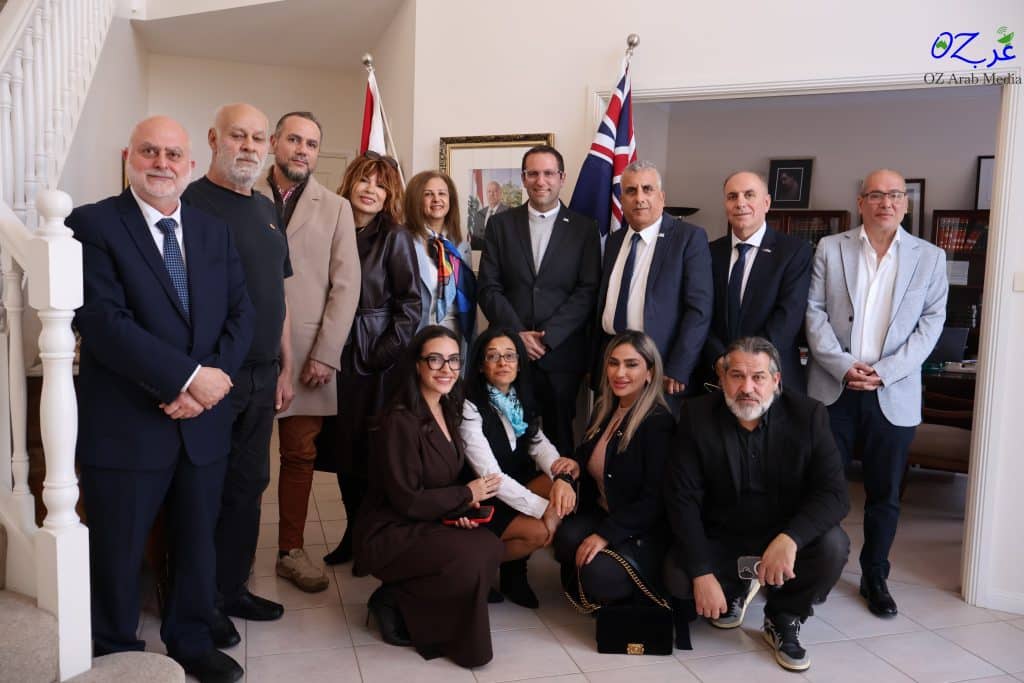
Lebanon’s Ambassador to Australia, Her Excellency Mirna Khawly, invited members of the Lebanese and Arab media in Australia for an introductory discussion focused on strengthening communication, improving consular services, supporting the diaspora and exploring greater economic cooperation between Lebanon and Australia.
The gathering provided an opportunity for Ambassador Khawly to share her diplomatic experience, explain the work of the Embassy and Consulate, and hear directly from media representatives and community members about the issues affecting Lebanese Australians.
Oz Arab Media was grateful for the invitation and was represented by Mr. Elie Kaltoum and Dr. Charbel Tadros.
A Strong and Active Lebanese Community
Ambassador Khawly began by welcoming the media and reassuring them that the embassy’s doors are always open for the media. In the conversation, she also reflected on her diplomatic career.
She praised the Lebanese community in Australia, describing it as one of the most active, welcoming and engaged Lebanese communities abroad.
The ambassador also highlighted the demanding diplomatic environment in Canberra, where official functions, meetings and engagements take place regularly across one of the world’s largest diplomatic communities.
Improving Consular Services
A major part of the discussion focused on consular services and the challenges involved in assisting Lebanese nationals across Australia.
Ambassador Khawly explained that the Embassy in Canberra is responsible for consular and diplomatic affairs throughout Australia, similar to the consular services provided by the consular offices in Sydney and Melbourne.
She acknowledged that some older applications and transactions remain in the system and said the mission is working progressively to address backlogs. While diplomatic pouches are available to send passport applications to Lebanon for processing and retrieve processed passports back from Lebanon, immigrants who require faster processing can send their applications via DHL.
On passports, the Ambassador said applications are currently processed in Beirut. Biometric fingerprint requirements mean passports cannot yet be issued locally in Australia, although there are future plans to provide the necessary equipment.
She noted that passport fees have been reduced significantly and that applications lodged in Australia generally take between 10 and 30 days to process. An express passport service remains available in Beirut, where passports can be issued on the same day for a minimal fee.
The Ambassador also clarified that powers of attorney require applicants to attend the Embassy or Consulate in person, in order to safeguard authenticity as per the law.
For birth registrations, applicants must provide a family civil extract and a marriage certificate registered in Lebanon, as these requirements are mandated by Lebanese law.
To improve access and organisation, Ambassador Khawly announced plans to launch a dedicated Consular website in the near future. The platform is expected to assist with appointments and make information and procedures easier for the community to access.
She said Lebanon’s continued reliance on paper-based systems is linked to security concerns and the need for an e-government law required to govern such systems.
Building a Stronger Relationship With the Media
Ambassador Khawly stressed the important role played by Lebanese media outlets in Australia, describing them as a key interface between the Embassy and the wider community.
She said the meeting was intended as an introductory and relationship-building discussion rather than a formal political interview. Under diplomatic protocol, official or political interviews require questions to be submitted in advance and approved through Beirut.
The Ambassador encouraged media representatives to contact the Embassy directly to verify information before publishing stories, particularly where rumours or unconfirmed reports may be circulating.
She also called for constructive and positive media coverage that highlights the achievements of the Lebanese community, the work of consular services and the contributions of Lebanese Australians.
Media representatives welcomed the initiative, with several attendees noting that it was the first time such an open introductory meeting had been held between the Embassy and Lebanese media representatives in Australia.
Expanding Trade and Economic Ties
The discussion also turned to the need for stronger economic and trade cooperation between Lebanon and Australia.
Participants noted that diplomatic gatherings often focus heavily on cultural and social elements, such as traditional food and heritage, while economic opportunities receive less attention.
Ambassador Khawly agreed that the economic file deserves greater focus. She said she intends to work on strengthening communication with relevant Australian government departments and the relevant Lebanese bodies.
She also reaffirmed her commitment to promoting Lebanese products during official functions, including Lebanese wine, chocolate and carob molasses.
The discussion highlighted potential opportunities created by the differing agricultural seasons in Lebanon and Australia. Products such as olives and cherries may offer particular commercial advantages, depending on harvest timing and export opportunities.
It was also noted that many Lebanese businesspeople operate through Australian companies, meaning the real level of commercial engagement between the two countries may be greater than official trade figures suggest.
Supporting Lebanon Through Trusted Initiatives
The meeting also highlighted the “Rooted for Lebanon” initiative, launched by Lebanon’s Ministry of Social Affairs in partnership with the International Organization for Migration, the United Nations and several non-government organisations.
The initiative aims to support people affected by the recent conflict in southern Lebanon.
Ambassador Khawly emphasised that donations made through the initiative do not enter the Lebanese state treasury. Instead, funds are managed through United Nations mechanisms and distributed directly to people in need.
She said the initiative provides a transparent and trustworthy pathway for Lebanese Australians and the wider diaspora who wish to support communities in Lebanon. An online platform is available to provide donors with information about how funds are allocated and used.
The Ambassador called on media organisations and community representatives to help promote the initiative and ensure that members of the Lebanese community are aware of reliable ways to contribute.
The meeting concluded with a shared commitment to maintain open communication between the Embassy, the media and the Lebanese community, while pursuing stronger consular support, economic engagement and community-led initiatives for Lebanon.