












Reading in English | Read in العربية (Arabic)
There is only one way for any idea to endure in collective consciousness: it must cease to be a debatable notion and transform into a fixed phrase. This phrase is not required to be accurate; rather, it should be comforting, familiar, repeatable, and easily digestible. Over time, people stop asking how this phrase came to be and instead focus on how it can be defended.
The story of “Muawiya, the Scribe of Revelation” serves as a prime example of this gradual transformation that occurs not through a single decision but through a long accumulation of simplification, abbreviation, and rephrasing, until the phrase resembles a slogan more than a historically verifiable description.
Ironically, history at its core does not possess this kind of certainty. Genuine history, when we return to its early layers, is neither a clean text nor a straightforward narrative. It consists of a complex web of intertwined accounts, shifting political contexts, and multiple names that emerge and disappear depending on the circumstances. However, this complexity seldom reaches the public; what is presented is a polished, condensed, and curated version designed to suit memory rather than inquiry.
In the case of the early Islamic period, this issue is even more pronounced, as the historical material itself was recorded in later phases within ever-changing political and sectarian environments. The goal was not always the cold documentation of events but rather the rearrangement of these events within an understandable and sustainable narrative.
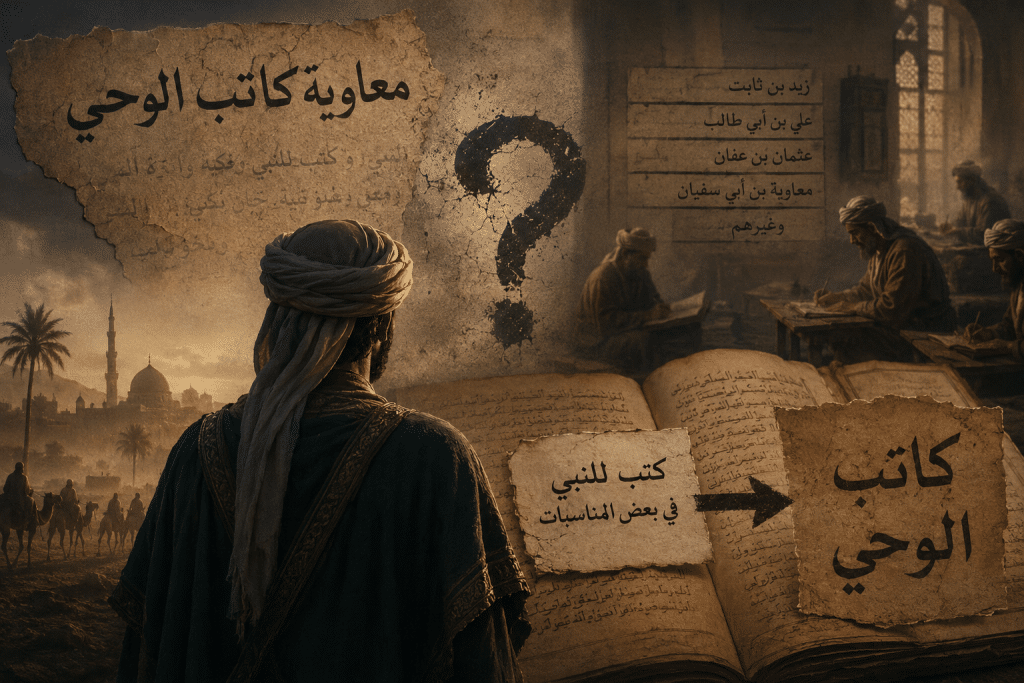
In this context, the name of Muawiya ibn Abi Sufyan appears in some accounts as someone who wrote for the Prophet ﷺ in specific instances. The leap from “participating in writing in certain cases” to “scribe of revelation” as a fixed and central role exemplifies the kind of jumps memory makes when it leans towards simplification over accuracy.
To grasp the magnitude of this transformation, one only needs to look at the broader picture: the Prophet did not have a single scribe but rather a group of writers who undertook various tasks depending on the circumstances. Among them were Zayd ibn Thabit, Ali ibn Abi Talib, Uthman ibn Affan, and others, indicating that the historical structure itself is rooted in plurality rather than monopoly.
However, collective memory seems to shy away from plurality. Diversity complicates the narrative, diminishes the story’s potential for condensation, and makes it difficult to transform history into a single phrase that can be circulated without explanation. Consequently, what typically occurs is the selection of one element from the scene, followed by its amplification, fixation, and re-presentation as the “complete picture.”
Here begins the first paradox: the more history is simplified, the more certain it appears in public discourse, even though, in reality, it loses a significant portion of its original accuracy.
The second paradox is that such transformation does not usually arise from “direct fabrication” but from a quieter process: re-use. A phrase is mentioned in a limited context, then repeated, shortened, and removed from its original context until it loses its connection to the event that initially produced it.
Thus, a limited participation in writing morphs into an all-encompassing title. Then, that title becomes a stable truth, and that truth turns into a part of cultural identity, where questioning it feels akin to questioning memory itself, rather than a specific historical narrative.
The more sensitive paradox is that Muawiya embraced Islam relatively late, after the conquest of Mecca—a simple temporal fact sufficient to reconsider the circulated image. This inquiry is not aimed at negation or definitive proof but is intended to understand how historical descriptions are shaped when reduced over time.
Yet, at this particular juncture, discussions sometimes cease to be historical and begin to shift towards debates about “the boundaries of the question itself.” It seems the issue lies not in the narrative but in the right to re-examine it. This, in itself, is an important indicator of how knowledge gradually transforms into a closed space.
Interestingly, the early narratives themselves, when read without subsequent layers of interpretation, do not present a cohesive picture. Instead, they offer a collection of scattered signals that require assembly, analysis, and comparison. However, late awareness dislikes this kind of cognitive chaos, rearranging it into a stable singular image, even at the cost of losing the complexity that renders it historically understandable.
Even the narratives used in this context often only indicate that Muawiya wrote for the Prophet on certain occasions, a formulation limited by nature, yet it gradually evolves into a meaning much broader than its original content. This is one of the mechanisms of invisible history: how a small phrase becomes a framework for an entire conception not present in the text itself.
Ultimately, the problem does not seem to lie with any particular historical figure but rather with the manner in which the past is managed within collective consciousness. Is it material subject to scrutiny? Or a completed narrative that is not allowed to be reopened? Is it the history of people with all its differences and diversities, or is it a finalized story arranged in advance to suit our need for certainty?
Perhaps the most troubling question is not about what happened but about why we always need what happened to be more orderly than it actually was. For history, in its unrefined form, is rarely neat. Often, the more polished it appears, the further it strays from its truth.