













Reading in English | Read in العربية (Arabic)
When Courtney Farren received her Ambulance Victoria paramedic epaulettes on the morning of 25 July, she never imagined that just hours later she’d play a crucial role in safely winching a patient to a specialist Air Ambulance helicopter.
A paramedic’s first shift after completing their graduate program is always memorable, but this Mansfield paramedic took it a step further by assisting with a technically demanding winch operation to rescue an injured dirt bike rider.
Courtney said it’s a case she will never forget.
“I remember thinking afterwards, I have such a cool job that I get to do something like this to help a patient receive the care they need even in such a remote location,” she said.
“During my year as a graduate paramedic, I attended plenty of cases where the Air Ambulance helicopters attended, but never one where they’d conducted a winch. They had always landed and it was a very controlled handover in the back of the ambulance.
“This case will be very memorable for me – there were quite a few firsts.”
Ambulance Victoria Mobile Intensive Care Ambulance (MICA) flight paramedics conduct winch operations from Air Ambulance Victoria’s Helicopter Emergency Medical Service (HEMS) fleet to access, treat and retrieve patients from challenging terrestrial, coastal and offshore environments where specialist winch capability is required.
Winches are highly technical operations that require significant training and skill, with support from the helicopter pilot and air crew, as well as paramedics on the ground where possible.
“My job was holding the rope, known as a tagline, and letting it out as the MICA flight paramedic was winched up to the helicopter with the patient in a specialised stretcher. My role was to keep the rope tight to stop them from spinning out of control in the air, which would put the safety of the MICA flight paramedic and our patient at risk,” Courtney said.
It’s an important task in conducting a winch safely and can be challenging with the strong downwash from the helicopter rotor blades.
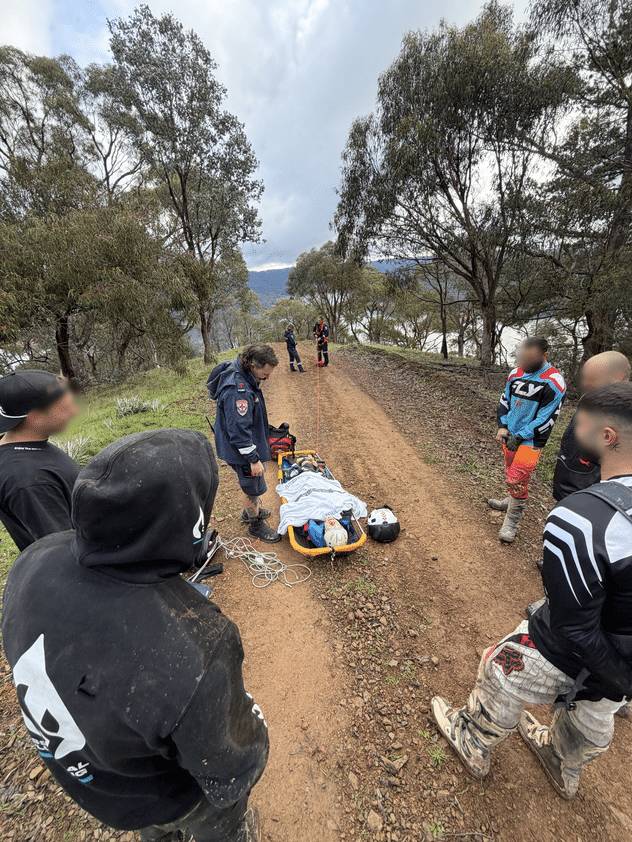
Winching was the only way to get the patient, Bradley Borg, into an ambulance for transport to hospital, after a fall off his dirt bike left him with a fractured pelvis and ribs at the top of a steep 4WD track.
Bradley’s friends drove Courtney and her partner, Mansfield paramedic Will Telley, to the top of the hill, allowing the paramedics to assess his condition and provide pain relief while the helicopter was on the way.
“He was in a position where he was in excruciating pain if we tried to move him. It made it difficult to fully assess his injuries and put a pelvic splint on, which we want to do to keep the pelvis stable,” Courtney explained.
“Once HEMS arrived, the MICA flight paramedic was able to provide additional pain relief and together we were able to get the pelvic splint on, and bandage and splint his legs together in a position that was somewhat comfortable for him for the trip to hospital.”
Bradley was airlifted to The Alfred and is now back at home to continue his recovery.
“I’ve been better, but I’m very thankful to everyone involved in treating me and getting me safely to hospital,” he said.
Courtney, originally from Melbourne, said supporting winch operations in bushland was not something she had pictured herself doing when she set out to become a paramedic.
“When I started studying paramedicine, I had no idea that I would be moving up to Mansfield and working rurally – I always imagined working in the metropolitan area,” she said.
“I went into paramedicine thinking there’d be exciting days and interesting cases but nothing to this extent.
“Working rurally has been amazing, I love it.”