












Reading in English | Read in العربية (Arabic)
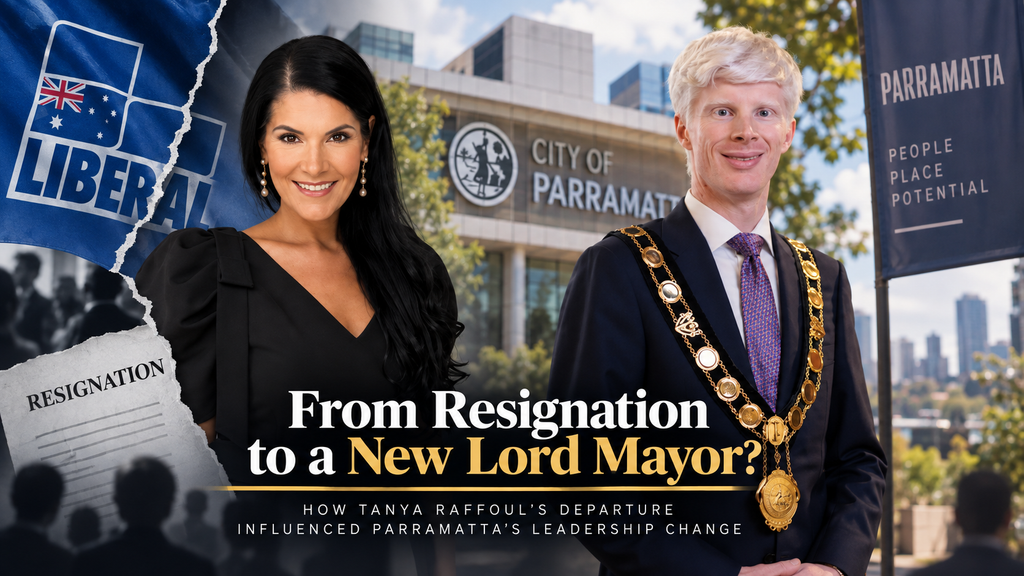
The political landscape of the City of Parramatta shifted dramatically on Monday, with two significant developments occurring within hours of each other: Councillor Tanya Raffoul resigned from the Liberal Party, and Labor Councillor Cameron MacLean was subsequently elected Lord Mayor.
Taken separately, both were significant events. Taken together, they raise an obvious question: how much did Raffoul’s departure from the Liberals affect the change in Parramatta’s leadership?
The timing makes the question particularly significant.
Raffoul announced her resignation from the Liberal Party on the morning of the mayoral vote, saying she had become increasingly concerned about the party’s direction, its approach towards multicultural communities and questions surrounding party culture.
Hours later, Parramatta councillors elected 28-year-old Cameron MacLean as Lord Mayor, replacing Liberal Councillor Martin Zaiter, whose term in the position had reached its scheduled end.
While the two events should not automatically be treated as cause and effect, Raffoul’s resignation unquestionably altered the political balance inside the council at a critical moment.
A Council That Was Almost Perfectly Divided
The 2024 Parramatta Council election produced an unusually balanced chamber.
Six Labor councillors were elected alongside six Liberals, with the remaining three positions held by councillors outside the two major parties.
That meant neither Labor nor the Liberals could control the mayoralty on their own. Both sides needed support beyond their formal party numbers.
This was demonstrated immediately after the 2024 election.
Martin Zaiter secured the Lord Mayoralty in October 2024 by the narrowest possible margin — eight votes to seven — defeating Labor’s Patricia Prociv.
Tanya Raffoul was among those who supported Zaiter.
The same meeting demonstrated just how fluid Parramatta’s numbers could be. Cameron MacLean was elected Deputy Lord Mayor by another 8–7 vote, with councillors outside the traditional party blocs helping produce a different majority.
In other words, Parramatta Council has effectively operated as a chamber in which one vote can change the leadership.
Raffoul’s Resignation Changed the Numbers
Until Monday morning, the formal party numbers remained six Liberals and six Labor councillors.
Raffoul’s resignation changed that equation.
Rather than six Liberal councillors facing six Labor councillors, the council suddenly contained five Liberals, six Labor councillors and four councillors sitting outside those two formal party blocs, including Raffoul herself as an independent.
That does not automatically mean Raffoul voted for MacLean, nor does it establish that her resignation alone determined the result.
But politically, the significance is difficult to ignore.
The Liberal bloc could no longer enter the mayoral election with the six votes it had held since the 2024 election. Any Liberal attempt to retain the Lord Mayoralty would therefore require considerably more support from councillors outside the party.
At the same time, Labor retained its six-member bloc.
Raffoul’s resignation therefore changed the starting position from an evenly divided 6–6 contest between the major parties to a 6–5 advantage in formal party representation for Labor.
From Supporting Zaiter to Leaving the Party
The development is particularly striking when compared with Raffoul’s position two years earlier.
In 2024, she backed Martin Zaiter for Lord Mayor.
By September 2026, she had not merely withdrawn that support but resigned from the Liberal Party itself.
Her resignation statement extended well beyond local council politics. Raffoul raised concerns about what she described as the Liberal Party’s growing policy and values alignment with a divisive political party, its treatment of multicultural Australians — particularly in Western Sydney — and questions about party culture highlighted by a recent ICAC public inquiry.
Her decision therefore represented a broader political break rather than simply a disagreement over who should become Parramatta’s next Lord Mayor.
Nevertheless, the timing meant that the consequences were immediately felt at council level.
MacLean’s Election Marks a Significant Shift
Later that day, councillors elected Cameron MacLean as Parramatta’s new Lord Mayor.
MacLean, 28, became the youngest person ever elected to the position.
Councillor Kellie Darley was elected Deputy Lord Mayor.
The outcome means Parramatta has moved from a Liberal Lord Mayor under Martin Zaiter to a Labor Lord Mayor under Cameron MacLean, while the deputy mayoralty has gone to a councillor outside the two major parties.
It suggests that Parramatta’s leadership will continue to depend heavily on relationships across party lines rather than straightforward Labor-versus-Liberal numbers.
More Than One Vote
It would be premature to claim that Raffoul’s resignation alone made MacLean Lord Mayor.
Mayoral elections are determined by the votes of all 15 councillors, and the individual voting record of the election is necessary to establish precisely how the winning majority was assembled.
What can be said is that Raffoul’s departure fundamentally changed the political arithmetic immediately before the vote.
A council that began the day with six Liberal and six Labor councillors ended it with Labor holding the larger of the two formal party blocs — and with a Labor councillor occupying the Lord Mayor’s chair.
The symbolism is equally important.
One of the councillors who helped install Liberal Martin Zaiter as Lord Mayor in 2024 left the Liberal Party on the very day Zaiter’s term ended and Labor’s Cameron MacLean was elected to succeed him.
Whether Raffoul’s vote ultimately proved decisive or formed part of a broader cross-party agreement, her resignation removed one vote from the Liberal Party’s starting numbers and added another independent voice to a council where independents and minor groupings can determine who governs.
What Happens Next Could Be Even More Important
The consequences may extend well beyond Monday night’s mayoral election.
With Raffoul now sitting independently, neither major party commands anything approaching a majority of the 15-member council.
Labor has six councillors. The Liberals now have five. The remaining four sit outside those two formal party blocs.
That means future decisions — budgets, planning matters, major projects, governance motions and potentially future leadership contests — may increasingly depend on negotiations with Raffoul and the other non-major-party councillors.
Her resignation therefore did more than coincide with a change of Lord Mayor.
It altered the balance of power inside one of Australia’s most important local councils.
And in a chamber where the previous Lord Mayor was elected by just one vote, that change could continue to matter long after the events of Monday night.