












Reading in English | Read in العربية (Arabic)
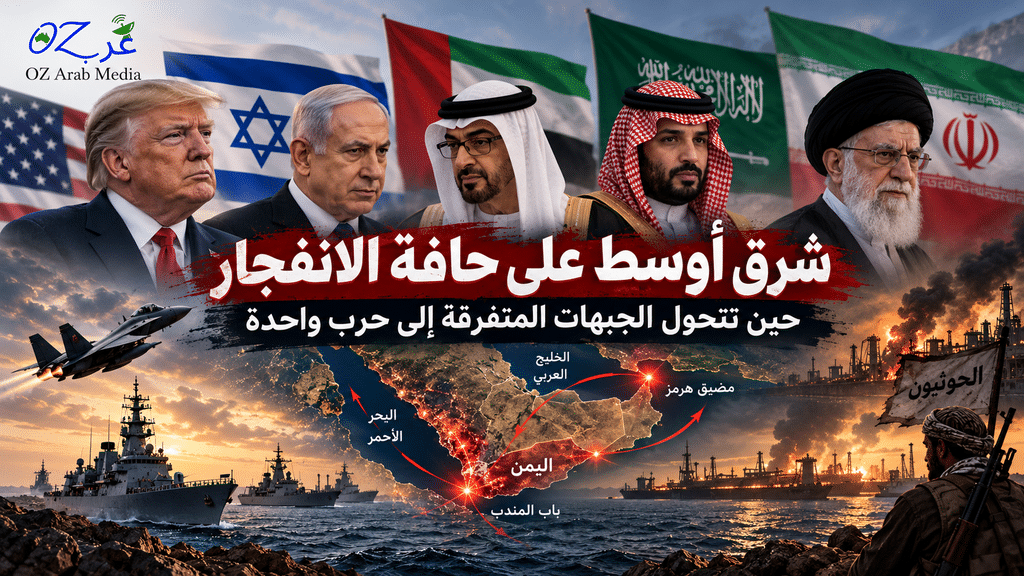
The Middle East no longer faces a single crisis that can be managed through a single political track, nor a set of separate crises each contained within its own geographic boundaries. What is taking shape now looks more like a comprehensive reordering of the rules of conflict and influence: the confrontation with Iran overlaps with Gulf security, Yemen connects to the Red Sea, the Strait of Hormuz has become a strategic card in a contest that goes beyond navigation, and Israel, the UAE, Saudi Arabia and the United States are moving within an expanding web of security and political contacts that reflect this new phase.
The region that once managed to separate its crises now faces a very different scene. Tehran is not merely a party in a confrontation with Israel and the United States; Yemen is no longer just an internal war; the Red Sea is not separate from the Gulf. Maritime routes, energy, and economic infrastructure have become direct tools of conflict. In this tangled environment, even a limited development on one front can quickly spread to another, turning a tactical incident into a broad strategic crisis.
It was in this context that Israeli Prime Minister Benjamin Netanyahu’s secret visit to Abu Dhabi and his meeting with Sheikh Mohammed bin Zayed took place at an extremely sensitive moment. Whatever the visit’s details, its timing sends a clear political message: communications between Israel and the UAE are occurring in a regional environment very different from past years, and regional security has risen to a central position in both sides’ calculations. At the same time, the Israeli move coincided with wide-ranging diplomatic activity by Saudi Arabia and the United States, reflecting that regional capitals and Washington treat this as a moment requiring intensive coordination—whether to prepare for escalation or to try to contain it.
These moves should not automatically be taken as definitive evidence of a fully integrated tripartite military alliance among Israel, the UAE and Saudi Arabia. Each country has its own calculations, interests, and political boundaries. Yet what cannot be ignored is that recent years have produced a network of shared security interests, especially regarding threats tied to Iran, the Houthis, and the security of sea lanes. What were once separate lines between states with differing positions have now become a broader space for coordination, even if disagreements remain on many details.
This shift becomes even more significant when viewed through the prism of Yemen. Yemen is no longer a purely local issue that can be isolated from the regional environment; the Houthis have acquired the ability to influence international navigation and to threaten ships and sea routes. Yemen’s geography has therefore become a central element in the regional security equation, and the Bab al-Mandab has become one of the keys that can be used in a broader contest.
Any large military operation against the Houthis would not simply aim to weaken an armed Yemeni faction; it could transform into a confrontation with regional dimensions—especially if the Houthis expand their operations or if Iran enters the conflict directly or indirectly. For this reason, Yemen is now one of the most sensitive points linking the Gulf, the Red Sea and Iran.
On the other side, the United States is operating militarily and politically on the basis of readiness for multiple scenarios. Long-range U.S. bombers based at British airfields, along with American air and naval movements, indicate that Washington does not view the situation as a narrow political crisis. But military buildup does not necessarily mean a final decision for full-scale escalation has been made; it can be part of deterrence, a way to improve negotiating leverage, or preparation for military options if political channels fail.
This distinction matters because the United States does not need to declare war in order to use military force as a political instrument. The mere presence of military capabilities in forward positions sends a message to both adversaries and allies that Washington intends to preserve the ability to act quickly should the balance shift.
Yet the core of the crisis remains the Strait of Hormuz.
The strait has shifted from a maritime passage to one of the most important cards in strategic confrontation. Iran understands that its geography gives it leverage over the flow of global energy, and the United States understands that control over freedom of navigation in Hormuz is not purely a regional matter but one directly tied to the global economy.
Hormuz’s importance is measured not just by the number of oil tankers that transit it, but by the shock to markets if navigation becomes highly risky or is disrupted for a long period. Energy prices, insurance costs, trade flows, gas supplies, financial markets and supply chains are all vulnerable once risk levels in the strait rise.
That is why Iranian messages about Hormuz carry exceptional weight. Tehran is trying to establish an equation in which pressure on it is not cost-free for others, asserting that regional and international energy security cannot be separated from Iran’s security and interests. Conversely, Washington sees persistent military and political pressure on the strait as a threat to its own interests and those of its allies, and as undermining one of the world’s principal trade and energy arteries.
In this sense, Hormuz is no longer an issue detached from Iran’s nuclear program, sanctions, or military confrontation; it has become part of negotiations over the future relationship between Iran and the United States. The greater the pressure surrounding the nuclear file, the more valuable Iran’s maritime cards become; the greater the risks in Hormuz, the more salient U.S. military options appear.
Paradoxically, diplomacy has not disappeared amid the escalation; it has moved in parallel. Indirect contacts continue, intermediaries try to keep a window open for dialogue, and capitals search for a formula to reopen a political track that prevents a slide into a wider war.
But current diplomacy is not calm diplomacy—it is diplomacy conducted under the pressure of force.
Each side enters negotiations while raising its military readiness; each wants to prove to the other that it has alternative options if talks fail. That makes any potential agreement harder to reach, but at the same time it makes reaching one more necessary.
The current scene is unlike classic crises because war and diplomacy are no longer sequential tracks; they run in parallel. Planes move while mediators shuttle, bases prepare while talks continue, and political rhetoric rises even as lines of communication remain open.
This environment is especially prone to miscalculation.
A confrontation might begin with a limited strike, the targeting of a vessel, or an attack on a military facility; a stronger response might follow, and then another, until the parties find themselves in a chain of military operations that none of them had planned as a full-scale war.
That is the real danger facing the region.
The problem is not only that some actors might want war, but that the multiplicity of fronts and the heightened tension could make war the result of accumulated decisions rather than a single decision by one party.
Israel views Iran as a long-term strategic threat; Iran sees Israel and the United States as projects aimed at curbing its regional position; Saudi Arabia seeks to prevent war spilling onto its soil and critical infrastructure; the UAE wants to protect its economic and security interests amid regional turbulence; and the United States wants to preserve its ability to control energy and navigation routes and to deter Iran.
These interests do not fully coincide, but they intersect across an increasing number of files.
Thus, talking about a single closed axis between Israel, the UAE and Saudi Arabia does not capture the full complexity. More accurately, there is growing overlap in security interests alongside each country’s distinct national calculations. These actors may cooperate on specific files while maintaining political channels with other parties.
This kind of relationship characterizes the new Middle East. Alliances no longer always rest on fixed formulas; they are built on temporary intersections, shared interests and networks of security and political cooperation.
At the heart of this network stands Yemen.
If military operations there expand, Bab al-Mandab could become an open naval front; if Houthi attacks on Saudi Arabia increase, the Gulf could become part of the battle; if Iran enters the confrontation directly, Hormuz could become a central theater; if U.S. or Israeli interests are struck broadly, responses could exceed the current limits of the confrontation.
In this way, disparate fronts convert into a single system.
Hormuz links to the Gulf; the Gulf links to Iran; Iran links to Israel; Israel links to the United States; the United States links to the security of sea lanes; the Red Sea links to Yemen; and Yemen links back to the Gulf and Iran.
This chain is what makes the current escalation different from any limited regional crisis.
Previously, it was possible to contain a crisis in Yemen away from Hormuz, or a crisis in the Gulf separate from the Red Sea, or a confrontation between Israel and Iran apart from energy markets. Today those files are intertwined in ways that make separation far more difficult.
The economy has now entered directly into the center of the equation.
Oil, gas, ports, shipping and insurance companies, and pipelines are now part of security calculations. The higher the risks, the greater the cost of war—even for states not directly participating.
This may be one of the most important turning points in the current conflict, because power is no longer measured solely by the number of missiles, aircraft or ships, but by a state’s ability to absorb the economic and political fallout of war.
Iran can threaten navigation, but it knows sustained disruption imposes heavy costs on itself as well. Israel has advanced military capabilities, but it understands that widening fronts increase risk. The United States has overwhelming military power, but it recognizes that a prolonged war in the Middle East carries political, economic and strategic costs. Gulf states have substantial resources and capacities, yet they understand their economic stability depends heavily on secure sea lanes and stable global markets.
For this reason, deterrence has become more important than military victory.
Each side tries to convince the other that it can inflict more damage than the other can bear, while simultaneously avoiding the moment when the use of force becomes irreversible.
But deterrence loses its value when one party misconstrues the intents of another.
Herein lies the danger of the current period. Each side views its moves as defensive while the other may see them as preparation for attack. Each raises readiness to deter, but the adversary might interpret that as readiness for a first strike.
This cycle has generated many wars throughout history.
Therefore, the greatest danger is not only the weapons in the region, but the misreading of others’ intentions.
Today the Middle East contains all the elements of a major crisis: multiple fronts, competing regional powers, direct U.S. involvement, Israeli‑Iranian tension, conflict in Yemen, disruption of maritime routes, and mounting economic pressures.
At the same time, however, there remain elements that can prevent a full eruption—chief among them ongoing political contacts and all parties’ awareness of the enormous costs that an open war would bring.
That is why the coming phase will be governed by a clear paradox. Everyone is preparing for war, but everyone also knows that war may exceed any party’s ability to control its outcomes.
Hence talk of an apocalyptic “war of the end” often reflects the scale of fears surrounding the region rather than an exact description of what is happening. The Middle East is not necessarily at the end of the world, but it is at the end of a whole phase of balances that governed the region in recent years.
The old phase rested on the possibility of separating crises and on major powers’ ability to manage contradictions through graduated security and political arrangements. The new phase rests on overlapping fronts, overlapping interests, and overlapping instruments of power.
Sea lanes have become political arenas; aircraft have become negotiating signals; sanctions have become weapons; energy has become leverage; alliances have become more flexible; and geographic borders no longer alone determine where war occurs.
This is the most important transformation to understand.
What is happening is not merely preparation for a new round of war; it is a struggle over the shape of the Middle East that will follow.
If political contacts succeed, the region could enter a new negotiating phase that reshuffles the Iran–U.S. relationship and redefines security in the Gulf and the Red Sea.
If they fail, the multiplicity of fronts makes the expansion of the confrontation likelier—not because all parties want a full-scale war, but because each possesses tools capable of igniting new fronts if it feels its security or interests are threatened.
In any case, the Middle East will not emerge from this phase as it entered it.
Even if military operations stop, shattered trust will not be easily restored, changed alliances will not revert to their former shape, deterrence rules that have been re-tested will not return to their old form, and sea lanes that turned into theaters of conflict will remain central to security calculations for decades.
So what is happening today may not be the apocalypse as the media sometimes describe, but it does indeed bear the marks of the end of a complete phase.
A phase in which fronts were separate, alliances clearer, and crises containable within borders.
Now the fronts overlap, each crisis carries the potential to spill into another, and the Gulf, the Red Sea, Hormuz, Bab al‑Mandab, Yemen, Iran and Israel are parts of a single equation.
Major transformations do not always begin with a declaration of war.
Sometimes they start with a series of small moves: secret visits, closed‑door talks, military maneuvers and exchanged messages that accumulate until the old order can no longer absorb the new reality.
The Middle East appears exactly at that point now.
A region caught between a war that has not yet begun in full and a regional order that has, to a large extent, already ended.
Thus the real question ahead will not only be how many missiles are launched or planes deployed, but what the Middle East will look like when it emerges from this historic moment.
If war occurs, it will be one tool among others reshaping the region.
But the larger transformation has already begun.