












Reading in English | Read in العربية (Arabic)
Reshaping the Regional Security Equation
Political and Security Assessment
Introduction
The Middle East entered a different phase of regional conflict in 2026. Confrontation is no longer confined to clear geographic boundaries or separate military fronts; it has become an interconnected web of military, security, economic and diplomatic pressures stretching from Iran and the Gulf to Israel, Yemen and Lebanon, with effects reaching energy markets and international trade.
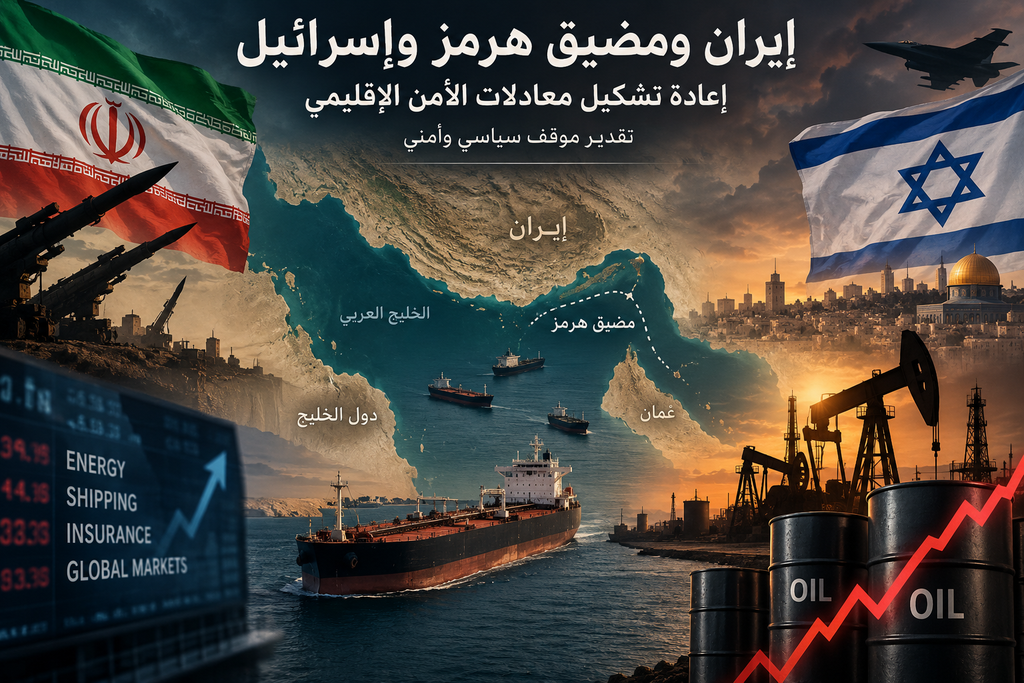
The Strait of Hormuz sits at the center of this equation as one of the most important sea lanes in the global economic system. It is no longer just a route for oil and gas transit; it has become a strategic pressure tool that can influence energy security, shipping and insurance costs, financial markets, supply chains and the political decisions of consuming countries.
At the same time, Israel is passing through an extremely sensitive political and security phase as the October 27, 2026 elections approach. Security has become a central part of domestic political debate amid the ongoing conflict with Iran and its regional fallout, and there are rising fears that the confrontation could spread into new rounds or additional fronts.
Conversely, Iran is combining military pressure with economic pressure while maintaining a negotiating track. Recent developments show Tehran still has influential tools in the regional environment, but it is also bearing rising economic and political costs due to the ongoing war, sanctions and disruption to navigation.
The central question is no longer simply whether the region is facing a new war; it has become more complex:
Is the current confrontation moving toward a gradual resetting of the rules of engagement, or will continuing mutual pressure lead to a renewed expansion of the conflict?
1. The Strait of Hormuz: From Energy Passage to Strategic Tool
The Strait of Hormuz is the most important choke point in the global energy system, so any major disruption to navigation there will not be contained within the Gulf.
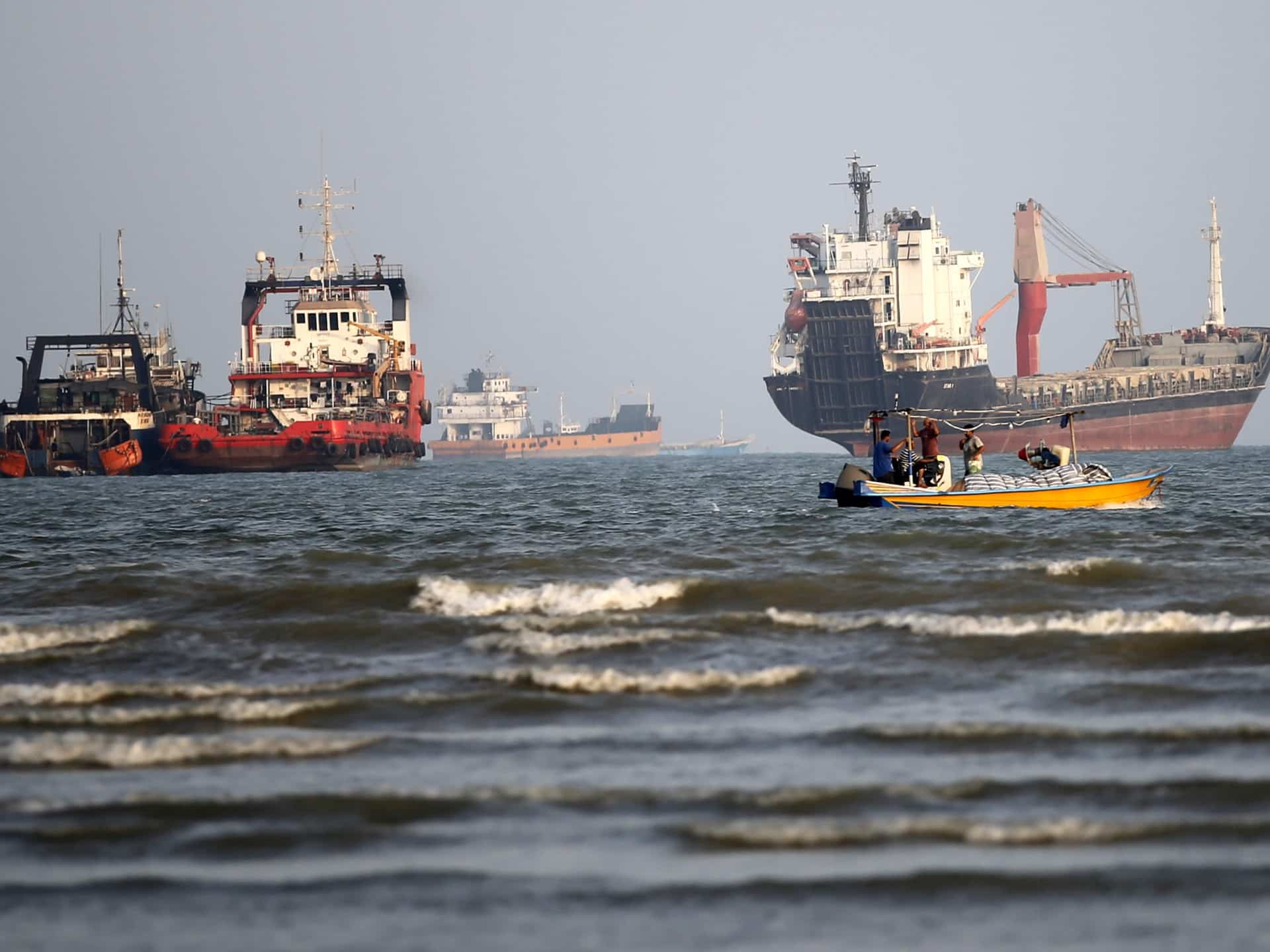
In recent months commercial ship traffic through the strait has fallen sharply compared with usual levels, before some tanker movement began to return gradually.
This is important because it shows that talk of a complete, sustained closure of the strait requires careful precision. The current scene resembles a severe disruption to navigation and an exceptional rise in security and commercial risks rather than a sustained, total closure.
The importance of the strait is not measured only by the number of ships transiting it each day, but by the scale of risks that any threat to navigation entails.
A rise in perceived danger alone drives up insurance costs, increases freight rates, prompts rerouting of ships, delays deliveries and adds a risk premium to energy prices.
Thus Iran can use the strait as a pressure tool even without deciding to close it completely.
2. The Equation of Full Closure versus Gradual Pressure
A full closure of the Strait of Hormuz would be extremely costly for all sides, including Iran itself.
Iran is a Gulf littoral state that depends, to varying degrees, on maritime trade and energy, so a long-term closure could damage its own economic interests as well as pressure its adversaries.
That does not mean Tehran is incapable of using the strait militarily.
There is a strategic distinction between closing the strait outright and keeping it partially open but at a much higher level of risk.
In the latter scenario every maritime voyage requires security and political calculations, while limited movement continues—allowing Iran to retain a pressure tool without bearing the full consequences of a shutdown.
This type of pressure can be more flexible than full closure because it allows escalation and de-escalation to be used as bargaining instruments.
Seen this way, the Strait of Hormuz can be part of a broader bargaining equation between Washington and Tehran rather than simply a military battleground.
3. Global Energy Facing a Prolonged Shock
Oil and gas were among the first sectors to feel the war’s effects.
Recent developments show that disruption to navigation does not necessarily remove supplies altogether; it redistributes them, raises their cost and increases the risks associated with them.
In September exports from major Middle Eastern producers rose compared with previous months, and some liquefied natural gas tanker movements began to return through the strait, including shipments linked to Qatar.
This reduces the likelihood of a global, total supply cutoff, but it does not eliminate the risks.
Markets do not need a complete halt in production for prices to rise. It is enough for market participants to feel that part of the supply is at risk or that transportation and insurance costs have risen sharply.
Therefore the real economic impact of the crisis may outlast the military confrontation itself.
Higher energy costs feed into transport, industry, electricity, fertilizers and food, so an energy supply crisis can gradually become an inflation and supply-chain crisis.
4. Strategic Stocks Do Not Eliminate the Risk
Industrialized countries have strategic reserves and mechanisms to deal with energy crises.
But these reserves are not a permanent substitute for normal production and trade.
They can ease the shock for a time, but they cannot replace a long-term shortfall in supplies if the crisis endures.
Hence the riskiest scenario is not necessarily a total stoppage of supplies but a prolonged period of uncertainty lasting several months.
Markets need clarity about the future. The longer ambiguity persists, the higher the risk premium, the wider hedging becomes, transportation and insurance costs rise, and states and companies begin building extra buffers.
At that point the crisis shifts from a regional military problem to a global economic pressure factor.
5. Israel at the Crossroads of Security and Elections
Israel enters the October 27 elections in a highly complex political and security environment.
National security has become one of the main pillars of the campaign, especially given the ongoing conflict with Iran and the war’s implications for the Israeli government domestically and internationally.
On September 29 Prime Minister Benjamin Netanyahu warned of a possible attempt by Israel’s adversaries to carry out an attack before the elections, while opposition leader Yair Lapid received a security briefing, then criticized the use of security issues within the campaign and called for professional handling.
This highlights a delicate equation.
A security warning may be based on real information that justifies raising preparedness, and at the same time it can turn into a political element during a highly sensitive election season.
From outside the security institutions it is impossible to determine the true motive behind each political warning.
Therefore we must distinguish between three levels:
The first level is the existence of an actual security threat.
The second is the level of intelligence information available about that threat.
The third is how that information is presented to the public and domestic politics.
Confusing these three levels leads to misreading the scene.
6. Israeli Elections Add a New Factor to Escalation Calculus
As the election approaches, security messages become more sensitive.
Any major attack could abruptly change political priorities, and any security success can be used to validate a particular political narrative.
That does not mean war or escalation is chosen automatically for electoral reasons.
Military decision-making in Israel involves a broad system that includes the army and security agencies, the government, international considerations and the U.S. alliance.
Thus the relationship between security and elections should be read as an influential factor in the political environment, not as the sole explanation for every military decision.
7. Iran and the Rewriting of Deterrence
Iran appears to be redefining the rules of deterrence that govern its relationship with the United States and Israel.
Iranian response no longer relies solely on missiles and drones; it also includes pressure on navigation and energy, the use of allied forces in the region, and threats to target economic interests tied to its adversaries.
Recently Tehran warned that energy facilities in the Gulf could become targets if its interests are attacked.
This message reflects an important shift in Iranian deterrence: the goal is no longer necessarily to prevent an attack, but to raise the cost of attacking to a level that forces the adversary to rethink its calculations.
From this perspective the Gulf, the Strait of Hormuz and the Bab al-Mandeb form interconnected elements of a single pressure system.
8. Iran Between Escalation and Negotiation
The key paradox in Iran’s posture is that Tehran is using military pressure concurrently with diplomatic engagement.
In September indirect talks took place between the United States and Iran mediated by Qatar, focusing on stopping hostilities, easing restrictions on navigation and reopening the Strait of Hormuz, alongside sanctions and the nuclear file.
At the end of the month Iran proposed confidence-building steps and a timeline for reopening the strait, while Qatari mediation continued trying to bring positions closer.
This means Iran does not treat war and negotiation as necessarily contradictory tracks. It uses military pressure to improve bargaining terms while using diplomacy to avoid the military pressure turning into a long, open war.
9. The United States Between Force and Negotiation
The United States faces a complex equation.
On one hand Washington has substantial military capability to protect navigation, strike Iranian targets and raise the costs of any threat to sea lanes.
On the other hand, a prolonged war creates economic and political pressures and increases the likelihood of conflict expansion.
So the American option appears to waver between military pressure and searching for a negotiated formula.
Mediation and indirect negotiations continue, while fundamental disagreements remain over sequencing, guarantees, sanctions and the nuclear file.
This explains the apparently contradictory messages from Washington: raising military readiness does not necessarily mean a political decision for full-scale war, just as ongoing negotiation does not eliminate the military option.
10. The Gulf Faces a New Security Equation
Gulf states find themselves at the center of the crisis without necessarily being the primary decision-makers in the root conflict.
They depend on stable navigation, energy and trade, and they fear their territories or economic facilities becoming part of the direct confrontation between Iran, the United States and Israel.
Thus recent months have seen Gulf initiatives to support a diplomatic track and seek political exits.
Regional developments indicate Gulf states are more engaged in managing regional security while still depending on the U.S. role to provide a security umbrella.
This could lead to a long-term shift in Gulf policy toward greater reliance on preventive diplomacy alongside military alliances.
11. Yemen and the Bab al-Mandeb
The Hormuz crisis cannot be read in isolation from the Red Sea and the Bab al-Mandeb.
Disruption in one passage can reflect on the other.
Ansar Allah in Yemen (the Houthis) is a main actor in this equation, especially as tensions with Saudi Arabia, the United States and Israel continue.
Unreported contacts took place in recent months between U.S. officials and Houthi representatives in Oman, showing that the diplomatic track remains active even amid confrontation.
This matters because managing the Red Sea could become part of any wider settlement with Iran.
12. Is a New Regional Front Forming?
There are signs of increasing convergence of security interests between Israel and some Gulf states against Iranian and Houthi threats.
But talking about a unified regional military alliance or a joint operations center that includes all the parties mentioned in some reports requires great caution.
The regional reality is more complex. Not all Gulf countries agree on how to deal with Iran, and each has its own calculations in relations with Washington, Israel and Tehran.
So it is more accurate to speak of a growing intersection of security interests rather than assume the existence of a complete, unified military alliance.
13. Information Warfare Is Part of the War Itself
A defining feature of the current crisis is the wide spread of unverified information.
Overlapping elements include leaks from the military, anonymous sources, accounts linked to parties to the conflict, non-independent media reports, reposted old clips, images reused in new contexts, and statements attributed to officials without official records.
A high volume of news does not necessarily mean a high volume of reliable information.
In military crises inaccurate information can perform a strategic function even if false, because it affects markets, public opinion and adversaries’ expectations.
Therefore narrative management becomes part of conflict management.
14. Douglas MacGregor’s Statements and Their Implications
Statements attributed to Douglas MacGregor should be treated as personal political and military analysis, not as an official report on the state of the U.S. economy or military.
Iran-affiliated media platforms and others have used his remarks to support a narrative of an imminent U.S. economic collapse.
There is a big difference between criticizing U.S. policies or discussing rising public debt and war costs, and concluding that the United States is on the verge of collapse.
Thus these statements can be valuable for studying information warfare and competing narratives, but they are insufficient alone to prove a strategic shift in American power.
15. Kaliningrad and the European Front
The European front, and particularly relations between Russia and NATO, also need monitoring.
But linking any tension around Kaliningrad directly to the Iranian conflict requires caution.
Russia, the United States and NATO have independent conflict files in Europe that may intersect politically without being part of a single military operation.
Any crisis around Kaliningrad should be analyzed as a separate strategic track that may be affected by the broader international climate, not as an automatic front in the Iran–U.S. war.
16. Scenario One — Gradual Containment of the Confrontation
This scenario assumes ongoing Qatari, Omani and other mediations leading to interim arrangements that permit increased navigation through the Strait of Hormuz in exchange for reciprocal U.S. and Iranian steps.
This could take the form of a phased agreement rather than a comprehensive settlement.
Supportive indicators include continued indirect contacts and reciprocal proposals to reopen the strait and halt escalation.
17. Scenario Two — Continued Limited War
In this scenario strikes, naval operations and indirect attacks continue but without escalating into a full-scale confrontation.
It allows all parties to use force and pressure without crossing a politically difficult-to-reverse threshold.
Its main problem is that prolonged operations increase the chance of a significant incident that pushes parties beyond the limits they set for themselves.
18. Scenario Three — Regional Expansion
In this scenario the confrontation spreads more directly beyond Iran, Israel and the United States into additional arenas.
Expansion could involve the Gulf, Iraq, Yemen, Lebanon or the sea lanes.
The main danger is not only a deliberate political decision to widen the war, but the possibility of a chain of reciprocal responses: a strike causes a response, the response prompts another response, and retreat becomes politically harder than continuing.
This is one of the most dangerous escalation mechanisms in regional wars.
19. Scenario Four — A Long, Phased Settlement
A definitive settlement may not emerge in the short term.
The most realistic outcome in such crises is a series of temporary understandings:
Gradual reopening of navigation
Suspension of some operations
Easing certain sanctions
Freezing some files
Resumption of nuclear talks
Naval security arrangements
Leading later to a broader agreement
This scenario allows parties to preserve political maneuvering space without making large, immediate concessions.
20. Indicators to Monitor
There are a number of indicators that will help understand the crisis’s direction in the coming phase.
First, the volume of ship traffic through the Strait of Hormuz.
Second, the level of tanker movements for oil and gas.
Third, oil prices and the risk premium.
Fourth, the nature of U.S. military movements in the Gulf.
Fifth, the level of Iranian maritime operations.
Sixth, Houthi activity in the Red Sea and the Gulf.
Seventh, the path of Qatari and Omani mediation.
Eighth, the nature of Israeli statements before the elections.
Ninth, the level of security coordination between Israel and Gulf states.
Tenth, any change in the rules of engagement between Iran and the United States.
These indicators will be more important than isolated political statements because they allow measurement of the crisis’s actual trajectory.
Overall Assessment
The Middle East faces a security phase unlike previous ones.
The conflict is no longer only about Iran’s nuclear program or Israeli security; it is tied to energy, sea lanes, global trade, Gulf security, the Red Sea, and domestic politics in Israel and the United States.
The Strait of Hormuz remains one of the most important elements in this equation.
But recent developments show the picture is more complicated than a total closure or full-scale war scenario.
Navigation has begun to recover partially, and some gas shipments have resumed transit, even as security risks and political negotiations continue.
At the same time, the continuation of the war imposes rising costs on Iran, the United States, Israel and Gulf states, creating stronger incentives to seek a negotiated formula.
That incentive, however, does not mean a settlement is near or guaranteed.
Disagreements over sanctions, the nuclear file, navigation, security guarantees and sequencing remain large, and parties face internal pressures that make concessions harder.
Israel is entering a highly sensitive political phase where security and elections clearly intersect, making any military development in the coming weeks politically consequential—without implying that every security warning is necessarily part of an electoral calculation.
Ultimately the greater danger in the coming period may not be a single decision to ignite a full regional war but the accumulation of errors, miscalculations and reciprocal responses.
The region is operating in an extremely sensitive environment in which military force sits alongside economic pressures, electoral calculations, diplomatic mediation and information warfare.
Therefore the crisis’s future will largely depend on the parties’ ability to control escalation and on mediators’ success in turning military pressure into a sustainable negotiating track.
A stable reopening of the Strait of Hormuz, restoration of trade and energy flows, and a reduction in military operations would indicate a move from managing war to managing settlement.
Continued maritime and aerial escalation, expansion of operations into new arenas, and increased targeting of critical infrastructure would mean the crisis is moving in the opposite direction.
In any case, the Middle East is entering a phase in which regional security rules will not easily revert to their pre-war status even if military operations cease.
What has changed is not only the scale of confrontation but also the way energy, sea lanes, regional alliances and economic pressure are used as tools in political and security conflict.
This is the most important strategic shift to monitor in the coming period.