












Reading in English | Read in العربية (Arabic)
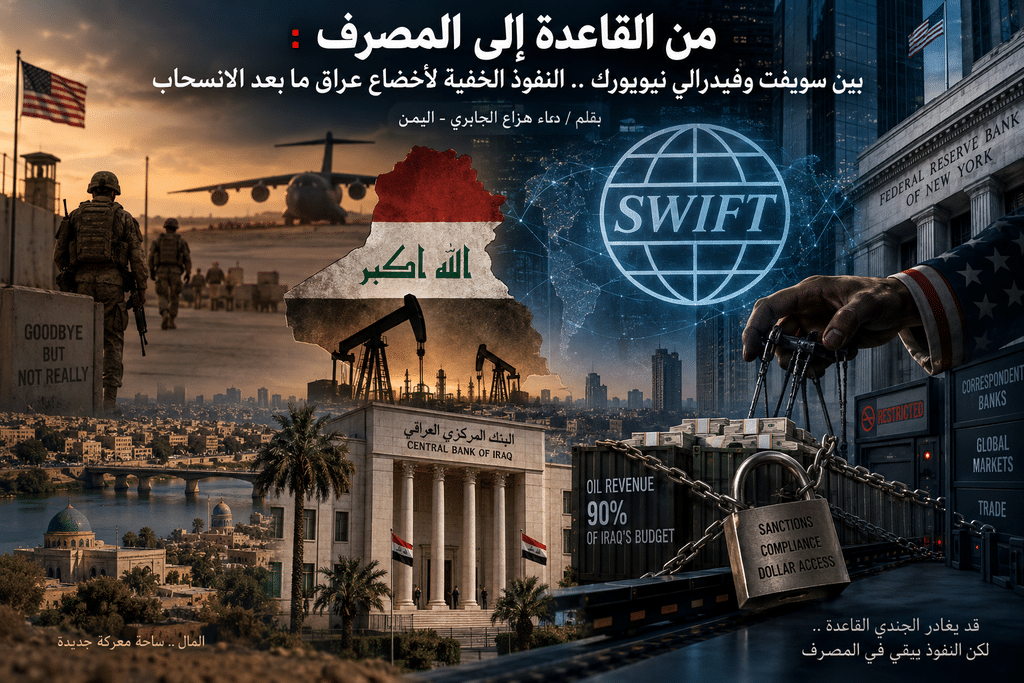
The moment the circulating news about “Iraq being cut off from the SWIFT system” appeared, it initially sounded like a routine banking story about an electronic network banks use to send payment messages. But behind that cold phrase lies a much larger story: a country from which U.S. forces have withdrawn militarily while the United States has not withdrawn to the same degree from some parts of the financial system that underpin Iraq’s economy.
A military withdrawal does not necessarily mean the end of influence. Sometimes when the soldier leaves the base, the state’s impact remains in the banks, the dollar, foreign accounts, and correspondent banking networks. That is precisely why the SWIFT story deserves to be examined beyond the narrow banking term. The reality, however, requires an important distinction: Iraq has not been entirely cut off from SWIFT as a country, based on available evidence. What is happening concerns restrictions, sanctions, and pressure on specific Iraqi banks and their ability to access the international financial system and foreign correspondents. In fact, the Central Bank of Iraq announced last July that it had reached an understanding to reintegrate seven restricted Iraqi banks into non-dollar external correspondent channels after they met compliance and governance requirements.
So why does the “cut off from SWIFT” story surface now?
Here politics becomes clearer than the headline. Iraq formally ended the U.S. military presence in September 2026, yet its oil revenues remain tied to an extremely sensitive external financial apparatus. Recent reports show that Iraq’s oil revenues—about 90% of the state budget—flow through the Central Bank of Iraq’s account at the Federal Reserve in New York, which gives Washington financial levers of influence even after the military mission ended. The real question, then, is not “Has SWIFT been closed to Iraq?” but rather: How far can Iraq operate within the global financial system without running into doors whose keys the United States and its allies control?
This is a new formula of influence. In older wars, a state identified its enemy by the color of their uniform. In modern economic wars, pressure can come from a banking screen, a correspondent account, a sanctions list, or a transfer that stops halfway. The danger is that a sanction does not need to be comprehensive to be effective: excluding a few banks, imposing dollar restrictions on them, or raising compliance requirements to the point that dealing with them becomes risky for foreign banks can be enough to widen the circle of impact.
This is not a theoretical assumption. U.S. sanction records already include Iraqi banks subject to financial restrictions, and some carry Iraqi SWIFT/BIC codes, which shows the issue is about financial institutions and access channels to the international system more than a total seclusion of Iraq from the SWIFT network. Money is more than a medium of exchange; it is a map of relationships: who transfers funds, where they go, who the real beneficiary is, which bank handles the transfer, and which foreign institution accepts to deal with it. These questions are now part of international security. Controlling money’s routes can sometimes be more effective than controlling territory.
Iraq sits at the heart of this equation. As a major oil state positioned between Iran, the Gulf, Turkey, and the United States, it relies on dollars, correspondent banks, and international financial networks for its external economic ties. At the same time, Baghdad has announced steps to reintegrate restricted banks into the global financial system, revealing that the confrontation is not only punitive but also a process of reshaping Iraq’s banking sector according to international compliance and governance standards. This makes the withdrawal of U.S. troops from Iraq even more thought-provoking.
If the military presence has ended, the lingering question is: Has influence shifted from a military base to a financial system? The facts suggest that economic influence did not disappear with the end of military presence, which makes the current moment extremely sensitive. Sovereignty in the twenty-first century no longer only means political decision-making within a country’s borders; it also means a state’s real ability to manage its funds, protect its banking system, and ensure its trade remains open to the world without its economic instruments becoming external keys that can be used when needed.
Therefore, today’s SWIFT story—even in its tentative form that requires verification—reveals something more important than the news itself: the battle over Iraq may be moving from who holds the weapons to who holds the keys to the money. Iraqi sovereignty is thus facing a quieter, far more complex test. A military war may end with the last soldier’s departure, but the influence of war can persist long within the depths of bank accounts.
In a world where alarm sirens are not always heard, a single stopped money transfer can sometimes change a nation’s behavior more effectively than a hundred tanks on its borders.