












Reading in English | Read in العربية (Arabic)
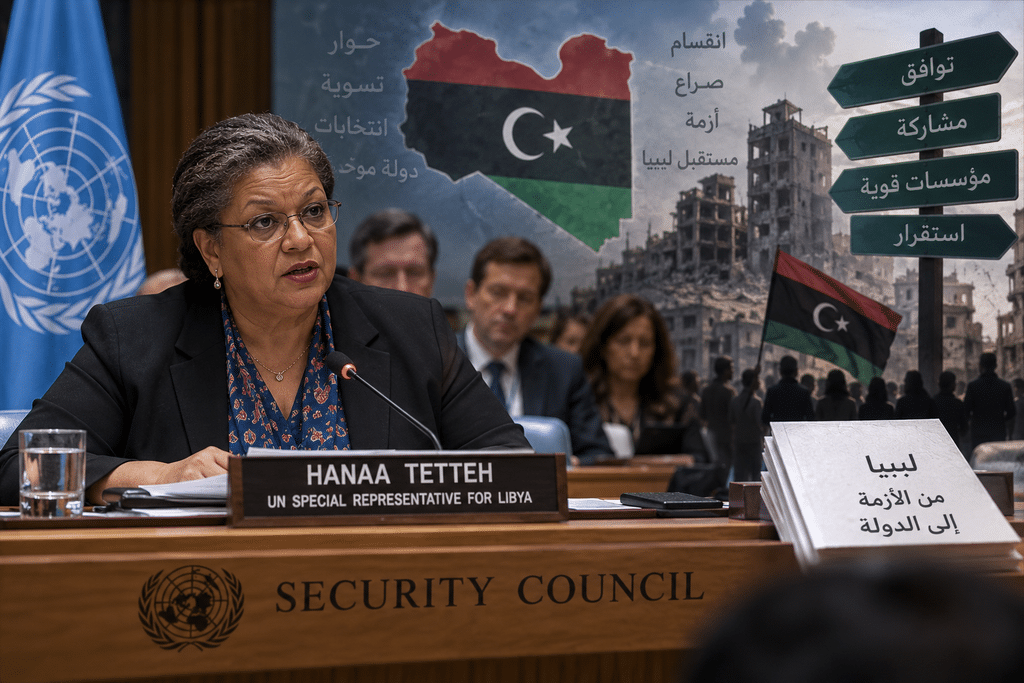
Hana Tetteh’s briefing to the Security Council and the future of the political settlement in Libya
Between trying to break the deadlock and reproducing the crisis
The problem facing Libya’s political track does not seem to be a lack of initiatives or understanding so much as the parties’ inability to turn agreements into a new political and institutional reality. For years UN initiatives have followed one another, committee names and forms of dialogue have changed, yet the result has been largely the same: fractured institutions, competing claims to legitimacy, and political forces treating the transition as a sustainable status quo rather than a phase that must end.
From that perspective, UN envoy Hana Tetteh’s briefing to the Security Council on 14 October 2026 is important. It comes at a time when the mission is trying to build on the 4+4 agreement amid disputes about how representative it is of Libyan actors and about the mechanisms needed to implement what was agreed. At the same time, mounting economic and social pressures make continued division increasingly costly for the state and its citizens.
The key indicator at this stage is not how much international support the agreement receives but the nature of the steps the mission will take when agreements run into objections from institutions and political forces. That will reveal whether the UN is trying to build a sustainable settlement or merely seeking a quick political result while the underlying reasons for past failures remain unchanged.
4+4: Is agreement among influential actors enough?
The UN mission appears to be betting that an understanding among a limited group of influential individuals could open the way to a broader settlement. This approach is not new in managing the Libyan crisis; solutions have often started from centers of power in the hope they can later impose commitments on others.
But Libya’s experience shows that an agreement among influential parties does not necessarily produce a national settlement. These actors may agree on certain arrangements around elections or institutions but diverge when negotiations reach the distribution of powers and resources, or when a party feels the deal threatens its place in the power balance.
This is the dilemma facing the 4+4 agreement. If its aim is to pave the way for elections, clear answers are needed on the pre-election issues that determine whether elections can succeed: the form of the executive, the scope of its powers, the rules by which the electoral process will be conducted, and guarantees ensuring acceptance of the results.
If the agreement is limited to resolving some disputes among participating parties while leaving the most sensitive issues for later, it may temporarily reduce tensions but will not be sufficient to end the crisis.
Thus the problem is not the number of participants but the substance of what they agreed and their willingness to bear the costs of implementation. A real settlement is measured not by the parties’ ability to find a common formula, but by their capacity to give up some interests when these conflict with the requirements of state-building.
Article Five: Broadening participation or seeking an exit?
Talk of activating a broadly representative national mechanism under Article Five of the agreement is a development that deserves attention. It reflects, directly or indirectly, that the current track needs a wider participatory base to overcome the objections it faces.
But expanding participation is not a solution in itself. Libya has seen many dialogues that included large numbers of political and social figures without resolving the power dispute or establishing stable rules for the transition. In some cases, more participants simply increased the number of actors able to object without a clear decision-making mechanism.
The core question, then, is what the new mechanism will add to the political process. Will it give parties not included in the 4+4 a real opportunity to influence outcomes, or will it merely provide broader political cover for a pre-existing agreement?
The difference is significant. If the mechanism aims to address objections and broaden consensus, it could be necessary to save the track. If it is only a way to bypass unresolved disputes without settling them, it could open the door to a new conflict over the legitimacy of its decisions.
Success for the mission at this stage requires clarity about the mechanism’s powers, how participants will be chosen, and its relationship with existing institutions. Participation that does not grant real influence risks increasing feelings of exclusion rather than resolving the problem it was meant to address.
The dispute with the High Council of State: A crisis beyond personalities
The disagreement over the 4+4 agreement exposes a deeper problem in managing Libya’s political process: the absence of consensus on who has the right to set the rules for the transition.
The UN mission wants to push the process forward and fears continued disputes will block any chance of holding elections. Meanwhile, factions within the High Council of State insist on not bypassing the legal and institutional frameworks that govern the political process.
This disagreement should not be dismissed as simply a clash between an international mission eager for results and a domestic institution resisting change. Nor should every institutional objection be assumed to be a defense of legitimacy; some positions reflect political calculations and fears of losing influence.
What is required is to distinguish between objections grounded in real legal problems and positions that use legal arguments to maintain the status quo. At the same time, the desire to accelerate the political process must not be used to bypass institutions or diminish their role without clear agreement on the rules of transition.
If the mission moves to circumvent or marginalize the High Council of State in a way that provokes broad objections, it may succeed in advancing the track to a new stage but will have greater difficulty ensuring acceptance of the results. If it waits for comprehensive consensus that is hard to achieve, it may face another round of open-ended negotiations.
Therefore the issue is not choosing one institution over another but setting rules that prevent legitimacy from being used to block solutions and prevent the need for solutions from being used to override legitimacy.
Elections are not necessarily the end of the crisis
There is a tendency among international actors to treat elections as the primary exit from Libya’s crisis. Politically this is understandable: renewing legitimacy through the vote is a key step toward ending the transition. But elections under current conditions could instead spark a new conflict if there is no prior agreement on their terms and the acceptance of their results.
Holding elections amid institutional division, multiple decision centers, and conflicting political and military interests does not guarantee all parties will accept the outcome. Post-election disputes over power could be more complex than those beforehand, especially if a winner emerges whom other actors do not accept as capable of governing or controlling institutions.
Therefore the focus should not be limited to the election date or changes to electoral laws, but must address issues that determine whether results can be implemented: the nature of the government that will oversee the period, its powers, guarantees for institutional neutrality, and mechanisms to handle disputes over results.
Forming a unified government should not become a new deal to divide posts among the same competing actors. A government born of a compromise aimed primarily at appeasing rival forces may reduce tensions but would not necessarily be able to run fair elections or assert state authority.
The greater danger is treating elections as an end in themselves, separate from institutional reform. That would simply replace people in positions without changing the rules of power and resource distribution.
The economy pressures politics — but it doesn’t decide it
The economic dimension grows more important because the split is no longer confined to institutions and decision centers; it now directly affects citizens’ lives. The dinar’s decline, rising prices, breakdowns in subsidy systems, and depletion of public resources all fuel public discontent and weaken trust in authorities.
Ongoing fuel smuggling and its related financial losses raise serious questions about the state’s capacity to manage its resources and protect public funds. The problem is not government spending levels alone but how funds are directed, the extent of oversight, and institutions’ ability to prevent their use to enhance political and economic influence.
But it would be wrong to assume that forming a unified government will automatically correct these imbalances. Economic reform requires decisions that may conflict with the interests of those who have benefited from the current arrangements for years—in subsidy systems, public spending, or management of activities tied to public resources.
Here the link between the political and economic crises becomes apparent. Financial reform needs an authority that can decide and implement, while unifying authority needs consensus that may be blocked by interests tied to financial resources.
Without addressing that relationship, the economic file may be used in political rhetoric for mutual accusations without achieving real reforms. Governments may change and alliances may shift while citizens continue to bear the crisis’s cost in their income and ability to meet basic needs.
For this reason, improving living conditions must be part of any political settlement, not a promise postponed until after the elections. A citizen who sees no improvement in daily life will have little reason to restore trust in the political process based only on political agreements.
The international stance: Agreement on the goal, differences in calculations
International support for the UN track provides an opportunity to break the stalemate but does not guarantee a sustainable settlement. Influential states may agree on the need for elections and stability but do not necessarily approach the Libyan issue from the same premises, and their relations with local actors can make their positions more complex than official statements suggest.
Rival Libyan forces exploit these divergences, seeking political, security, or economic backing or using foreign ties to strengthen their position in domestic negotiations. Thus any progress in the UN track will remain susceptible to regional and international calculations that sometimes go beyond the direct Libyan dispute.
Threatening measures against parties that obstruct the settlement or undermine economic stability may raise the cost of continuing the impasse but will not on its own force those parties to change behavior. External pressure may push actors to negotiate, but it cannot guarantee their acceptance of concessions that affect their core interests.
The value of the coming phase lies in the mission’s ability to turn international support into a coherent practical stance that links political commitments to desired outcomes and treats obstruction according to clear, consistent criteria regardless of the party involved.
If international pressure remains limited to statements and warnings, local forces are likely to absorb it. If it is combined with concrete political steps, guarantees for implementation, and a more consistent international position, it could influence the parties’ calculations.
Possible scenarios
Scenario 1: Saving the track by broadening consensus
Tetteh may succeed in widening political participation around the 4+4 agreement and reach understandings on outstanding issues. This path will be more sustainable if objecting parties take part in shaping solutions rather than being asked to accept ready-made outcomes. Its success, however, will depend on the willingness of influential forces to make real concessions, not merely agree to widen the circle of dialogue.
Scenario 2: Reshaping the track without fundamentally changing power balances
If progress within the small committee stalls, the mission may move to a broader negotiation mechanism. That could rearrange the political process and provide broader cover for existing understandings, but without real change in the balance of influence or resolution of core disputes. In that case, procedural progress would outpace substantive progress.
Scenario 3: Continued deadlock and erosion of trust
If disputes over legitimacy and institutional powers persist and agreement on implementation steps proves impossible, the UN track may remain politically active without delivering tangible results. As economic and social pressures continue, trust in institutions and the value of dialogue may decline while the entrenched forces retain their positions and continue managing the crisis rather than resolving it.
Overall assessment
Hana Tetteh’s briefing reveals a renewed attempt to move Libya’s political process forward by building on the 4+4 agreement while keeping open the option of expanding national participation if progress within the current framework stalls. But the briefing, regardless of its political signals, does not mean Libyan actors are necessarily close to a final settlement, nor that international support for the agreement will be sufficient to overcome existing disputes.
The central problem is that the Libyan crisis is no longer merely a disagreement over election timing or government form; it is tied to a prolonged struggle over power and resources and the absence of stable rules governing relations among institutions and influential forces. Any agreement that does not address these issues will remain vulnerable, even if it receives broad international backing.
It is likely the mission will try to preserve the 4+4 agreement in the coming phase while pressing more strongly to broaden participation and turn understandings into concrete steps. The success of this approach will depend on the parties’ readiness to treat the agreement as an entry point to end the transition, not as an opportunity to improve their positions within it.
In my view, the worst outcome would be for political forces to reach a new deal on power-sharing without changing how the state is run or how institutions and public resources relate to one another. Such a settlement might provide a period of calm but would not remove the crisis’s causes; it could simply postpone their explosion to a later stage, perhaps after the elections.
Conversely, failing the current track without offering a practical alternative will not serve Libya’s stability; it will instead give those who benefit from division an extra chance to keep their positions. The choice should not be between accepting the 4+4 agreement as-is or rejecting it entirely, but subjecting it to a serious test of its ability to broaden consensus, respect legal frameworks, and prevent monopolization of political decision-making.
A realistic way out begins with defining the tasks and limits of the transitional phase, setting clear guarantees for holding elections and accepting their results, tying the formation of the executive to specific commitments, and pursuing economic reforms that protect public resources and improve living conditions.
Ultimately, Libya does not need another initiative as much as it needs to break the cycle that makes every initiative a new opportunity to redistribute influence. The real measure of Tetteh’s success will not be her ability to bring parties to the table but her ability to push them to accept common rules that no party can change to suit its political calculations. Without that, elections will remain a postponed promise and political settlements temporary stops in a crisis whose basic rules have not changed.