
Reading in English | Read in العربية (Arabic)
The ninety minutes that brought Russian President Vladimir Putin together with the leaders of Finland and Norway were not just another entry in the diplomatic log. They felt like a window opened in a European wall that has long been built on language of rupture, reopening an old question that resurfaces whenever the continent edges toward major change: can Europe speak to Russia with one voice, or does each region bring its own fears and calculations that do not match those of others?
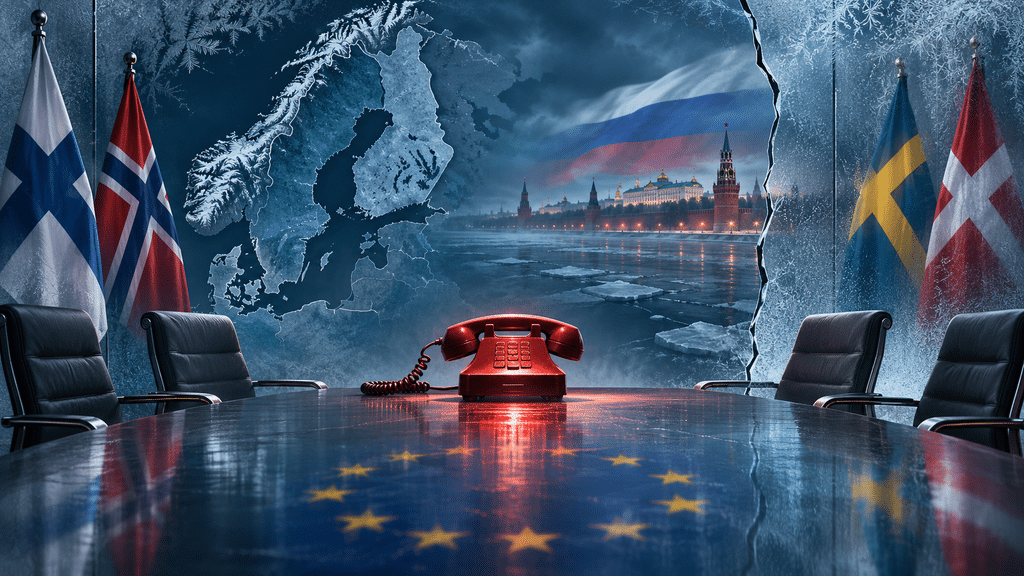
On October 27, the phone call between Finnish President Alexander Stubb and Norwegian Prime Minister Jonas Gahr Støre on one side and Putin on the other carried more than symbolic weight. It came at a moment when U.S. efforts to revive a settlement track in Ukraine intersected with European attempts to reclaim a role in negotiations. Northern capitals viewed the initiative from different angles, and the call itself became a source of dispute before its outcomes were clear. Denmark and Sweden were present in the scene not through the handset but through the reservations publicly voiced by their leaders and prime ministers. The episode thus shifted from mere contact with the Kremlin to a political test of unity within Northern Europe — as if the ninety-minute conversation revealed a distance deeper than geography between the four capitals. In moments of tension, diplomacy is measured not only by who sits at the table but by who sets its shape, who lays down the terms of dialogue, and who fears that silence will turn into isolation or that speaking will become an uncalculated concession.
Finland and Norway look at Russia through the lens of immediate geography. Finland carries the memory of a long shared border and a historical experience that ties its security to what happens just beyond its eastern boundary. Norway understands that Russia’s neighborhood in the north is not a mere map detail but a permanent factor in defense, energy, and maritime-route calculations. From this perspective, direct contact can be seen as an attempt to preserve some influence over unfolding events before great powers redefine them away from northern capitals. Denmark and Sweden, by contrast, seem to harbor different concerns: they fear that unilateral initiatives could create cracks in European coordination and present Moscow with more than one voice, more than one door, and multiple readings of Western intent. The disagreement is therefore not only about whether to engage in dialogue but about who speaks for European security and how far national independence can stretch when interests within a single alliance begin to diverge.
At the center of this scene stands Russia, aware that political time does not always follow the rhythm of the battlefield. Wars are not decided solely by weapons, and settlements are not born of words alone. Between fronts and diplomatic tables a gray area forms, where states can test their adversaries, measure their patience, and reshuffle their cards without necessarily declaring a fundamental shift in position. That is why the resumption of direct contact with Putin raises a question that reaches beyond the war in Ukraine: are some European capitals beginning to realize that diplomatic isolation, however useful as pressure, cannot permanently replace negotiation channels? And does Europe fear waking up to a settlement shaped by Washington and Moscow, finding its security, borders, and future affected without having been a full partner in crafting the outcome?
Europe, which sought a unified stance in response to Russia’s actions, faces an internal test about what unity actually means. Consensus does not erase differing fears, and alliance does not eliminate divergent calculations. The problem arises when these differences turn into parallel diplomatic tracks, leaving capitals unsure where lines converge and where they diverge. The Baltic Sea, with its geographic and strategic memory, is a key to understanding this landscape: the waters that connect Northern Europe to Russia are no longer mere routes for trade and navigation but have become part of deterrence, surveillance, and influence competition. In a world where military alliances intersect with economic and intelligence calculations, every political gesture can carry meanings beyond its stated content. The deeper question, then, is not what was said in those ninety minutes but what those minutes failed to settle: was the call the start of a broader understanding or merely an attempt to open a window in a wall that still stands? Can diplomacy recover its ability to build settlements while the conditions of war remain part of the parties’ calculations?
History offers no permanent guarantees, and alliances are tested when interests shift and options narrow. This episode shows that Europe stands at a juncture requiring more than unified rhetoric; it needs to define its place in a world where decision-making centers are no longer confined to a single capital and wars do not necessarily end when guns fall silent. The call between Putin and the leaders of Finland and Norway may have concluded after ninety minutes, but the questions it raised still hang over Northern Europe. Between Moscow, Washington, and the European capitals, the contest is not only over the borders of Ukraine but over the shape of the security order that will emerge from this war and who will have the authority to write the terms of the next phase.
The riskiest moments in politics are always those before an agreement, when tables appear calm while maps of influence and balances of power shift underneath. European silence today is no longer an easy option, and talking to Moscow is no longer a cost-free step. Between those two states, the continent faces its hardest question: how can it protect its unity without losing its ability to negotiate?