
Reading in English | Read in العربية (Arabic)
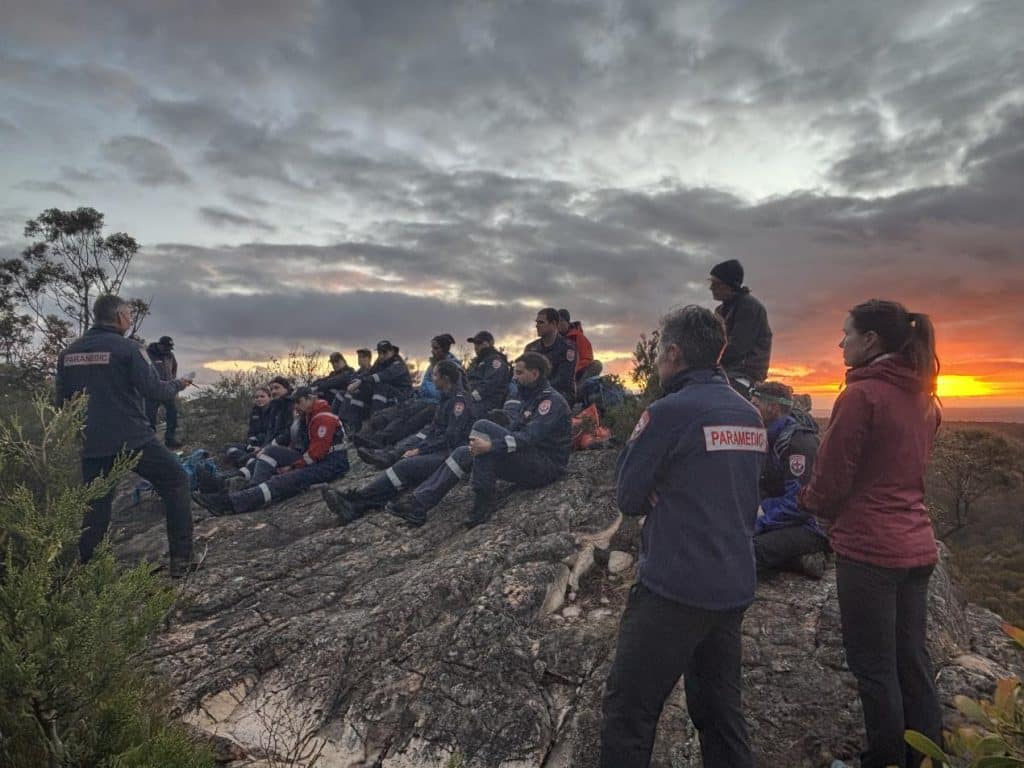
Air Ambulance Victoria’s new interns have spent three days braving the elements in the Grampians as part of an intensive personal preservation training course that tested their teamwork, outdoor survival skills and interagency collaboration.
The annual immersive training program sees newly recruited Mobile Intensive Care Ambulance (MICA) and Advanced Life Support (ALS) flight paramedics – known as interns – arrive in the Grampians with minimal knowledge about their location and limited supplies and equipment.
Participants are put through the rigours associated with working on Air Ambulance Victoria’s fixed wing planes and specialist helicopters. The aim is for crews to sharpen their rescue skills, increase confidence in leadership scenarios and prepare for emergencies in Victoria’s most remote and rugged locations.
Ambulance Victoria Manager Air Operations Anthony de Wit said this year’s training saw the largest cohort ever put through their paces, including two Critical Care Helicopter Emergency Medical Service paramedics from Western Australia.
“The goal is to educate our flight paramedics on what it’s like being out in the wilderness and how to look after themselves in external environments. It also puts them in a fatigue state and simulates the rigours of the role while in a controlled environment,” he said.
“It’s quite an intensive three days walking in the Grampians bushland, learning about the appropriate layering system for clothing, sheltering considerations and equipment use, food and nutrition, navigation and camping etiquette.
“It challenges their personal safety and preservation skills but also tests how the group functions together.”
While lifesaving skills make up a portion of the course, it also heavily focuses on building leadership and communication skills, both of which are essential when working in remote locations.
The last day of the training involves crews participating in a multiagency rescue scenario, with this year’s set-up involving three patients, including an injured climber stuck on a ledge.
Working alongside representatives from Victoria Police, Country Fire Authority, Victoria State Emergency Service, and Ambulance Victoria’s Emergency Management Unit, the participants completed a high-angle rescue exercise to extricate patients to a road ambulance for further treatment.
“Each year, we receive tremendous support from our partner agencies, giving crews the opportunity to build relationships and practice a coordinated rescue in difficult and dangerous terrain,” Anthony said.
Since being introduced over 15 years ago, the personal preservation training has received positive feedback, thanks to the dedication of everyone involved.
“Our highly skilled and knowledgeable instructors make the course what it is. To have a holistic program, we involve instructors from different roles at Ambulance Victoria, with each drawing on their vast ambulance experiences and varying skillsets to help shape the training,” Anthony said.
“Fundamentally, the participants fully immerse themselves in the training meaning they can provide better care and outcomes when responding to patients in some of the toughest locations imaginable.”