
Reading in English | Read in العربية (Arabic)
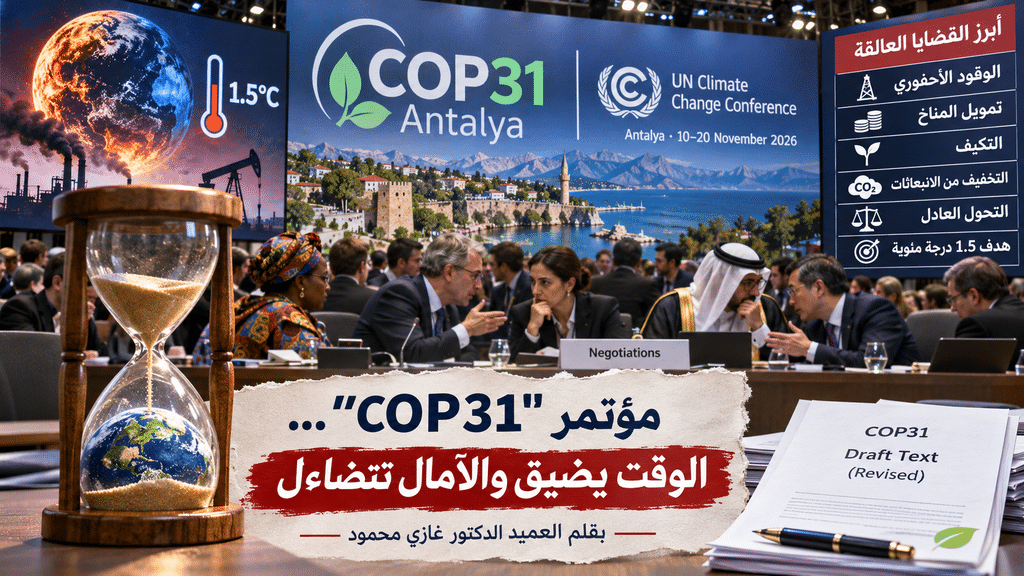
On the eve of the COP31 closing in Antalya, negotiators are racing the clock ahead of the Friday, 20 November 2026 deadline. Meetings have intensified across the conference corridors, with long hours and a string of high‑level diplomatic talks as delegates try to turn climate pledges into practical steps toward a final agreement amid sharp divisions over fossil fuels, climate finance and the 1.5°C temperature goal.
Unsuccessful attempts at agreement
As the conference reaches its last day and the window for extensions narrows, 21 issues remain unresolved, including adaptation, finance, mitigation and just transition. New texts on these topics are to be tabled in hopes of producing agreed, operational outcomes.
On Wednesday, 18 November, participants launched a new global mechanism to verify compliance with climate pledges. Still, some of the summit’s most complex questions remain deadlocked — from who bears the costs and how quickly the world should move away from fossil fuels, to whether a “green future” can be deemed just if the poorest countries cannot afford it.
The first draft of a comprehensive political agreement exposed divisions on fossil fuels, finance, the 1.5°C goal, electrification, and the role of science, prompting work on a revised version.
The Antalya AI Pledge, which urged governments and companies to take voluntary measures to run AI systems with lower environmental impact using “cleaner energy sources,” to support more efficient infrastructure, to track emissions, and to improve access to AI technologies in developing countries, failed to gain the expected uptake after major U.S. tech firms withheld their support.
Disagreements that overshadowed achievements
Because of these divisions, the terse revised draft released by the Australian co‑presidency on Thursday, 19 November removed any language on phasing out fossil fuels. It also omitted explicit references to coal, oil or gas, despite those fuels being central to one of the conference’s most contentious debates.
The draft did include a target to raise electricity’s share of global final energy consumption to 35% by 2035 — the “35×35” goal — a prominent practical target promoted by Turkey during its presidency of the conference, alongside expanded renewables and improved energy efficiency. However, critics noted the draft did not explicitly require that this electricity come solely from clean energy sources.
Support for the Turkish initiative rose to 75 countries on Wednesday. Australia, which is chairing the COP31 negotiations, was the first signatory, and 94 business and civil society organizations also endorsed the initiative.
Earlier commitments sidelined
Notably, the text left open the possibility of exceeding the Paris Agreement’s 1.5°C limit, stating that any overshoot should be short and as limited as possible. The draft also did not resolve the question of increasing adaptation finance threefold by 2035, deferring the details of how such financing would be calculated to later talks.
Voices have threatened to block any final deal that does not include a cap on global oil production and stronger methane reductions — among them Panama’s environment minister, Juan Carlos Navarro. Vulnerable countries and activists warned they might pursue legal escalation if talks fail to produce concrete commitments.
Just transition remains one of the most prominent unresolved disputes at the climate conference. The issue is how to move away from high‑emission industries without imposing the costs of that shift on workers and communities — by integrating social considerations into climate policy from the outset, including how public money is spent and the conditions attached to investments.
While the countries most vulnerable to climate change want the major forthcoming reports completed in time to guide negotiations, others — including Russia, Saudi Arabia and China — argue the timetable is too tight, potentially limiting effective participation by scientists from developing countries.
Modest achievements
On finance, the conference made significant progress: a grant package exceeding $480 million was announced, plus an additional $25 million for the Qatar‑led Accelerated Action Coalition to Combat Major Pollutants, which welcomed seven new countries and now includes 14 members in total.
Canada, Finland and Switzerland announced new contributions to the coalition, and a leaders’ summit focused on solutions for methane and other non‑CO2 greenhouse gases, together with the ministerial meetings on the Global Methane Pledge and the 2026 ministerial for the Accelerated Action Coalition, strengthened international cooperation and national implementation priorities.
Progress spanned multiple sectors and partnerships: the coalition launched a 2026 challenge program on organic waste; Australia backed an international statement addressing major methane leaks from fossil fuels; and Mexico, Panama and Cambodia joined the Black Carbon Peer Network.
The United Nations resets the compass
Lixin Xiaoming, Vice‑President of the United Nations University and Director of the University’s Institute for Environment and Human Security, said the conference discussions raise a fundamental question: “What is the real purpose of development?” She added, “We tend to assume development is always good. But I think it’s like a plane taking off without knowing where it will land — economic growth alone is not enough.”
Xiaoming said development should be aimed at human well‑being. “Ultimately, we all want to live a decent life,” she said. Her message to conference participants was simple: “The ultimate goal is not just for humanity to survive, but to thrive. This is fundamentally about people’s well‑being, but it is also built on the health of the planet.”