Reading in English | Read in العربية (Arabic)
When geography itself becomes a matter of suspicion and distances between states grow heavy with anxieties, we realize the world has entered a different phase of conflict — one where state power is measured less by armies than by what lies behind closed doors, by the signals intelligence systems pick up, and by movements that leave no obvious trace. Borders in international calculations have become like “open intelligence pages”: the flow of travelers is read as a probability, silence is interpreted as a message, and trust retreats in the face of a security vigilance that no longer knows where caution ends and confrontation begins.
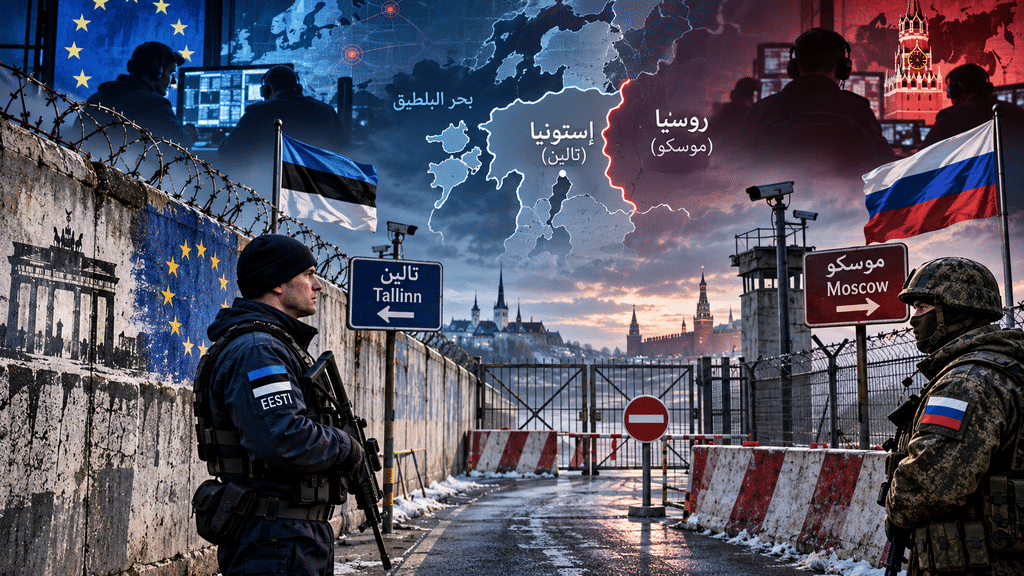
In Northern Europe, where historical memory intersects with power calculations, the Russian–Estonian border seems to be testing a new meaning of sovereignty. It reveals the contours of a confrontation that goes beyond crossings to shape the future of relations between Moscow and the European continent. Estonia — a small state on Russia’s doorstep and on the Baltic Sea — thus emerges as one of the most sensitive points in Europe’s security equation. Its decision to close border crossings with Russia, citing security concerns and allegations of sabotage and intelligence interference, cannot be understood apart from the shifts that reshaped European perceptions of Russia since the outbreak of the war in Ukraine. The issue is no longer only about the movement of people and goods, but about what borders can transmit: information, influence, and invisible messages.
Indeed, the concept of threat in Europe has changed fundamentally. In times when armies marched across territories and wars were declared with artillery, battle lines could be identified with relative clarity. Today, however, states confront far more complex possibilities: a cyberattack that paralyzes institutions, an intelligence network infiltrating security structures, sabotage targeting industrial or technological facilities, or a disinformation campaign that sows division across a society without a single shot fired. Accordingly, borders have taken on a new significance: they are no longer merely lines separating national sovereignty from the outside world but spaces for testing a state’s ability to protect its secrets, institutions, and strategic interests. From this perspective, Estonia’s sensitivity to activities it attributes to Russian services becomes understandable — especially given its membership in NATO and the EU and its geographic position on the eastern front most affected by Russian–Western calculations.
From the other angle, Moscow sees the rising European measures as an extension of a containment policy aimed at shrinking its presence in its neighborhood. Turning borders into closed zones, from the Russian viewpoint, reflects a political trend that goes beyond security concerns to an attempt to redraw the relationship between Russia and Europe. Hence the Russian rhetoric denouncing what it calls “anti-Russia” tendencies, while European discourse foregrounds national security as justification. Between these two narratives, the space for suspicion widens until every defensive measure appears to the other side as a potential offensive step. This is one of the most dangerous paradoxes in international relations: fear of a threat becomes a means of producing a new threat, and protective measures themselves enter the circle of escalation that states claim they wish to exit.
But the deeper question is not about Estonia alone; it concerns the future of Europe, which seems to be rediscovering its eastern borders after decades of assuming that geopolitical divisions could give way to economic interests and regional integration. The European Union, which built part of its modern identity on removing barriers and facilitating movement, now faces a reality where some member states tighten controls, close crossings, and rethink what openness to their Russian neighbor means. There is a historical irony here: the Europe that knew the Berlin Wall as a symbol of continental division now confronts new kinds of walls. They may not always be concrete, but they materialize as security barriers, border restrictions, surveillance systems, and intelligence classifications — walls that separate not only ideologies but also conflicting interests, fears, and conceptions of security and international order.
This does not necessarily mean a return to the Cold War in its old form. The world has changed; the tools of conflict are more entangled, and the economic, security, and international ties between Russia and Europe are not the same as those that governed the twentieth century. What may be emerging, however, is a new form of division based on selective isolation, intelligence competition, and digital and military hardening, while keeping narrowly defined political channels open when necessary. The Baltic Sea is an important strategic key to understanding the picture: waters that once bridged trade and contact have become part of deterrence calculations, military deployments, and maritime monitoring. Estonia’s significance stems from its position between the Russian sphere and the Euro-Atlantic space, so any tension on its borders can expand into broader debates about the security of the Baltic states and the future balance in Northern Europe. The gravest outcome of this trajectory would be geography turning into a permanent repository of enmity, producing political generations that see only danger in their neighbor. True security is not achieved simply by shutting doors, and sovereignty is not measured by the number of barriers a state erects but by its capacity to protect interests without losing the ability to engage in dialogue and maintain balance.
The world does not need open borders without safeguards, nor does it need closed borders governed solely by fear. It needs a system that can distinguish between protecting the state and turning fear into a permanent policy. Europe’s challenge today is not only how to prevent intelligence penetrations but also how to preserve its political cohesion amid an expanding conflict, and how to avoid each security measure becoming a prelude to a harsher one. The honest answer lies in recognizing that walls, however high, cannot by themselves halt the movement of history, and borders that close to people may remain open to information flows, intrusions, and strategic calculations. In a world where technology, interests, and intelligence are intertwined, nothing can be sealed off entirely by fences and barbed wire.
So this is not merely about Estonian crossings closing in the face of Russia; it is a sign of a phase in which the very function of borders is changing — from lines organizing neighborhood relations to forward fronts in a struggle for influence. Between Tallinn and Moscow, between European fears and Russian calculations, the question hangs over the continent’s maps: Is Europe building a wall to protect its security, or is it, perhaps without realizing it, reconstructing divisions it once thought it had overcome?