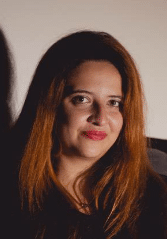
Starting over from scratch is often an unthinkable challenge. Yet, even fewer can imagine having to start over twice, each time being treated differently based on their origins. Zoya Miari shares her quest for a life of peace while uncovering the double standards embedded in many people’s perceptions.
One morning in February 2022, in Ukraine, Zoya Miari was awakened by her mother’s urgent words, words she would never forget: “Zoya, war has been declared again; we have to go.” Just like that, she found herself fleeing her country for the second time.

Nowhere safe: the failed quest for peace
Despite her youth, Zoya has already been a refugee twice. Born to a Ukrainian mother and a Palestinian father, she spent her childhood in a Lebanese refugee camp. Immersed in both Palestinian and Ukrainian cultures, she and her siblings cherished their life in Lebanon. However, the deteriorating conditions eventually compelled them to leave their father behind and flee to Ukraine in 2021, seeking a safer environment and a fresh start. They found happiness there, until a fateful morning in 2022 when Zoya learned that war had once again shattered their peace. “Being a refugee for the second time is profoundly shocking,” Zoya explains. “We had escaped to what we thought was safety, but then we found ourselves in peril once more. It’s incredibly unfair; just as we began to rebuild our lives, we were forced to flee again.” This time, Zoya, her mother, and her siblings sought refuge in Switzerland, where they arrived as Ukrainian refugees.
A Tale of Two Identities
Although Zoya was familiar with the refugee experience, her arrival in Switzerland presented a startling revelation: the stark contrast in treatment between being a Palestinian refugee and a Ukrainian refugee. “I was not accustomed to being treated humanely as a refugee,” Zoya reflects. “As a Ukrainian, empathy and compassion were readily extended to us. As a Palestinian, however, I had to continually prove that I was not a terrorist—that I, too, am human. In Europe, there’s no time to grieve; we are constantly justifying our existence, asserting our right to life. We should adopt the compassionate approach shown to Ukrainians as a standard for all refugees.”
Caught in this new cycle of displacement yet finding solace in a more peaceful environment, Zoya grapples with complex emotions while balancing her Ukrainian and Palestinian heritages. Initially fearful of revealing her Palestinian identity, she has grown more hopeful. “At first, I was hesitant to declare my Palestinian heritage; I needed to ensure our safety. However, my hope has grown stronger,” she shares. “I receive different reactions based on whether I’m seen as Ukrainian or Palestinian, yet I remain the same person. It’s challenging, but I’ve realized the importance of not distancing myself from others, as I want to reveal the truth about my heritage.”

Zoya continues, “Many don’t realize I may not have any family left in Palestine; my father could never return. It’s crucial that we amplify Palestinian voices and share our rich culture and history. Visiting Auschwitz made me question how such atrocities could be repeated. We must raise awareness and advocate for a free Palestine—it’s time for global awareness and action. It is the first time I am feeling the power of collective liberation.”
Zoya emphasizes the importance of listening and solidarity. “Just as we support Ukraine, we must also stand with Palestine. Freedom is universal—no one is truly free until everyone is free.”
“A part of me is treated as a human, and the other part of me is completely dehumanised”
Here’s an improved version of the passage:
In her new life, Zoya navigates the constant challenge of reconciling her dual heritage and grapples with the realization that people’s behavior toward her shifts depending on whether she identifies as Palestinian or Ukrainian. “One part of me is treated with dignity, while the other is dehumanized, despite being the same person,” she explains. “As refugees, it’s crucial that we assert our true identities, and combat the criminal stereotypes we are often saddled with. For 75 years, the cries and pleas of Palestinians have been largely ignored.”
Initially confused and frustrated, Zoya has come to understand the reasons behind the differing treatments: “Human self-interest plays a role, particularly with the conflict in Palestine perceived as a more immediate threat. People have become accustomed to the dehumanization of others, often reduced to mere statistics by the media. The visibility of the genocide in Palestine on social media has provoked many to break their silence, offering a fuller perspective of the truth. This isn’t just about Palestine; it’s about how the world functions—we’re advocating for a world free from oppression.”
As she matures, Zoya’s hope flourishes, and she gains new insights into countering global desensitization and reshaping public narratives. “Numerous factors contribute to desensitization, including decades of biased language portraying Palestinian men not as fathers, but as threats. It’s time for us to change the narrative. We must define our own stories, as we are the most authentic narrators of our experiences.”

The Transformative Power of Storytelling
Zoya’s tumultuous life inevitably led to profound personal transformations, and she is no exception to this rule. “After so much travel, I decided to become a messenger for peace and love,” she shares. “During my second displacement, I found myself yearning for a peaceful existence, free from violence. This craving for tranquility reshaped my destiny, compelling me to become a peace ambassador dedicated to the belief that everyone deserves a serene life.” Zoya adds, “For a long time, I pondered what being a peace ambassador meant. I cherish peace and am willing to strive for it. To me, peace also encompasses justice; there can be no peace without it.”
In her journey to define this vital role, Zoya realized the most effective way to advocate for peace nonviolently was by empowering people to narrate their own stories. “I could view myself as a victim or a warrior, and I chose the latter. I initiated a storytelling movement for refugees and others, aiming to alter our self-image and the world’s perception of us. The stories we embrace internally are those we project to the world, which, in turn, shapes how we are remembered.”
Zoya elaborates on her motivations for starting this movement, seeing it as a therapeutic tool for refugees and those in distress, as well as a means to leave a lasting impact. “I launched this initiative to provide refugees the opportunity to share their narratives directly. Those who have lived through the ordeal are the most compelling storytellers. Through storytelling, we forge deeper connections and draw strength from our shared vulnerabilities. War may strip us of our homes and possessions, but our stories remain ours alone — unassailable and enduring. Being part of a community that understands each other’s journeys is profoundly affirming.”
The War After the War: From Frustration to Advocacy
As Zoya extols the virtues of storytelling and collective unity, she reflects on their profound impact from a Palestinian perspective. “For the first time, Palestinians felt genuinely heard and seen, both empowering us internally and resonating globally,” she states. “Across the world, individuals are now encouraged to amplify the Palestinian narrative, a story historically overlooked or misrepresented by mainstream media.”
Despite identifying some positive developments amidst the ongoing crisis in Palestine, Zoya, like many Palestinians, remains deeply affected. She expresses her frustration with the inconsistent treatment she receives based on her identity: “It’s frustrating to be treated differently just because I am the same person, whether I present as Ukrainian or Palestinian. While I am surrounded by supportive individuals, the reality in Palestine is grim—there’s frustration but also hope. There’s pervasive anger and sorrow over the indifference of many who too quickly categorize others, losing sight of their humanity.”

Zoya describes her response to these challenges: “I choose not to respond with hatred. Instead, I channel these intense emotions towards constructive change. We must use our feelings to drive positive transformations, not allow ourselves to become numb to injustice. The current situation is far from normal, and I constantly seek ways to leverage my emotions to advocate for Gaza through nonviolent means like writing and speaking.”
She concludes with reflections on her complex feelings towards Russia, shaped by personal experiences and geopolitical insights. “Having grown up among Russians and counted them as friends, I later came to understand broader global dynamics and the ironies of selective empathy and double standards.”
A bright, hopeful future full of peace
Two years after fleeing a second war and resettling in a new country for the second time, Zoya has found a measure of peace in Switzerland with her family. They are still awaiting the arrival of her father, hoping to finally reunite and solidify their new life together. Zoya’s lifelong pursuit of a serene and stable existence has at last borne fruit; she now lives in an environment where she can thrive, empower herself, and help others discover their own paths to peace. Currently, Zoya is pursuing a master’s degree in psychology, aiming to become a positive psychologist. “I want to assist others in finding the significance within their own stories. I see this as my mission: to transform pain into something positive. None of the adversities I faced were choices, yet they shaped me. No one should ever feel shame for their stories, their culture, or their background. We must honor our resilience and the identities we’ve crafted from our struggles—these experiences are normal and should be shared openly, not concealed.”
Zoya adds, “For too long, I concealed my true circumstances, but I’ve vowed that surviving would mark the end of my victimhood and the beginning of my life as a warrior. I’m now writing a book about my experiences. Previously, I felt embarrassed to discuss my own story, but now I’m eager to reach out, share, and hopefully inspire others who might hear it.”