









Reading in English | Read in العربية (Arabic)
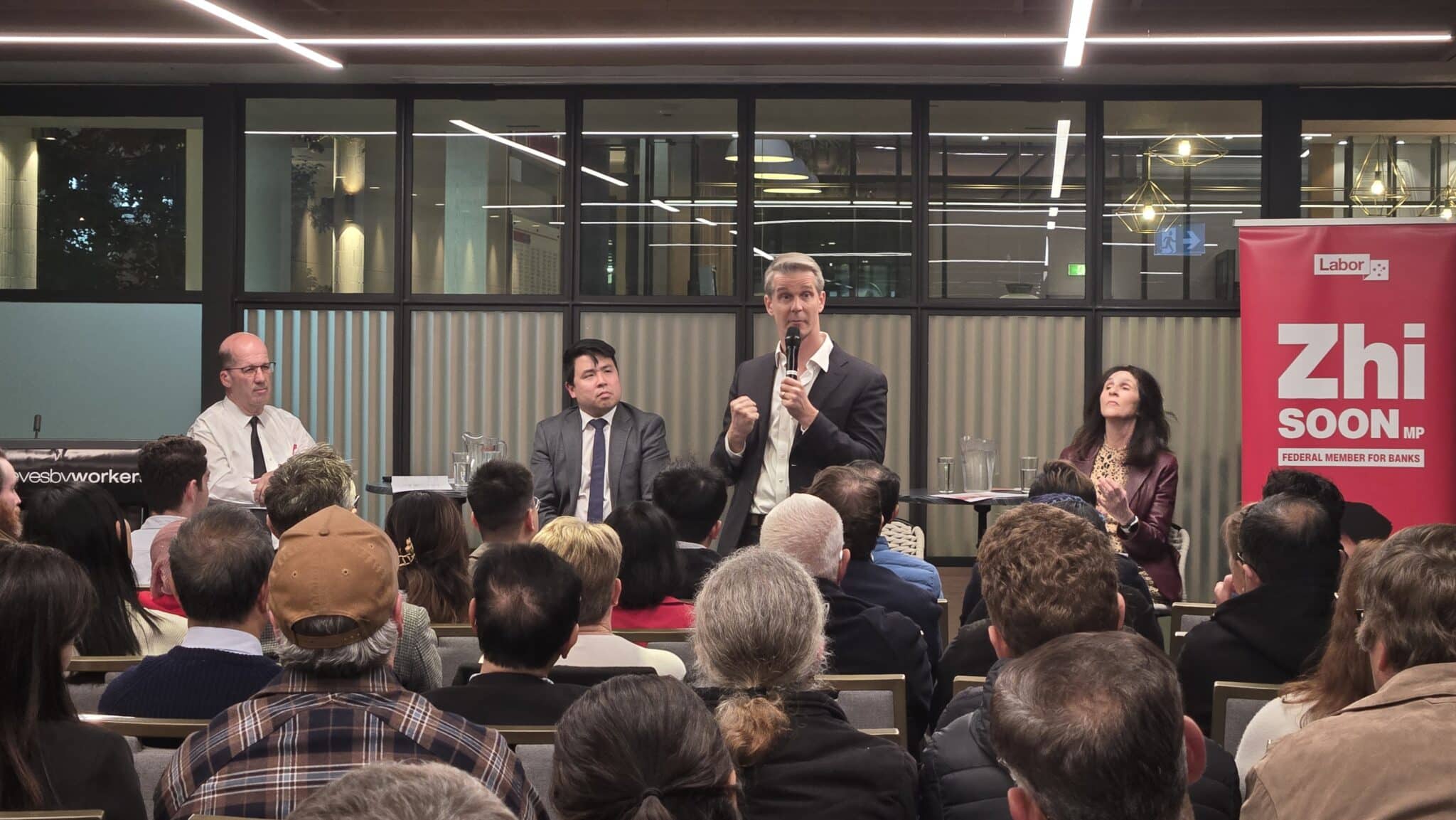
REVESBY, NSW – Community leaders, entrepreneurs and federal policymakers gathered at Revesby Workers Club on the evening of 29 July for “Real Talk: AI and Small Business – Straight Facts from Zhi and Andrew,” an open forum examining how artificial intelligence is transforming the way Australians work, run businesses and prepare for the future. The event, held in the federal electorate of Banks, brought the national conversation on AI to a local audience eager to better understand both its opportunities and its challenges.
Hosted by Zhi Soon MP, Federal Member for Banks, the forum featured Hon Dr Andrew Charlton, Assistant Minister for Science, Technology and the Digital Economy, and was moderated by Tony Urban. Throughout the evening, audience members were encouraged to ask questions and engage in an open discussion about AI’s impact on small business, employment, cybersecurity and the creative industries.
In his opening remarks, Zhi Soon set the tone for the evening by highlighting the need for a balanced conversation.
“What we’re really looking to do is really identify a lot of the opportunities that AI presents, which no doubt many of you have seen already. But also some of the risks and challenges that we’re seeing as well,” he said.
The Double-Edged Sword: Productivity vs. Peril
Dr Charlton described AI as a powerful “accelerator” capable of amplifying both positive and negative human behaviour.
“It’s going to accelerate the actions of people for good, but it’s also going to accelerate the capabilities of people for bad,” he explained.
His comments resonated with attendees, with one audience member expressing excitement about using AI to develop applications without any coding experience, while another cautioned, “If not in the right hands, it could be a disaster.”
Addressing those concerns, Dr Charlton outlined the Australian Government’s efforts to strengthen AI safety, including the establishment of the AI Safety Institute to evaluate emerging AI systems and identify potential risks before they become widespread. He also referenced testing that has revealed concerning behaviours in some advanced AI models, reinforcing the need for appropriate safeguards as the technology continues to evolve.
AI in Practice: A Tool for Small Business
The discussion also focused on the practical benefits AI is already delivering for small businesses.
One panellist described AI as an invaluable assistant for time-poor business owners.
“I love AI,” she said. “Small business, the biggest challenge we have is time because we’re expected to be HR, we’re expected to be operations, cleaner, customer service, the whole thing.”
She emphasised that the quality of AI’s output depends largely on the quality of the user’s instructions.
“I am the boss of AI,” she said. “I am only as good as the questions I ask it and the information I give it.”
Using the example of a joinery business seeking a marketing strategy, she explained that detailed information about the business allows AI to generate far more relevant and practical recommendations. She also cautioned that AI-generated information should always be verified.
“It’s like having an apprentice; very important that you cross check that.”
Several real-world examples highlighted how local businesses are already benefiting from AI. A swim school is using it to optimise complex class scheduling, allowing instructors to focus on teaching rather than administration. A local café has embraced AI to strengthen its social media marketing and position itself as a destination venue, while another business is using AI to analyse sales trends and improve stock ordering decisions.
The Future of Jobs: Disruption and Opportunity
The future of employment emerged as one of the evening’s most discussed topics, with audience members expressing concern that routine administrative and clerical roles could be among the first to be affected by automation.
Dr Charlton responded by explaining the economic concept known as Jevons Paradox, which suggests that improvements in efficiency often create new industries and employment opportunities rather than simply eliminating jobs.
“A lot of people thought, ‘Well, the printing press is going to just wipe out all of the work that currently goes into books,'” he said. “But what actually happened? … The number of books produced in the world increased a thousandfold.”
He acknowledged, however, that while history demonstrates technology often creates new opportunities, transitions can still be difficult for workers.
“That Jevons paradox about the opportunity to create more jobs doesn’t mean there aren’t massive transitional impacts,” he said.
Quoting the Prime Minister’s recent remarks on AI, Dr Charlton added:
“Our job is not to make sure that AI doesn’t change jobs. It’s to make sure that there are good jobs on the other side of this transition.”
Protecting Creators in the AI Era
The conversation also explored the growing challenge AI presents for copyright and intellectual property.
Zhi Soon spoke about concerns raised by musicians and other creatives who fear their work could be used to train AI systems without permission or compensation. The discussion examined the need for an appropriate legislative framework that protects Australian creators while continuing to encourage innovation.
The panel also noted that internationally, public figures are increasingly seeking to protect not only their names and images but also their voices and likenesses as AI-generated content becomes more sophisticated.
Community Engagement Continues
The forum concluded with an extended question-and-answer session before attendees remained for informal conversations with the speakers, reflecting the strong community interest in understanding how artificial intelligence will shape the future of work, business and everyday life.
As AI continues to evolve at an unprecedented pace, the evening reinforced a clear message: while the technology presents enormous opportunities for innovation and productivity, its successful adoption will depend on responsible governance, informed public debate and ensuring that people remain at the centre of Australia’s digital future.