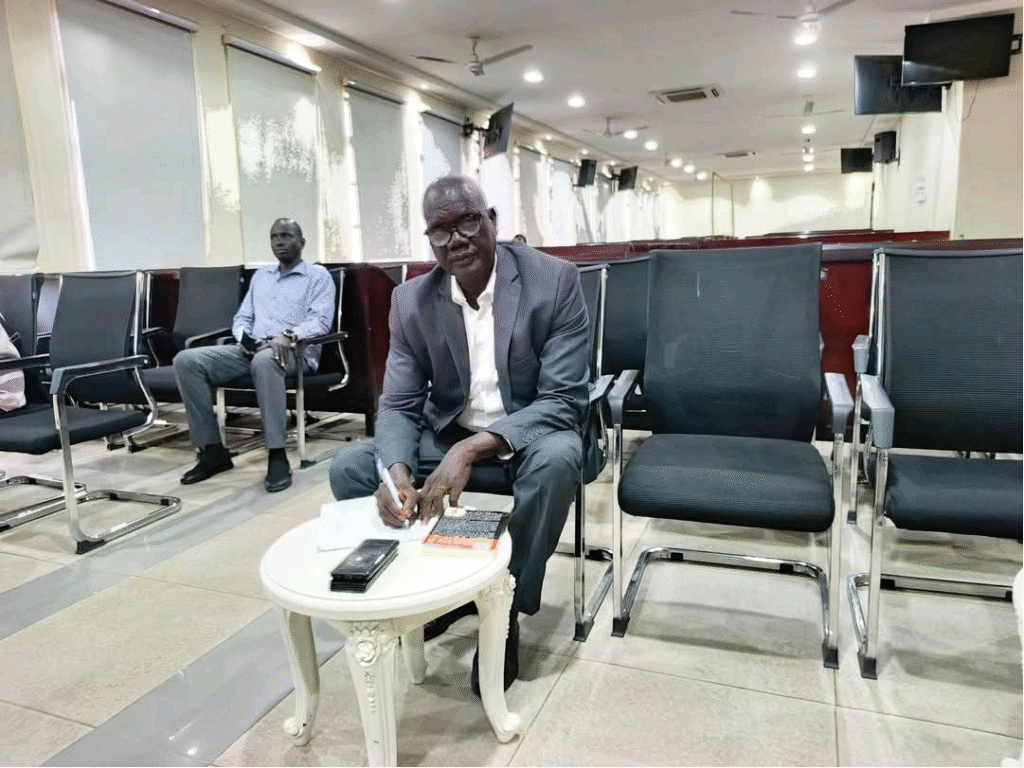













The University of Juba proudly hosted the official launch of Breaking Chains: South Sudan’s Path to Liberation (1820–Present), a remarkable new book by Lt. General Chol Biar. This historical work chronicles South Sudan’s long and arduous journey toward independence, shedding light on pivotal moments such as the Torit Mutiny, the rise of the Anyanya Movement, and the eventual formation of the Sudan People’s Liberation Movement/Army (SPLM/A).
Lt. Gen. Biar’s book offers an in-depth reflection on the resilience, unity, and sacrifices that defined the liberation struggle. It provides readers with valuable insight into the nation’s political evolution and the personalities who shaped its destiny.
Recounting key moments in the liberation story, the author highlights how, following the Torit Mutiny, several South Sudanese politicians fled the country and convened at the Silver Hotel in Kampala, Uganda. The meeting—attended by Joseph Oduho, George Akumbek, Julius Severino Fuli, Aggrey Jaden, and Philip Pedak—resulted in the formation of the Anyanya Movement. The name “Anyanya,” meaning “snake venom,” was proposed by Aggrey Jaden, who became its first leader before resigning in 1969 out of frustration with the movement’s direction.
The book also explores the crucial role of regional support in the liberation struggle. The Ethiopian government, for instance, assisted by airlifting key South Sudanese figures—Dr. John Garang, Samuel Gai Tut, and Akuot Atem—to Addis Ababa to present the movement’s manifesto. Within a week, Salva Kiir Mayardit joined them, followed by Lual Ding Wol, who arrived voluntarily from Bahr el Ghazal with his troops. These milestones culminated in the creation of the SPLM/A and its Political-Military High Command, which would go on to steer the liberation efforts that ultimately secured South Sudan’s independence.
During the launch, Hon. Antipas Nyok commended Lt. Gen. Biar for his dedication to preserving the nation’s heritage through the written word. He noted that while no single book can encompass the entirety of South Sudan’s complex history, Breaking Chains makes a vital contribution to ensuring that future generations understand the struggles that birthed their nation.
Hon. Deng Dau Deng also spoke, acknowledging the SPLM’s ideological inspiration from the Sudan African National Union (SANU) and emphasising the SPLA’s pivotal military role in achieving freedom. He called on South Sudanese scholars to continue documenting the nation’s story to safeguard the authenticity of its historical record.
Professor Leben Nelson Moro, Director of the Centre for Refugee and Migration Studies at the University of Juba, praised the author’s efforts and reflected on the symbolism behind the title. “The chains were broken,” he remarked, “but some have been brought back. The question remains—who brought them back?” He encouraged the author to explore such themes in future editions and congratulated him on behalf of the University for his valuable contribution to national history.
The event concluded with a collective call to action for South Sudan’s intellectuals and youth: to embrace the power of storytelling and written history. As Breaking Chains so powerfully demonstrates, documenting the nation’s struggles and triumphs is essential to preserving its collective memory and inspiring generations to come.