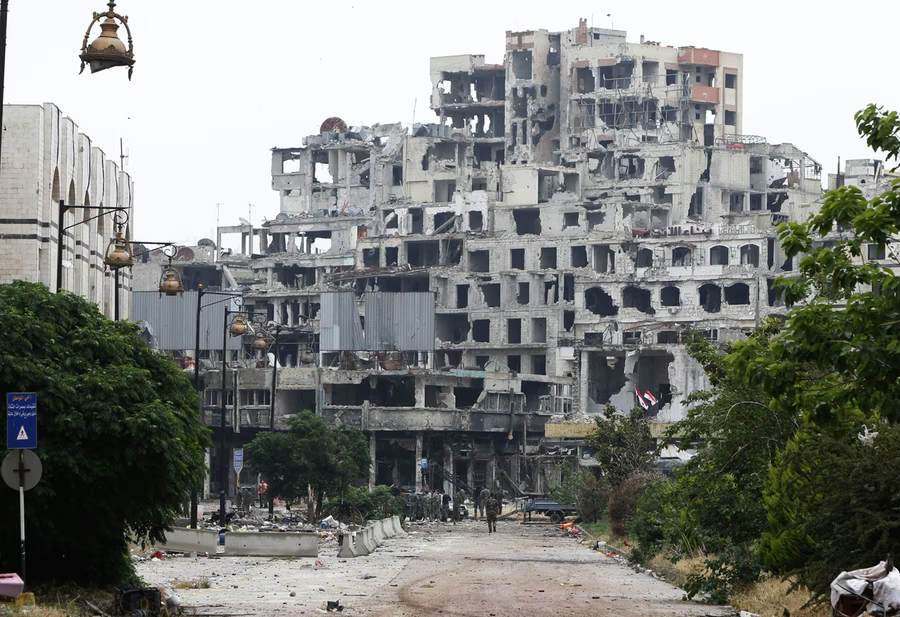













It is estimated that over 140,000 buildings were seriously damaged or destroyed by the Syrian conflict between 2011 and 2024. A recent World Bank report, ‘Syria Physical Damage and Reconstruction Assessment 2011–2024’, puts the cost of rebuilding the damaged buildings and infrastructure at $216 billion (a less conservative estimate $1 trillion). The conservative estimate of $216 billion includes $33 billion for residential buildings, which will require external financing, resulting long delays in the reconstruction works, leaving millions without proper housing for an extended period of time.
This project aims at alleviating this dire housing crisis by recycling blast-damaged buildings that preserve a sound reinforced concrete structural frame. Due to the nature of blast damage, where the force resulting from pressure waves on the building is proportional to its surface area, walls are often ‘blown out’, leaving the load-bearing structural frame of the building with limited or no damage.
Based on a review of hundreds of pictures of blast-damaged structures, it is estimated that 10–15% of blast-damaged buildings (140,000) could be recycled, representing 15,000–20,000 buildings. If just 10% of these suitable buildings were recycled, approximately 2,000 buildings or 20,000 apartments (10 per building) would be made available to families in dire need, significantly reducing their suffering. And all at an extremely low cost.
Besides the invaluable human impact, recycling construction materials and structures will also result in significant environmental benefits. The demolition of structurally sound structures would add to the existing massive amounts of rubble and their unnecessary replacement with new ones would further add to the detrimental environmental impact.
Blast-damaged buildings preserving sound structural frames can be made habitable again using low-threshold building technology, which offers access to a cross-section of the local population and enables them to be included in the reconstruction process. Recycling suitable structures will minimise the economic cost and waiting time. Once approved by the relevant authorities in Damascus, the reconstruction process will consist of four main stages.
First, a number of buildings with blown-out walls but marginal structural damage must be identified. This inspection must be carried out by trained civil engineers or architects, who will follow a pre-established procedure and set of criteria.
Secondly, of the preselected suitable structures, it is necessary to identify at least 50% of the legal owners of the apartments making up the building and they must consent to participate in the reconstruction programme. This percentage is required to ensure the viability of the reconstruction works of the building.
Then, a two-day on-site training workshop should be conducted to familiarise participants with building simple walls with openings and inserting window and door frames. As these walls will be non-load-bearing (they will only carry their own weight), they do not need to be built by experienced masons. It is also necessary to train participants in how to recycle blocks, bricks and frames found in the rubble around the building. This workshop will take place directly in the building in question, with participants working in their own apartments. This will ensure they are motivated to learn quickly.
Finally, the apartment owners will continue to work on reconstructing their own apartments under the supervision of a mason. Apartment owners must commit to contributing to the reconstruction of common areas and utilities, such as water, electricity and sewage.
There is no doubt that this is a challenging project to implement in today’s Syria. Official approval must be obtained, a replicable system for structural assessment must be developed to identify potential salvageable building stock, the owners of the majority of apartments in the structures to be recycled must be found, and workshops must be organised to train them in basic construction and recycling practices.
Nevertheless, given the constructive attitude of the current Syrian government and the urgent need for Syrians to rebuild their housing quickly and cheaply, I am convinced that this project will be successful.