











Reading in English | Read in العربية (Arabic)
No nation can build a sound historical consciousness if it treats its history with double standards: one standard that hardens when it comes to its enemies, and another that softens when it concerns those it considers part of its political or sectarian legacy. Justice is indivisible; truth does not change with the names of people; the sanctity of blood does not differ according to affiliations.
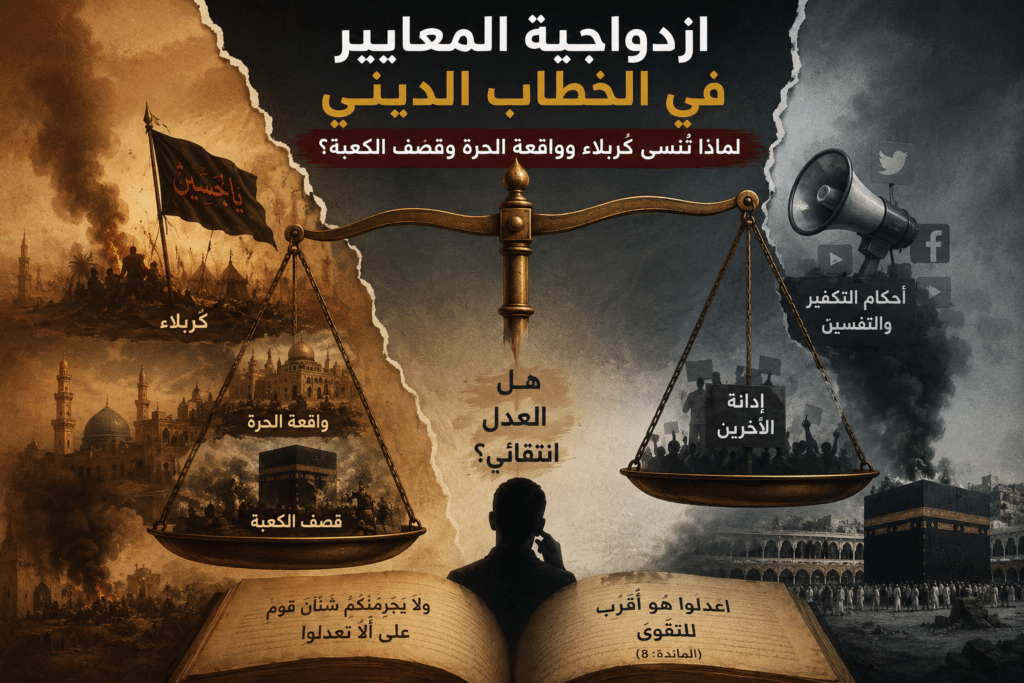
Anyone who follows religious discourse in recent decades notices a phenomenon worth pausing over: selective recall of history. Some events are repeatedly invoked to inflame anger and issue takfir and declarations of impiety, while other events of no lesser, and perhaps greater, significance for the history of the Muslim community are buried.
Imam Husayn ibn Ali, the Prophet’s grandson (peace be upon him), was killed along with his household and companions in one of the most impactful tragedies in Islamic history. Then came the incident of al-Harra, when the city of Medina— the Prophet’s city—was violated; many were killed and its people suffered grave abuses, as Islamic historical sources record. After that, the Sacred Kaaba was besieged and shelled during the conflict with Abdullah ibn al-Zubayr—an episode preserved in historical books as one of the gravest events to beset Mecca in the early Islamic period.
These events are not marginal tales or inventions of one historical school over another; they appear in well-known Islamic historical sources. Historians may disagree about some details, but not about the fact that they occurred.
A legitimate question follows: why do these events not occupy the same place in religious discourse that proclaims the defense of sacred values? Why do some contemporary issues become grounds for takfir and denunciation, while those historical incidents are explained away as political struggles or fits to be left unspoken?
Respecting history does not mean sanctifying individuals, nor does criticizing events amount to attacking Islam or the Muslim community. Islamic history, like the histories of other peoples, contains luminous pages and painful ones. Denying the painful chapters does not serve the truth; it opens the door to a selective reading of history.
Conversely, much is said about Iran or about Shiites as if they have repeatedly violated sanctities and shed blood in many arenas. There is no doubt that any violation of innocent blood or of sacred sites deserves condemnation, whoever the perpetrator. But the pressing question is: will the stance be the same toward all parties? Or does the standard of condemnation change with sectarian identity?
If the sanctity of blood is the principle, then the blood of Imam Husayn and his household deserves foremost defense. If the sanctity of holy places is the criterion, then Medina and the Kaaba are no less sacred than any other site. If aggression against Muslims is a crime, that principle must apply to all incidents without selection.
The issue of insulting the Companions and the Mothers of the Believers is one of the most exploited to inflame sectarian division. There is no disagreement among the majority of Muslims that disparaging Islamic symbols is reprehensible, and several senior Shiite maraji‘ have issued rulings forbidding insults toward the Prophet’s wives and offenses against Sunni sacred symbols. At the same time, the majority of Sunni scholars do not deem mere insults against the Companions to constitute takfir that expels one from Islam; they consider it a grave sin and a serious wrongdoing.
It is paradoxical and worthy of reflection that Islamic historical sources record how insults against Ali ibn Abi Talib were allowed on Umayyad pulpits for many years until Caliph Umar ibn Abd al-Aziz stopped them. These same sources recount that refusing to join in that practice could expose a person to punishment. Yet that chapter of history did not become a basis for declaring an entire community outside Islam, nor a justification for labeling everyone associated with that era as unbelievers.
The true danger is not that Muslims differ in reading history—that is natural—but that history is turned into a weapon used only against opponents, into a means of monopolizing religious truth and issuing judgments on millions of Muslims based on political or sectarian stances.
The Qur’an taught us that justice is an absolute value: “And let not the hatred of a people prevent you from being just. Be just; that is nearer to righteousness.” Justice is not due only to those who agree with us, but also to those who disagree. Fairness is not limited to those we side with; it includes those we oppose.
The Muslim community today does not need more takfir rhetoric or a replay of past conflicts. It needs a discourse that acknowledges historical mistakes and distinguishes between criticizing historical events and turning disagreements into fuel for contemporary sectarian strife.
Those who want to defend the sacred must defend it at all times and places. Those who want to defend inviolable blood must hold one consistent measure that does not change with different names or banners. Justice does not recognize sect; truth is not measured by affiliation. A community that looks at its past with two standards will be incapable of building a future founded on the single standard of justice.