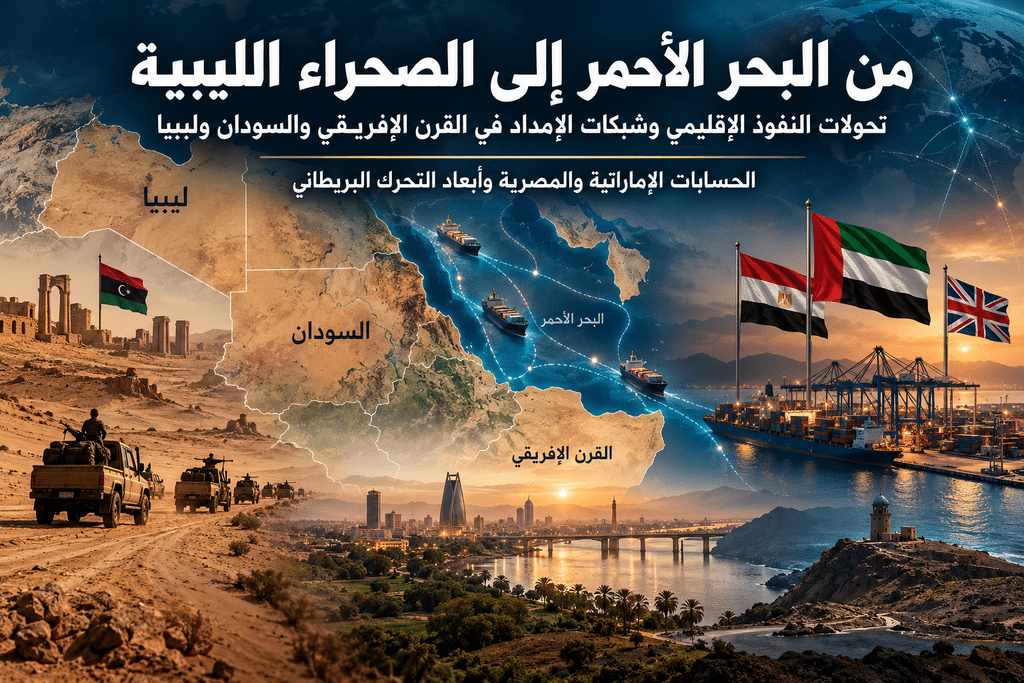












Reading in English | Read in العربية (Arabic)
Emirati and Egyptian calculations and the dimensions of the British move
Executive Summary
Security developments in Sudan, the Horn of Africa, and Libya are no longer separate files that can be analyzed in isolation. The growing overlap between local conflicts and regional interests has reshaped the importance of sea lanes, desert borders, airports, and logistical bases, making control of supply lines a central element of power balances. In this context, the relationship among competition in the Red Sea and Gulf of Aden, the Sudanese war, and sites of influence in eastern Libya emerges as a key angle for understanding the ongoing shifts in the region.
The United Arab Emirates has built a wide network of economic and security ties in the Horn of Africa and has accumulated influence in several coastal and strategic sites. Egypt, meanwhile, views Sudan, Libya, and the Red Sea as interconnected circles of its national security, especially amid the Sudanese war, instability along its southern and western borders, competition over Nile waters, and trade routes. The UK operates within a broader diplomatic and security framework linked to supporting the UN-led track in Libya, preserving regional stability, and safeguarding interests related to navigation, energy, and anti-smuggling efforts.
However, connecting these files requires distinguishing declared facts from political assessments and unresolved accusations. Overlapping interests or regional competition do not necessarily imply a single operations room managing all these trajectories. A more realistic interpretation is that the region is witnessing interactions among competing strategies that sometimes intersect and sometimes clash, while local conflicts turn into arenas that offer external powers opportunities to expand their influence.
This paper starts from the basic assumption that the futures of Libya, Sudan, and the Horn of Africa will be increasingly shaped by regional powers’ ability to control supply networks and strategic corridors, and by how successful those states are in preventing their territories, borders, and institutions from becoming instruments in other parties’ conflicts.
First: The Horn of Africa and the transformation of geography into a source of power
The Horn of Africa’s importance extends beyond its immediate political boundaries. It overlooks the Gulf of Aden and the Red Sea, guards the southern approaches to one of the world’s most important maritime routes, and is geographically connected to Sudan, South Sudan, Ethiopia, Egypt, and the Arabian Peninsula. This location gives the region an influential role in calculations about international trade, energy, and maritime security, as well as direct links to migration crises, smuggling, and border conflicts.
In recent years, competition for influence in the region has moved beyond diplomacy and economic investment. Ports, airports, training centers, security cooperation, and military agreements have become important elements in building regional influence. Weak state institutions and fragmented authority in some countries have allowed external powers to form direct ties with local authorities or security and military actors, enabling influence outside traditional governmental frameworks.
The importance of this shift becomes clear when looking at the relationship between the Red Sea and the African interior. Coastal ports are not merely commercial nodes; they can serve broader logistical and security roles. Airports located inland can acquire strategic value when linked to cross-border transport lines or to supply operations for forces engaged in armed conflicts.
But geography alone does not explain regional moves. A strategic location becomes a source of power only when it is operable, secured, and connected to political, economic, and military networks. Thus, the key question is not simply who owns ports or signs agreements, but who can turn those sites into sustainable influence and who bears the political and security costs that entails.
Second: Emirati calculations and the widening scope of influence
Over the past years the UAE has built an expanding economic and security presence in parts of the Horn of Africa and along the Red Sea. That presence rests on intertwined interests including maritime trade, investment in ports and infrastructure, expanding ties with governments and local authorities, and strengthening security partnerships. This approach aligns with a broader view of the importance of sea lanes for protecting trade and ensuring access to markets and resources.
The UAE’s policy in the region cannot be reduced to economic motives alone, nor can it be confined to military considerations. Ports, investments, and political relationships together form a long-term influence structure that gives an economically present state broader leverage over security and political decisions. In contexts of weak institutions or fragmentation, commercial interests can blend with security arrangements, making it harder to separate them.
At the same time, allegations about supporting armed groups in regional conflicts should be approached with caution. In February 2026, Reuters published an investigation — citing multiple sources, documents, and satellite imagery — claiming there was a training camp in Ethiopia’s Benishangul-Gumuz region where thousands of fighters linked to the Rapid Support Forces were trained, and that the UAE funded and provided logistical support for the camp’s establishment. The UAE has categorically denied these accusations.
This issue matters because, if proven, it would suggest the transfer of support networks from known or established routes to new geographic environments that offer greater logistical depth. But this alone does not prove the existence of a unified system encompassing all movements connected to Sudan, Libya, and the Horn of Africa. Demonstrating such linkage requires independent information on transport movements, operators, funding sources, the nature of the cargo, and operational relationships among the parties involved.
Strategically, the focus should be less on the accusation itself and more on what it reveals about the widening competition over supply routes and the propensity of internal conflicts to attract cross-border regional support. The more supply lines become decisive for a party’s survival in a conflict, the more valuable sites that grant access to them become—whether internal airports, overland corridors, or border crossings.
Third: The Sudanese war and cross-border supply networks
The Sudanese war has shown that control of territory alone is not enough to decide a conflict. Continued military operations also depend on securing fuel, ammunition, vehicles, spare parts, financing, and maintaining transport and supply channels as front lines shift. Long borders, desert areas, and hard-to-monitor corridors therefore become part of the military equation rather than mere geographic surroundings of the war.
Policing these networks is made harder by the vastness of Sudan’s borders and their overlap with countries facing their own security and political challenges. Border areas between Sudan, Libya, Chad, Egypt, South Sudan, and the Central African Republic differ in nature and in who controls them, but they share vulnerabilities: limited government oversight, poor infrastructure, widespread smuggling networks, and multiple local actors.
In this context, the borderlands between Sudan and Libya are particularly significant. Vast desert expanses can permit irregular movement of people, goods, fuel, and vehicles, but identifying the nature of each route, who uses it, and for what purpose requires evidence beyond mere geographic proximity or political ties among conflict parties.
It is mistaken to treat all transit activity as part of a single military network. Informal trade can overlap with traditional smuggling; some transport routes may be repurposed for military supply while others remain tied to local economic interests. A route that was important at one stage may lose value after front lines change, enforcement tightens, or it comes under military pressure.
These facts indicate that understanding the Sudanese war requires simultaneous monitoring of battlefield developments and the surrounding logistical environment. Changes in supply routes may indicate shifts in power balances, but they do not by themselves identify who is behind them or the nature of the support being moved. This point remains essential when assessing reports about the use of Libyan, Ethiopian, or other neighboring territories to support parties in the war.
Fourth: Eastern Libya and Al-Rajma in the equation of regional influence
Eastern Libya is one of the areas where local considerations intersect with regional calculations. For years the military leadership based in the east has had multiple external ties, while Libya’s political and institutional division has limited the state’s ability to impose a unified security policy across its territory. This situation has made the east, with its geographic reach and long desert borders, part of regional discussions on the security of Sudan and North Africa.
Al-Rajma and its surroundings are important because of their place within the military power structure in eastern Libya, not because their existence is proof of cross-border operations. Political or security ties between eastern leadership and regional actors, or the convergence of interests on particular files, do not suffice to demonstrate that Libyan territory is being used to transport military supplies to Sudan. That conclusion requires specific evidence about the routes used, the nature of the cargo, who supervises them, and the connection to Rapid Support Forces operations.
Nevertheless, the fragility of Libya’s southern and southeastern borders makes those areas worthy of special attention in any regional security assessment. Weak central control, multiple armed actors, and longstanding smuggling networks all create multiple possibilities for movement of goods and people. The vastness of the desert also makes on-the-ground verification difficult, especially when the information circulating comes from parties involved in the conflict or with an interest in directing accusations at rivals.
The core issue for Libya is that continued institutional division weakens its ability to prevent its territory from being used in regional conflicts. When there is no unified security apparatus and no stable coordination between military, security, and civilian authorities, it becomes difficult to build a comprehensive picture of movements of people and cargo across borders. The state’s ability to distinguish between legitimate trade, smuggling, and conflict-related activity is similarly weakened.
Therefore, assessing eastern Libya’s role should not start from assumptions about the loyalties of local actors but from examining facts, capacities, and changing patterns of transport. The strategic question is whether Libya can prevent its borders from becoming an open corridor fueling external conflicts, and whether the powers controlling parts of its territory understand that using Libyan geography in neighboring disputes could impose long-term political and security costs.
Fifth: Egypt and the boundaries of national security
Egypt views Sudan and Libya as direct extensions of its national security. Sudan’s stability is tied to the security of Egypt’s southern border, Nile water issues, and preventing the war from spreading to new areas. Libya’s long western border is an ongoing security challenge, especially given the spread of smuggling and arms networks and the multiplicity of power centers.
These considerations lead Cairo to treat developments in both countries within an interconnected framework, even if its tools differ from one case to another. In Sudan, preserving Sudanese state institutions and preventing their disintegration are paramount, while the Libyan file centers on western border management and balances of power between the east and west. Developments in the Horn of Africa and Ethiopia also affect Egyptian interests in terms of Nile water security, Red Sea balances, and regional states’ relations with external powers.
Convergence of interests does not mean that Egyptian positions always align with those of all regional actors. Cairo’s relations with Abu Dhabi, for example, include important economic and political partnerships but do not negate the possibility of differing calculations on specific files or divergent risk assessments. Thus, analyzing Egyptian policy should focus on the interests Cairo seeks to protect and the instruments it uses, rather than assuming a fixed alignment across all issues.
Regarding military activity near the tri-border area between Egypt, Libya, and Sudan, one must distinguish documented facts from circulating interpretations. In October 2026 the area witnessed an airstrike that caused deaths and injuries among artisanal miners, but published information did not determine the perpetrator’s identity. It would be inappropriate to use that single incident as evidence that Egypt targeted supply convoys for the Rapid Support Forces without independent proof confirming the target’s nature and the responsible party.
Nevertheless, increasing border risks make it likely that Egypt will maintain pressure to tighten oversight of people and vehicle movements, pursue smuggling networks, and prevent the Sudanese war from spilling into areas that directly affect its security. This policy may take security, diplomatic, and intelligence forms depending on field developments and the nature of the threats Cairo faces.
Most likely, Egypt’s stance will remain governed by a delicate equation: preventing Sudan’s disintegration and the widening of war, preserving security along the Libyan border, and avoiding regional shifts that give Cairo’s adversaries or competitors more influence over issues vital to it. Whether Egypt would move from border security measures to broader military operations depends on the nature of the threat, the available evidence, and the political considerations surrounding each case.
Sixth: From Yemen to the Horn of Africa — Is the map of influence changing?
Changes in the Horn of Africa cannot be understood separately from developments in the Red Sea and Yemen over recent years. The war in Yemen showed how a domestic power struggle can quickly become a regional confrontation tied to ports, sea lanes, islands, and military deployments. It also demonstrated that regional powers do not always move according to fixed alliances; they frequently reorder priorities as threats and interests evolve.
The effects of this competition have extended into the Horn of Africa, where economic investments have overlapped with security partnerships and political ties. As rivalry among Gulf and regional powers has broadened, ports, coastal sites, and agreements with local authorities have become significant variables in maritime security calculations. At the same time, conflicts in Sudan, Ethiopia, and Somalia are no longer purely internal matters; they are increasingly affected to varying degrees by competition among states seeking to expand their regional presence.
Nevertheless, claiming a direct and organized transfer of operations from Yemen to Sudan and then to Libya requires scrutiny. Similar tools—such as investing in ports, building security partnerships, or supporting local actors—do not necessarily indicate that all these moves are part of a single plan. Similar actions can stem from independent interests that intersect in some locations or from attempts to seize opportunities created by weak states or shifts in the balance of power.
More importantly, the strategic environment has changed. Competition is no longer confined to influence within a single country; it now involves the ability to link distant geographic areas through networks of trade, transport, and security relations. That connectivity may give some powers influence across multiple theaters, but it also raises the cost of involvement and makes any local crisis more likely to spread.
For Libya, this shift poses a challenge that goes beyond internal disputes over power. As the country’s strategic value grows in regional calculations, the likelihood increases that its border areas and security institutions may be drawn into arrangements that do not necessarily serve Libya’s national interests. The danger does not lie in the existence of external relations