












Reading in English | Read in العربية (Arabic)
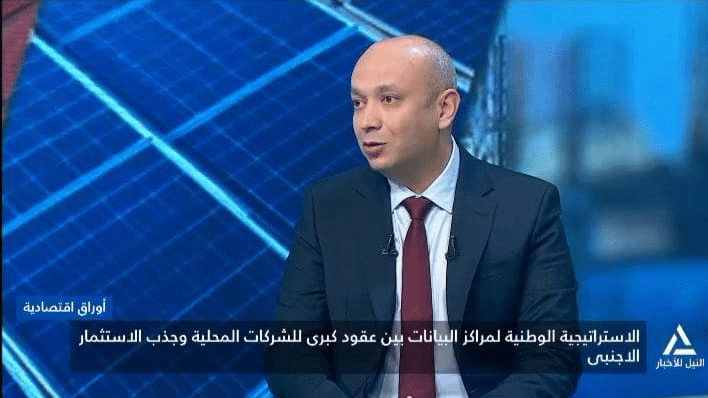
Hany Donia, a cybersecurity and artificial intelligence expert who holds a master’s degree in Cybersecurity Leadership and Operations from the University of San Diego, said the announcement of a $400 million investment to build a new data center in Egypt is a positive start for expanding digital infrastructure and supporting cloud computing and AI applications.
He explained that the announced $400 million reflects a serious intent to develop Egypt’s data center industry. Based on global average costs to build data centers, this level of investment could roughly indicate an operational capacity between 30 and 50 megawatts. The actual capacity, he noted, may vary depending on factors such as land costs, power infrastructure, cooling systems, server density, and the quality of equipment and supporting infrastructure.
Donia stressed that the 30–50 MW range is an indicative estimate based on global averages, not an official technical figure announced for the project.
Speaking on the “Economic Papers” program on Nile News, he said the project’s importance goes beyond building a new data center: it supports Egypt’s shift from being merely a transit route for data to becoming a hub that hosts, processes, and delivers digital services from within the country.
Egypt’s strategic geographic position and its extensive network of international submarine cables linking Asia, Europe, and Africa give it the opportunity to become an “international digital port.”
He likened the idea to the evolution of traditional ports—from mere transit points for ships to hubs for storage, logistics, and trade. Similarly, the greater economic value comes not from data merely passing through Egypt, but from hosting, processing, and operating cloud services and digital applications locally to serve the Egyptian and regional markets.
Donia pointed out that power is one of the biggest challenges for building and operating data centers, given their continuous electricity needs for servers, cooling, and supporting infrastructure.
He explained that the AI ecosystem rests on four main pillars: power, infrastructure (data centers), AI models, and the applications that rely on those models.
Solar power is an important option Egypt can rely on to support data center projects, especially given the country’s significant renewable energy potential. He also mentioned the expected role of nuclear energy—with the El Dabaa nuclear plant project—in providing stable, low-emission electricity, which is important for global companies operating in data centers, cloud computing, and AI.
Donia noted that the El Dabaa plant comprises four units of 1,200 MW each, for a total capacity of 4,800 MW, which could add a stable, low-emission source to Egypt’s energy mix in the coming years. He added that leveraging this capacity to attract data center investments will depend on the timing of each unit coming online, grid connection plans, and the availability of infrastructure to transmit power to project sites.
He also observed that global companies are increasingly focused on reducing carbon emissions and achieving net-zero goals, making the availability of renewable and low-emission nuclear power a competitive advantage for Egypt when attracting such investments.
However, Donia emphasized that energy availability alone is not sufficient. Data centers need multiple power sources to ensure continuous operation, prevent service interruptions, and meet agreed availability levels with customers. Facilities that serve clients across multiple markets cannot rely on a single power source; they require primary and backup sources, uninterruptible power supplies, generators, and other systems to maintain service during emergencies or maintenance.
During the interview he also explained the difference between public cloud and private or sovereign cloud models, saying the main distinction relates to the nature of the data, its sensitivity, and access requirements. Data in any country is typically classified as public, private, sensitive, or highly sensitive, and storage and processing environments are chosen accordingly.
Public cloud can meet a large share of companies’ and institutions’ needs by providing computing, storage, and application services with advanced security and operational standards. Private or sovereign clouds are used where higher levels of isolation and access control are required, or in sectors that handle sovereign or highly sensitive data—such as defense, interior ministries, and certain government institutions.
He stressed that cybersecurity is a fundamental element across all cloud computing models—public, private, or sovereign—and is not limited to one type of data center. Trust in data centers depends directly on their ability to protect information, manage user identities and access rights, encrypt data, defend against cyberattacks, and ensure service continuity.
Donia said the $400 million announcement is a positive step, but assessing the project’s real impact over the coming period should be based on a number of indicators: the actual operational capacity that comes online, the number of customers and hosted services, availability and cybersecurity levels, and the number of specialized jobs created. He concluded that Egypt has a real opportunity to leverage its geographic location, submarine cable network, diverse energy sources, local market, and human talent to move from being a mere data transit route to a regional center for hosting, processing, and delivering digital services and artificial intelligence.