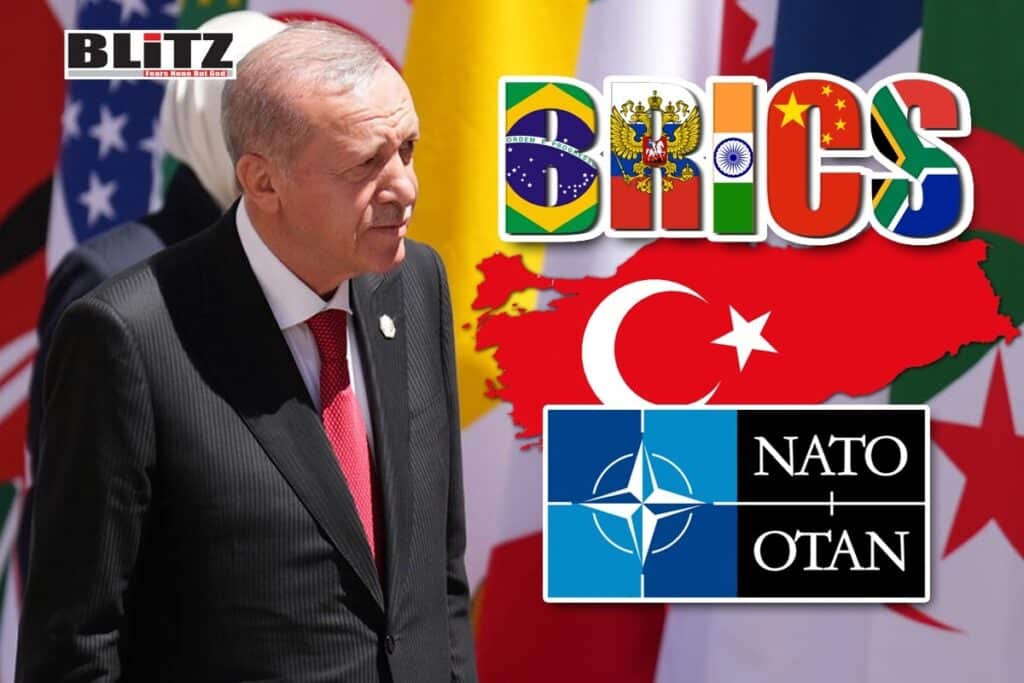












Türkiye, a NATO member positioned at the crossroads of Europe and Asia, has officially applied for full membership in BRICS. This application, as revealed by senior Kremlin official Yuri Ushakov, marks a notable shift in Türkiye’s foreign policy alignment. BRICS, an alliance initially founded by Brazil, Russia, India, and China in 2006, with South Africa joining in 2010, aims to challenge the Western-dominated global order. Türkiye’s move to join this bloc highlights its strategy to diversify its global alliances and enhance its influence on the international stage.
Under the leadership of President Recep Tayyip Erdoğan, Türkiye has pursued an independent foreign policy, striving to balance relationships with both Western and Eastern powers. Erdoğan has articulated a vision of Türkiye navigating a middle path between the two spheres, a strategy he reiterated last week by stating that Türkiye should “simultaneously” develop relations with both the East and the West. This approach reflects Erdoğan’s long-term ambition to bolster Türkiye’s geopolitical flexibility.
Türkiye’s aspirations to join the European Union (EU) have encountered significant obstacles. Negotiations, which commenced in 2005, have stalled due to concerns over Türkiye’s democratic backsliding, ongoing disputes with Cyprus (an EU member), and various human rights issues. This stagnation has prompted Türkiye to seek alternative alliances, and BRICS presents an appealing option for expanding its global influence.
BRICS is increasingly seen as a counterbalance to Western-dominated international institutions such as the United Nations, the International Monetary Fund (IMF), and the World Bank. The bloc’s members advocate for a more equitable global order and criticize the dominance of the US and its allies in shaping global economic and political structures. Türkiye’s interest in BRICS aligns with this narrative, as Erdoğan has frequently expressed dissatisfaction with Western influence, particularly within NATO and the EU.
Türkiye’s strategic goals resonate with BRICS’ mission to amplify the voices of major emerging economies. Erdoğan has voiced frustration with the global order, emphasizing the constraints imposed on Türkiye by Western powers. Recent years have seen Türkiye strengthen bilateral relations with Russia, despite divergent interests in regions like Syria, and enhance economic and diplomatic ties with China. This alignment underscores Türkiye’s pivot towards the East.
The recent expansion of BRICS, which now includes countries like Iran, Egypt, Ethiopia, and the United Arab Emirates, further enhances the bloc’s appeal. With additional nations such as Saudi Arabia and Azerbaijan expressing interest in membership, BRICS is poised to wield greater influence in global geopolitics. Russia, this year’s BRICS chair, has expressed strong support for Türkiye’s application. Ushakov confirmed that Türkiye’s bid will be reviewed in forthcoming BRICS meetings, signaling a potential expansion of the bloc.
China, another prominent BRICS member, has shown enthusiasm for deepening ties with Türkiye. Both nations share an interest in promoting a multi-polar global order and reducing Western dominance. Chinese investments in Türkiye, particularly through the Belt and Road Initiative (BRI), highlight a strategic alignment. Erdoğan’s government views these investments as vital for bolstering Türkiye’s economy, which has faced challenges such as high inflation and currency devaluation.
Joining BRICS could offer Türkiye several benefits. It would provide Ankara with increased diplomatic leverage in its dealings with the West, especially regarding stalled EU membership talks. Additionally, it would enhance Türkiye’s economic ties with some of the world’s fastest-growing economies, opening new opportunities for trade, investment, and infrastructure development.
However, Türkiye’s bid to join BRICS is fraught with potential risks. As a NATO member, Türkiye’s alignment with a bloc that includes Russia and China-both of which have strained relations with NATO-could provoke concerns within the alliance. Türkiye has often walked a fine line, balancing its NATO obligations while pursuing an independent foreign policy.
Tensions between Ankara and Washington have been heightened, particularly following Türkiye’s acquisition of the Russian S-400 missile defense system, which led to US sanctions. Erdoğan’s growing relationship with Putin, especially in the energy sector, has further strained US-Türkiye relations. Türkiye’s application to BRICS may be perceived as a move away from its traditional Western allies, potentially exacerbating existing tensions within NATO.
Moreover, Türkiye’s alignment with BRICS could raise questions about its commitment to democratic values. Critics argue that BRICS members, particularly Russia and China, are authoritarian regimes with questionable records on human rights and dissent. Erdoğan has defended his administration’s policies as necessary for stability, but his government’s actions against opposition figures and independent media have led to accusations of democratic regression. Joining BRICS might intensify these concerns and complicate Türkiye’s relationship with the EU.
Türkiye’s application to BRICS represents a significant juncture in its foreign policy. The country’s pivot towards the East and efforts to forge connections with emerging economies reflect broader shifts in global geopolitics. As the US and its allies contend with a rising China and resurgent Russia, countries like Türkiye are seeking to redefine their roles beyond traditional alliances.
For BRICS, Türkiye’s membership would be a notable addition, strengthening the bloc’s influence in the Middle East and Mediterranean regions. As global power dynamics shift towards a multi-polar order, Türkiye’s bid to join BRICS underscores its ambition to play a key role in shaping the future global landscape.
However, Türkiye faces a challenging balancing act. Navigating its NATO obligations while pursuing BRICS membership will require nuanced diplomacy, especially as tensions between the West and East continue to rise. Whether Türkiye can successfully manage this balancing act remains to be seen, but its application to BRICS marks a bold step in redefining its position in an increasingly complex world.
Please follow Blitz on Google News Channel
The post How will NATO respond to Türkiye’s BRICS application? appeared first on BLiTZ.