












Reading in English | Read in العربية (Arabic)
I fear for Lebanon, because my homeland is not well. Today, it is not only tired and devastated, but also drained and exposed. This fear is not fleeting, it is deep and painful, because it touches the essence of the homeland, not just its details. Lebanon has been, and still is, a victim of others’ wars on its land. Therefore, I fear for it from this harsh crowding of international, regional, and local interests, from these tensions that do not see it as a homeland for us, but as a battleground to settle their scores at the expense of the Lebanese people.
Lebanon is not a field for others’ wars nor a card for settling external accounts. When conflicts are imposed on it that do not arise from its interest, the homeland becomes the first loser, and its sovereignty and existence are endangered, while the Lebanese people are the greatest victims, paying a heavy price in their blood, their livelihoods, their security, their stability, and the future of their children.
I fear for Lebanon, because my homeland is undergoing an existential test of its essence as a state and a nation. For the first time, I feel a disturbing sense and an overwhelming feeling the true fear for Lebanon. It is not fear of a passing war that we have learned how to survive, nor of a crisis we are used to overcoming, nor of an occupation that we resisted and confronted with unwavering will until the occupier was forced to leave. Rather, it is fear of a time in which the homeland itself seems threatened in its meaning and existence. It is a fear like a silent pain that lives in the heart and does not leave, as if this country, which has always stood on the edge of the abyss, is today facing a deeper uncertainty, greater ambiguity, and an existential danger.
I fear for Lebanon, I fear that Lebanon may not remain as we have known it. This feeling is no longer individual or temporary, but a collective feeling lived daily by all Lebanese people. Everyone feels that things may move toward the worse, without clarity of direction or the ability to predict what will happen in the coming days, because decision-making in Lebanon is not fully sovereign, but is influenced by external forces that interfere in political and security affairs, limiting the Lebanese state’s ability to take independent decisions.
I fear for Lebanon, which is today living one of the harshest stages in its history, as it stands at a sharp and dangerous crossroads, where the decision of war and peace is not in the hands of the state and the army. Weapons are uncontrolled in the hands of Hezbollah, which is engaged in ongoing wars driven by external Iranian interests. The first confrontation was under the title of supporting Gaza, followed by another round motivated by retaliation for the killing of Ali Khamenei. These are wars that do not reflect Lebanon’s interest; we have no part in them. In this situation of dual weapons and decision-making, the Lebanese people are paying the price for wars they did not choose: endless wars that have led to the displacement of more than one million Lebanese, caused massive destruction, left thousands dead, weakened state institutions, collapsed the economy, reduced trust between the state and the people, and increased the feeling of insecurity.
I fear for Lebanon. I fear for its south from Israeli aggression that has destroyed its villages and leveled them to the ground, soaking its soil with the blood of its martyrs. I fear for the features of homes that have disappeared, buried beneath years of hardship and exile, and a lifetime’s work lost among the rubble. I fear for its people who have been displaced into the unknown, carrying their keys and moving into endless uncertainty in the hope of returning. However, a real fear is entering their hearts that this displacement may not be temporary, but the beginning of a long absence, where departure turns into permanent residence and the hope of return is lost, especially after Israeli forces have advanced into southern Lebanon. What is happening is no longer hidden but declared openly, as southern Lebanon has been turned into a buffer zone and emptied of its people, with attempts to change borders and move the Blue Line to the Litani River.
I fear for the Christians of the south, the true resisters who remained in their villages, rooted in their land, insisting on staying in their homes despite the surrounding danger and difficult living conditions. They are besieged, trapped between two merciless forces, with no refuge but God’s mercy. The Lebanese state has left them after the army withdrew, and their villages have been cut off by the destruction of bridges and roads. These are not just roads that were cut, but lifelines that were severed, as if the heart was separated from the body, isolating them from the rest of Lebanon not only geographically but also in life and humanity, leaving them alone to face an unknown fate.
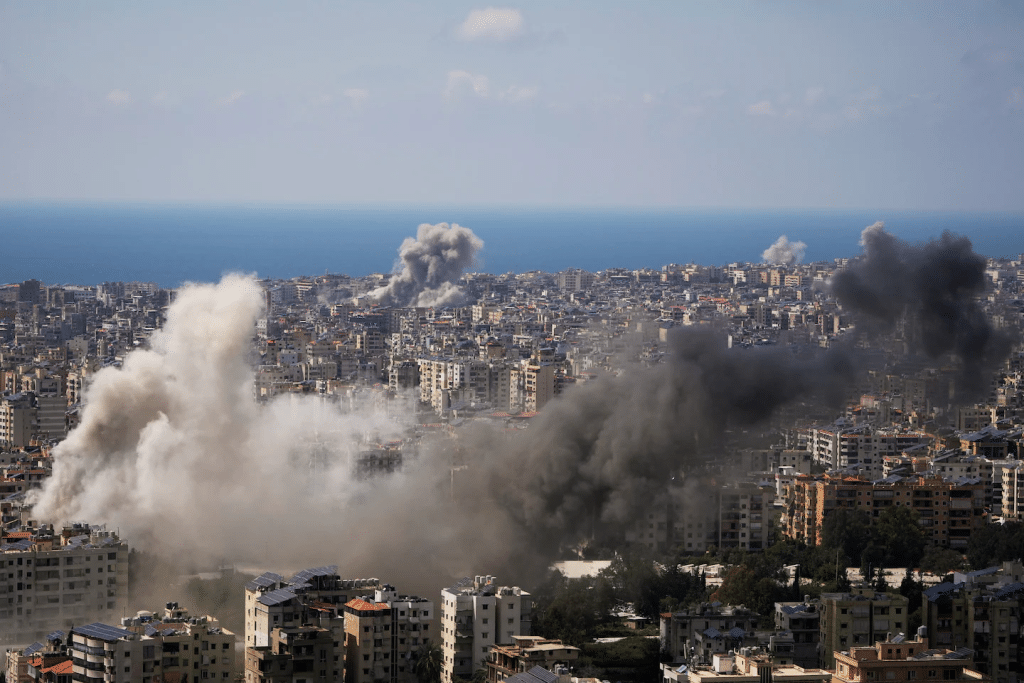
I fear for Lebanon in all its regions. Its east is also exposed to intense Israeli airstrikes, among the most severe. Its north is threatened by possible Syrian military intervention. Beirut is subjected daily to heavy bombardment aimed at turning it into another Gaza, and it also faces ongoing threats to its civil peace due to attempts to destabilize the country and drag it into chaos, especially after the failure of a plan to overthrow the state.
I fear for Lebanon. Even its calm sea has become turbulent under the presence of warships and rocket fire, and its clear sky is no longer blue as we knew it, but filled with military drones that block the sunlight. There is no longer a safe place, no protected roof anywhere in Lebanon, and no peaceful civilian safe from the danger of death. It is as if reassurance has been broken and safety has disappeared, leaving the homeland exposed to continuous pain, fear, and anxiety.
I fear for Lebanon because I love it and know it well. I know its high mountains that do not bow, its valleys that echo with prayer through its saints who blessed its land, reminding us that Lebanon has never been just a country but a message of life. I know its abundant rivers, especially the Litani River, which has historically been an important water resource and a subject of regional interest and ambition, particularly from Israel. I know its resilient people who are attached to their land and love life, people who have suffered but never abandoned their love for it. I fear that all this may become a memory, or that it may change silently while we watch without being able to do anything.
I fear for Lebanon, this homeland that no longer knows calm or is given a moment of peace. Yet throughout its history, it has shown a remarkable ability to endure and rise again. However, the truth that cannot be ignored is that resilience this time is more difficult, and the cost may be greater. This country is not just land, but a story of resilience told through time. It has gone through hardships, faced aggression, and stumbled many times, but it has never fallen.
But I will defeat my fear. I will not remain a prisoner of my anxiety despite all the darkness. My strong faith in my homeland gives me stability and belief that Lebanon will remain, because it has a people who believe in life and peace despite everything and hold on to hope. Lebanon will remain the country that has turned pain into strength and ruins into a new beginning, like the phoenix. Every time the world thought it had faded, it rose again from its ashes stronger and brighter, as it has always been a homeland that rises from the ruins and writes its story of victory again and again.