











Reading in English | Read in العربية (Arabic)
The Libyan crisis has evolved beyond being merely an internal power struggle or a disagreement among competing political institutions. It has transformed into one of the most complex geopolitical crises in the Mediterranean region, where security considerations intertwine with economic interests, and the calculations of regional powers intersect with the priorities of international actors. This intricate web makes the future of Libya contingent upon the various parties’ ability to forge a governance formula that can conclude a transitional phase that has persisted for over a decade.
Consequently, the ongoing discussions within political and diplomatic circles have shifted from the traditional question of who governs Libya to a deeper inquiry about how to rebuild the state. This involves determining who holds the political and security legitimacy to manage this process and whether the focus should first be on reshaping power or on returning to the will of the people through elections.
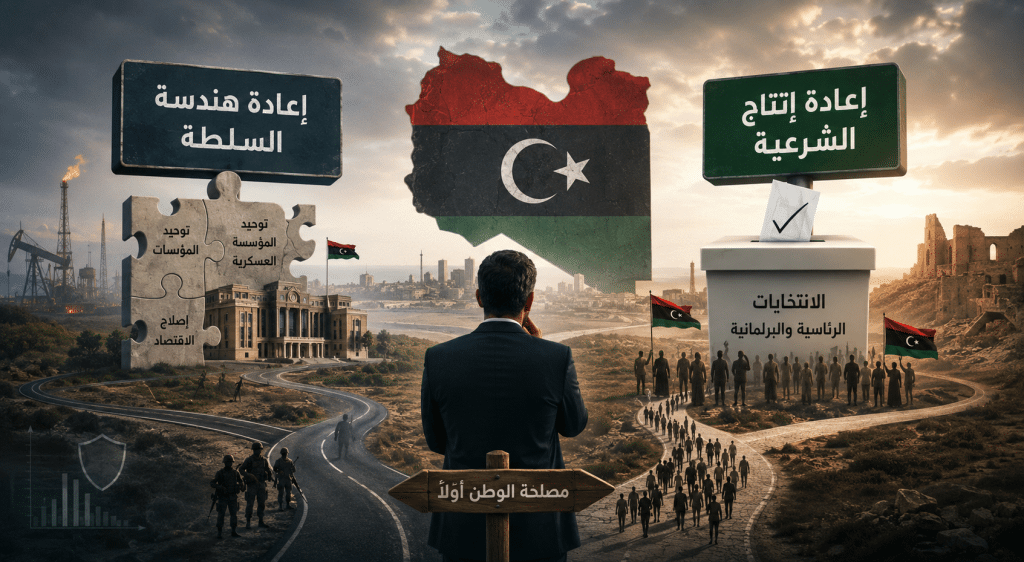
Recent debates reveal two distinct perspectives on managing the Libyan situation, representing not just a difference in methods but also contrasting political philosophies about the nature of the crisis itself.
The first perspective assumes that the Libyan crisis is no longer just a matter of electoral legitimacy; it has become a structural crisis affecting the nature of existing institutions and their ability to perform state functions. Therefore, it argues that merely reproducing current institutions through elections may not be sufficient to resolve the division. This requires establishing a new executive authority capable of unifying political and military decisions and reinstating state authority throughout Libyan territory.
In contrast, the second perspective contends that any attempt to reshape power outside the framework of popular mandate will lead to an extension of the transitional phase and the creation of new institutions that face the same legitimacy crisis as the current ones. Hence, the most viable and sustainable route involves directly holding presidential and parliamentary elections, as these are seen as the only source capable of endowing the forthcoming political system with a legitimacy that is difficult to challenge.
This divergence highlights that the core of the disagreement is not about which individuals may hold high offices but pertains to the type of Libyan state envisioned for the coming years. Some argue that the state first needs a strong authority to enforce stability before seeking electoral legitimacy, while others believe that legitimacy is the prerequisite for stability, asserting that any authority lacking popular endorsement will remain vulnerable, regardless of its executive capabilities.
Many observers suggest that this debate also reflects differing interpretations of the Libyan experience since 2011. The past years have demonstrated that political agreements alone have not sufficed to end the division, while also revealing that elections cannot succeed in a fragmented security and institutional environment. Thus, each side relies on aspects of the Libyan experience to justify its vision for the future.
Moreover, the most significant dimension is that Libya’s future is now shaped not only within its borders but also as a critical element in regional security equations, energy security, irregular migration, and military balances in the Mediterranean. This reality has granted international powers an increasing role in defining the contours of the next phase.
In this context, it is unsurprising that international perspectives on managing the crisis vary. For some actors, stability might mean a unified executive authority capable of making swift decisions, ensuring ongoing energy production, and protecting security interests. Conversely, others argue that true stability can only be achieved through institutions that derive their legitimacy from the ballot box and enjoy broad popular recognition.
This variation in approaches does not necessarily denote a complete contradiction in objectives but rather reflects a difference in prioritizing goals. Everyone speaks of stability, expresses support for Libya’s unity, and emphasizes the importance of building state institutions; however, disagreements arise regarding the path to achieve these objectives.
The military institution remains one of the most sensitive issues in any future vision. Any political process cannot ignore the reality that unifying the military is a fundamental condition for establishing a stable state. Conversely, any attempt to reorganize the military landscape outside a broad national consensus may deepen the division rather than resolve it.
Additionally, the Libyan economy continues to be a decisive factor in determining the chances of success for any settlement. While the state possesses considerable resources, it suffers from administrative and institutional fragmentation that directly impacts the effectiveness of managing these resources. Therefore, any political project that fails to present a clear vision for reforming and unifying economic institutions will find itself unable to achieve stability, even if it addresses part of the political crisis.
The social dimension of the crisis cannot be overlooked either. The prolonged transitional period has eroded the trust of the Libyan citizenry in the political class and the institutions’ ability to produce real solutions, making the restoration of public confidence one of the most challenging tasks facing any new authority, regardless of its form or source of legitimacy.
Thus, the real challenge lies not in redistributing positions or changing names of officials but in redefining the relationship between the state and society based on the rule of law, institutional independence, transparency, accountability, and equal opportunities. These principles form the foundation for any political system capable of enduring.
Comparative experiences in post-conflict countries demonstrate that political agreements may halt conflict but do not build a state. Elections can provide legitimacy but do not automatically produce effective institutions. Lasting stability requires a delicate balance between legitimacy and efficiency, as well as between political consensus and institutional reform.
Therefore, Libya’s future will not only be determined by the nature of the settlements reached in the coming months but also by the ability of these settlements to evolve from agreements among elites into a new national contract that allows Libyan citizens to feel like partners rather than mere recipients of outcomes.
The greatest challenge facing Libya today lies not in choosing one of the prevailing paths but in avoiding a return to the cycle of temporary solutions that postpone the crisis without addressing its root causes. States do not stabilize merely when governments change but when the rules of power transition are clear, respected by all, and when institutions are stronger than individuals. True national interest must take precedence over factional, regional, and international calculations.
Hence, any political initiative, regardless of the support it receives, will not achieve stability unless it successfully builds a broad Libyan consensus that transforms the state from a battleground for power balances into a state of institutions governed by sovereignty and law. Political history teaches us that externally imposed stability may temporarily contain a crisis, but it cannot alone lay the groundwork for sustainable peace. True peace begins when legitimacy arises from within, and the state becomes a unifying framework for all its citizens, without exception.