












Reading in English | Read in العربية (Arabic)
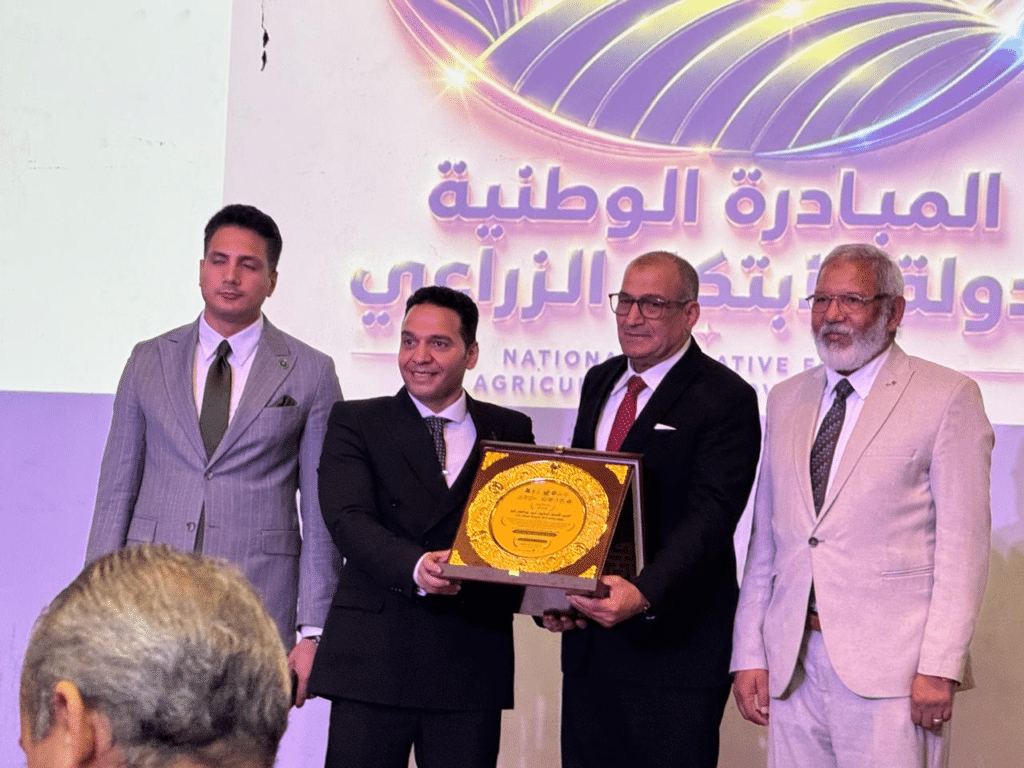
The Supreme Organizing Committee of the Agricultural Innovation Conference from Idea to Implementation honored Dr. Ahmed Rajeh, Chairman of the Board of Khairat Rajeh Agricultural Company, an expert in sustainable agriculture and a member of the Export Council for Agricultural Crops, during the announcement of the results of the Agricultural Innovation for Sustainable Development 2026 competition under the umbrella of the National Initiative for the State of Agricultural Innovation.
The ceremony was attended by several university presidents, representatives of international organizations, deans of agricultural faculties from Benha, Zagazig, South and North Sinai, and King Salman International University, members of the judging panel, as well as many participating students and researchers. The conference aims to discover agricultural talent and ideas.
Dr. Ahmed Rajeh stressed that agriculture is a fundamental pillar for achieving food and social security, not merely an economic activity. He emphasized its deep connection to the history and identity of the Egyptian people, noting that Egypt was the cradle of agriculture from which the world learned.
Speaking on the program “Economic Papers” on Nile News channel, Rajeh said that revitalizing the agricultural sector requires large investments and broad adoption of modern technology to boost productivity, conserve water, and reduce operating costs. He affirmed that the future of agriculture depends on scientific solutions and innovation.
He explained that his passion for agriculture led him to invest in the sector despite his medical background, and that agriculture holds great promise if given the necessary resources. He pointed out that Egyptian farmers face many challenges, foremost among them the small size of land holdings, which limits their ability to adopt mechanization and modern technologies.
Rajeh praised the state’s efforts in land reclamation and recovery and the expansion of cultivated areas, viewing these projects as important steps toward strengthening food security and achieving self-sufficiency. He noted that expanding the cultivation of strategic crops, especially cotton, over large areas helps raise productivity and enables more efficient use of aircraft for crop spraying.
He confirmed that solar energy has become one of the most important solutions supporting sustainable agriculture, explaining that his farm relies on a solar power plant with a capacity of up to 3 megawatts to run wells and pumps, reducing dependence on conventional fuels and lowering production costs.
Rajeh said his farm implements an integrated model combining fish farming and crop production, where nutrient-rich water from fish ponds is reused to irrigate crops. This approach maximizes water use, reduces the need for chemical fertilizers, and enhances environmental sustainability.
He pointed out that the goal of aquaculture is not only fish production but also recycling water and taking advantage of the nutrients it contains, thereby reducing consumption of water, energy, and fertilizers.
Rajeh emphasized the importance of recycling agricultural waste and turning it into economic value. He said he uses algae and bacteria to improve soil fertility and reduce reliance on chemical fertilizers, and he supports young people in launching small projects to produce organic compost from agricultural residues.
He reported success in converting some plant residues into high-nutrition feed for livestock on his Wadi El Natrun farm, which houses about 650 head of cattle. He established a specialized factory on the farm to apply the latest technologies in this field.
Rajeh said Egypt has significant opportunities to expand date production and praised the state’s move toward planting high-quality international varieties such as Medjool, Barhi, Sukkary, and Khodry. He noted that palm residues are now used in various industries, including the production of biopesticides and animal feed, which raises the sector’s economic value.
He also stressed his commitment to supporting young people and innovators in agriculture, asserting that Egyptian minds can provide innovative solutions to develop the sector and boost production.
Regarding food security, Rajeh called for rationalizing wheat consumption, changing citizens’ dietary culture, encouraging a return to home production of some food items, and expanding reliance on healthy, diverse food alternatives to ease pressure on wheat consumption.
He concluded by emphasizing that population growth poses a major challenge to the food system. He insisted that investment in sustainable agriculture, applying modern technology, and maximizing the use of natural resources is the best path to secure the future of food. He affirmed that agriculture will remain the foundation of nation-building and that food is the first line of defense for a country’s stability and development.