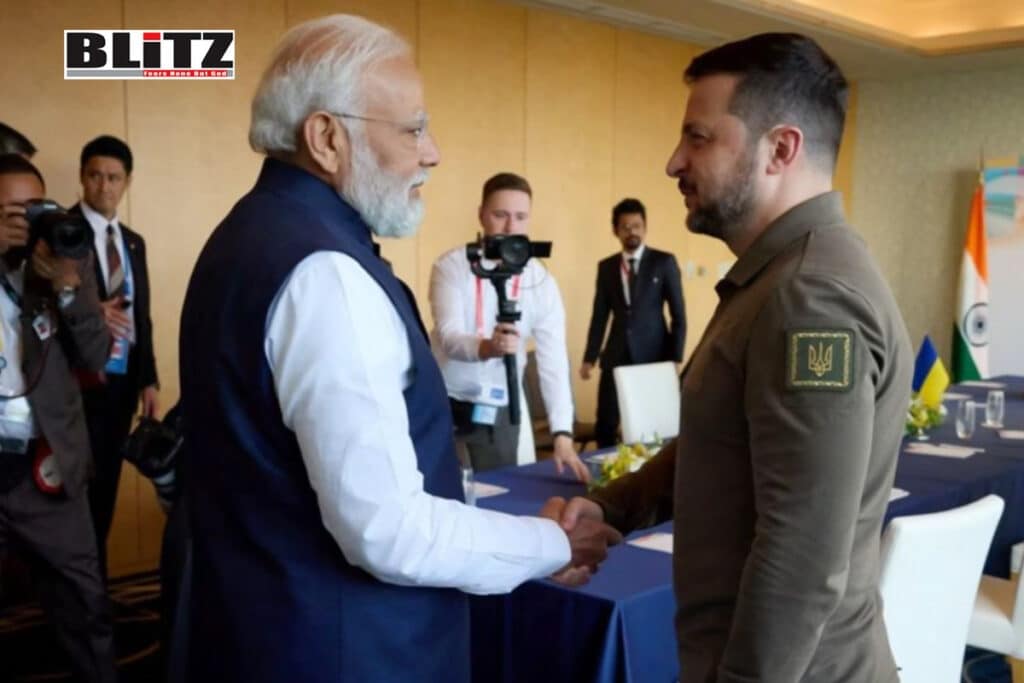












Prime Minister Narendra Modi’s recent visit to Kiev, which lasted seven hours, was met with much anticipation, but it ultimately proved to be a less impactful event than many had hoped. The visit, which was heavily hyped by Indian corporate media and American diplomats in Delhi, was seen by some as a potential turning point in India’s stance on the Ukraine conflict. However, the outcome of the visit demonstrated India’s commitment to its carefully constructed policy of positive neutrality, a stance that has been in place since the onset of the conflict in 2022.
India’s approach to the Ukraine conflict is a complex blend of objectivity, creativity, and self-interest, guided by a number of key principles. These include national interest, adherence to international law and the UN Charter, non-interference in the internal affairs of other nations, the indivisibility of inter-state security, and the principle of peaceful coexistence. This policy is designed to maintain India’s strategic autonomy and avoid being drawn into the geopolitical power struggles between major global players.
India’s position on the conflict is nuanced. On one hand, it recognizes the violation of Ukraine’s territorial integrity by Russia. On the other hand, it is aware of the broader geopolitical context, in which Ukraine has become a de facto proxy for American interests in the region. Reports of numerous CIA stations operating along the Ukraine-Russia border have not gone unnoticed in Delhi, which understands the complexities of inter-state security dynamics, particularly in regions with a history of conflict and external interference.
The media buildup to Modi’s visit to Kiev was unprecedented. Indian corporate media, possibly influenced by American diplomats, portrayed the visit as a potential shift in India’s Ukraine policy. This narrative was eagerly picked up by the American lobby in India, which has long sought to align Indian foreign policy more closely with Western interests. The result was a media frenzy that suggested Modi’s visit would mark a departure from India’s policy of positive neutrality.
However, the reality of the visit was far more subdued. Despite the media hype, Modi’s visit did not signal a shift in India’s policy. The joint statement issued at the end of the visit, along with subsequent press briefings by Indian officials, made it clear that India remains committed to its neutral stance. Modi did not endorse Ukrainian President Volodymyr Zelensky’s Peace Framework, instead reiterating the need for “sincere and practical engagement” between all stakeholders to find “innovative solutions” that would lead to the restoration of peace.
This carefully worded statement was significant. The phrases “sincere and practical engagement” and “innovative solutions” were seen as a veiled reference to the need for Western powers to stop fueling the conflict and consider compromises, including potential territorial concessions, that would address Russia’s concerns about Ukraine’s NATO membership. This stance underscores India’s refusal to be drawn into the binary narrative of the conflict as presented by the West.
The influence of the American lobby in India has been a significant factor in the media coverage of Modi’s visit. This lobby has long sought to align India’s foreign policy more closely with Western interests, particularly in relation to the Ukraine conflict. However, India’s commitment to its policy of positive neutrality has prevented this alignment from occurring. Instead, India has maintained a delicate balance, refusing to condemn Russia outright while also avoiding any actions that could be seen as undermining its relationship with the West.
India’s relationship with Russia is a key factor in this balancing act. The two countries have historically warm relations, particularly in the areas of defense cooperation and energy trade. Russia is the largest supplier of military equipment to India, and Russian oil accounts for a significant portion of India’s energy imports. Bilateral trade between the two countries is booming, and this economic relationship is unlikely to be jeopardized by the Ukraine conflict.
The American lobby’s attempts to influence India’s Ukraine policy have not gone unnoticed in Delhi. Indian policymakers are aware of the risks posed by any shift in policy that could undermine India’s strategic autonomy. This awareness was reflected in the joint statement issued during Modi’s visit to Kiev, which emphasized the need for all parties involved in the conflict, including Western powers, to engage in sincere and practical efforts to restore peace.
Zelensky’s reaction to Modi’s visit was one of disappointment and frustration. The Ukrainian leader, who had hoped for a shift in India’s stance, expressed his discontent in a media outburst following Modi’s departure from Kiev. Zelensky’s comments were seen as an attempt to pressure India into taking a more definitive stance against Russia. However, this approach is unlikely to succeed, given India’s commitment to its policy of positive neutrality.
The relationship between India and Ukraine is likely to remain complicated in the near future. While India has no interest in antagonizing Ukraine, it is also unwilling to compromise its strategic relationship with Russia. Zelensky’s suggestion that he would like to visit India to connect with the Indian people directly may be an attempt to build support within India for a more pro-Ukraine stance. However, such efforts are unlikely to sway Indian policymakers, who are deeply aware of the importance of maintaining a balanced and independent foreign policy.
Modi’s visit to Kiev, despite the media hype, did not mark a significant shift in India’s Ukraine policy. Instead, it reinforced India’s commitment to its carefully constructed stance of positive neutrality. This policy, which is guided by principles of national interest, international law, and strategic autonomy, has allowed India to navigate the complex geopolitical landscape of the Ukraine conflict without being drawn into the power struggles between major global players.
India’s relationship with Russia, which is based on historical ties and mutual interests, remains a key factor in its Ukraine policy. Despite pressure from the American lobby and Ukrainian leaders, India is unlikely to abandon this relationship or compromise its strategic autonomy. As the conflict in Ukraine continues, India’s approach will likely remain one of cautious engagement, focused on finding peaceful and pragmatic solutions to the crisis.
Please follow Blitz on Google News Channel
The post Modi’s Kyiv visit: India maintains neutral stance on Ukraine appeared first on BLiTZ.