













Reading in English | Read in العربية (Arabic)
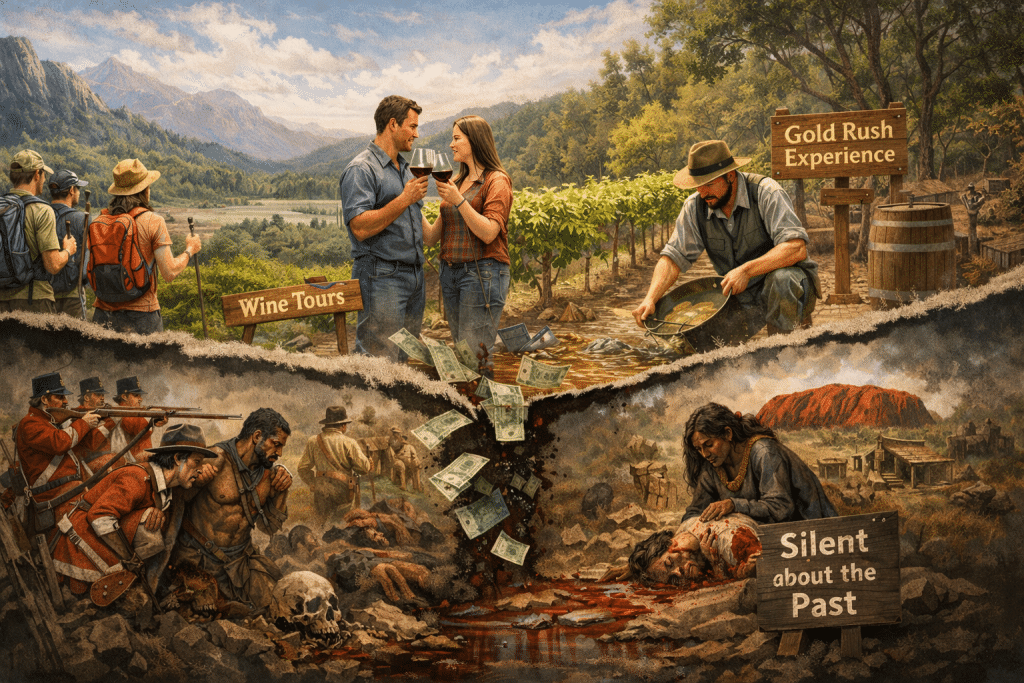
How much would you pay to hike around Tasmania’s beautifully pristine forests and mountains?
What would you give to sample the Barossa Valley’s finest vintages straight from the source?
What are you willing to do to go to the old Bathurst goldfields where paying tourists can recreate the experience of fortune finding by the sweat of one’s brow?
These seem like given questions but the truths behind these sightseeing places are seldom comforting.
Would people still hike Tasmania if they knew that, in four years’ time, the island state will mark 200 years since the execution of the infamous Black Line campaign?
Would they still imbibe Barossan wine grown from land seized from local Indigenous groups?
And will people want to pan for gold from soil drenched in Indigenous blood, spilt by invaders out to tame the untamed by the sweat of their imperialist brows?
Truth in the eye of the tourist
Truth and profit.
Rarely do the two work in tandem.
Least of all in the Australian tourism industry. This cornerstone of the national economy, maybe even the national identity, thrives off immense seasonal volume in order to operate the way it does. The industry’s long-term strategy is acquiring repeat business, cultivated by delivering a carefully curated feel-good experience.
And that’s all Australia’s tourism industry really is about. The most reductive description one could make regarding tourism is distilled into three words: creating feel-good.
After all, why do American retirees need to know about successive federal governments’ 25-year treatment of maritime asylum seekers when enjoying the Great Barrier Reef? What good will it do for businesses when British honeymooners learn about Cardinal George Pell’s abuses while admiring Saint Mary’s Cathedral? Why risk harming profit by telling the truth?
The reality is, tourism often ignores, obfuscates or manipulates the historical truth in favour of maintaining profit. Dark truths and ugly histories are quietly buried in the name of revitalising the economy or touting national prestige or some other generic cause that engenders some collective responsibility on society whilst ignoring the monied interests powering this industry. Every facet of tourism is geared towards making sure the visitor enjoys their time.
The problem with turning a blind eye to atrocity in tourism is that it’s a two-way effort. Rarely do the majority of tourists fork out hundreds or thousands of dollars for a history lesson, after all; they pay to enjoy a new experience, plain and simple. How are they at fault?
Well, if one were to continue that line of argument – that the figure of the tourist occupies a blameless position in this transaction of consuming enjoyment – you would have to ignore their ethical and moral agency. Ignorance of history is a poor defence for anyone.
However, if we are criticising the tourist’s actions, we are then presented with a larger ethical problem when considering what this says about the people who actually live in Australia. The places we live in, the clothes we wear, the food we eat, the very air we breathe – even the mere act of writing this article – are all actions made possible because of atrocities committed against the Indigenous people of Australia.
That ethical conundrum can be for another article. For now, let’s focus on two realised examples of the atrocity-blind tourism I’m talking about.
Climbing Uluru
Uluru’s history during the settler period is perhaps the most infamous example of touristic intransigence encouraged by an industry driven towards earning profit.
What was remarked as an unusual yet ultimately insignificant geological sandstone oddity by colonial settlers soon became a tourist destination as the nation’s infrastructure penetrated deep into the interior. The site was taken by the Northern Territory government and only returned to the indigenous Pitjantjatjara people in 1985 (with the caveat that it would be leased for 99 years back to the Commonwealth).
The reason why it makes this article is because the site’s stony exterior used to be climbed by tourists. However innocuous the act might have been intended by visitors, every climb was a violation of local Aboriginal law and custom. Tourists would never be allowed to freely climb Lakemba Mosque or Parliament House or the Shrine of Remembrance so, logically, why would the same be allowed for a significant site like Uluru?
It’s quite telling that tourists barred from climbing Uluru on the 26th October 2019 by the site’s management only after increasingly egregious acts took place like strip teasing.
The historical permissibility for tourists being allowed to climb Uluru in contravention of and without regard for Aboriginal interests reflected a cultural double standard empowered by profit from the tourism industry. The tourist and the tourism industry are both at fault here. The former is driven by a mindset of experiential consumption, using wealth to do something without suffering from substantial tangible consequences, while the latter recognises the desirability of this niche market and indulges touristic inclinations.
My Beautiful Dark Twisted Adelaide
On my second example, it is with supreme irony that I must implicate myself in this argument: I am a perpetrator to the activities of this industry.
My visit to Adelaide was the impetus in writing this article. In addition to touring parts of the city, I was also able to visit some regional areas like Hahndorf and the Barossa Valley. I joined a tour group that sampled the local food and businesses whilst being regaled with the history of the area, clearly prided upon by its locals (if not for pride, then certainly for economic reasons).
However, there was one rather tinselled claim being hammered home to every tourist present including me: South Australia was explicitly founded without convicts.
I did some digging and, technically speaking, the penal colony of New South Wales initially claimed close to two thirds of the continent, which just so happened to include modern day South Australia.
Ignoring this (as I’m sure many already have), no practical effort was made to impose a British settlement on the land occupied by the city of Adelaide until the 1830s. And yet death still followed for the Aboriginal people of South Australia. They were dispossessed; their customs ignored or disrespected; their wellbeing turned inequitable in favour of British settlers.
I was pointedly told about how convictless South Australia was but rarely was the history of displacement talked about, let alone broached. Yet I ate good food, drank good wine and largely enjoyed myself free of any compunctions about not seeking out the full, nuanced reality of things.
I could not even give you – dear readers – the name of the original Indigenous groups inhabiting the places I visited. Their onomastic existence, it seems, was unworthy of a mention in my tour of Adelaide.
The Future of Tourism
So which should win? Truth or profit? Tourism in Australia isn’t likely to die anytime soon (unless another COVID-style lockdown affects the world).
Can tourists still keep their morality, convictions and beliefs intact knowing these things? Maybe some sort of change can happen down the track but it will face immense political, economic, industrial, social and ultimately personal opposition from everyday people who have internalised the acceptability of tourism’s current state. Reforming a key industry of Australia’s economy and identity is no easy task nor is it one that might be wholly accomplished in the coming generations.
A solution must come only after years of evidence have been collected, rigorous and open scholarly debates held about tourism’s future and specialists, intellectuals and stakeholders pooling their knowledge – free of industry influence – to create something new which properly acknowledges the truth whilst delivering a tourist experience.
Maybe then I won’t feel so bad after the feel-good.