












South Sudan’s National Elections Commission has confirmed that the country will proceed with its first general elections in December 2026, despite the absence of a new population census.
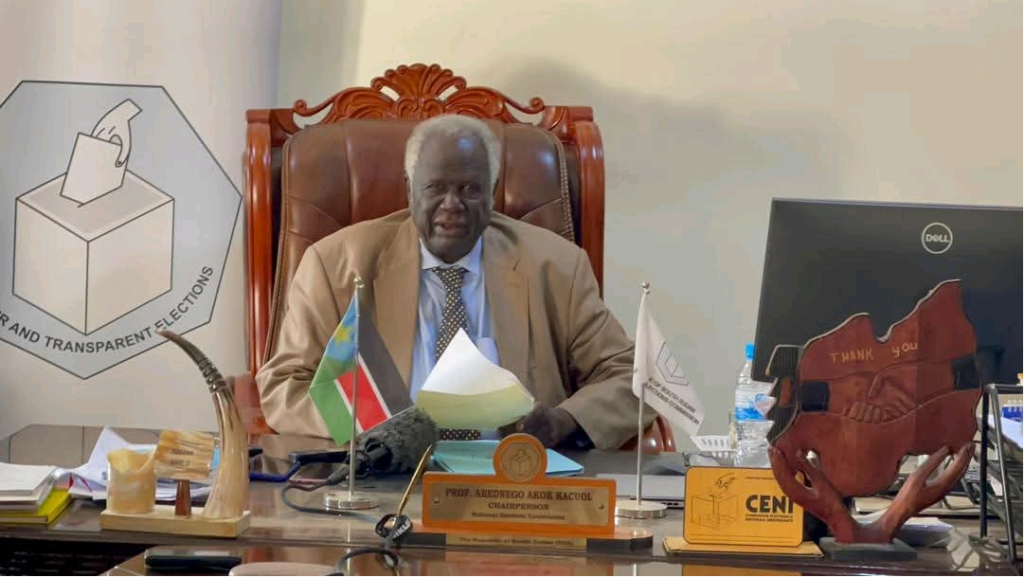
Speaking to the media, Abanego Akok, Chairperson of the South Sudan National Elections Commission, said the commission is ready to conduct the polls using data from the 2010 population census. He acknowledged the challenges posed by the delayed census but stressed that these should not prevent the country from moving forward with democratic elections.
Professor Akok emphasised that holding elections within a reasonable timeframe is essential for national stability and democratic transition. While recognising logistical and political obstacles, he argued that postponing elections indefinitely would undermine the peace process and the country’s democratic aspirations.
Opposition from SPLM-IO
The announcement has drawn strong opposition from the Sudan People’s Liberation Movement‑In Opposition (SPLM-IO), which argues that conditions are not yet suitable for elections. The party has called for the release of its leader, Riek Machar, along with seven other individuals accused of crimes linked to violence in Nasir County. Those accused have denied the charges in court.
Despite its objections to the election timeline, the SPLM-IO has reiterated its commitment to peace, maintaining that key political and security issues must be resolved before the country can move towards credible elections.
Calls for Security Sector Reform
South Sudan was initially expected to hold elections in December 2025, but the vote was postponed to 2026 due to ongoing disagreements among political parties over the implementation of key provisions of the peace agreement. Years of conflict and repeated delays in reforms have continued to hinder progress.
The Reconstituted Joint Monitoring and Evaluation Commission (RJMEC) has renewed its call on the transitional government to prioritise the unification of armed forces. The body stressed that security sector reform is critical to ensuring a peaceful and credible electoral process, urging all parties to demonstrate genuine commitment by completing the unification of forces before the election period.
RJMEC warned that failure to address these issues could jeopardise the stability required for South Sudan’s long-awaited democratic transition.