












Reading in English | Read in العربية (Arabic)
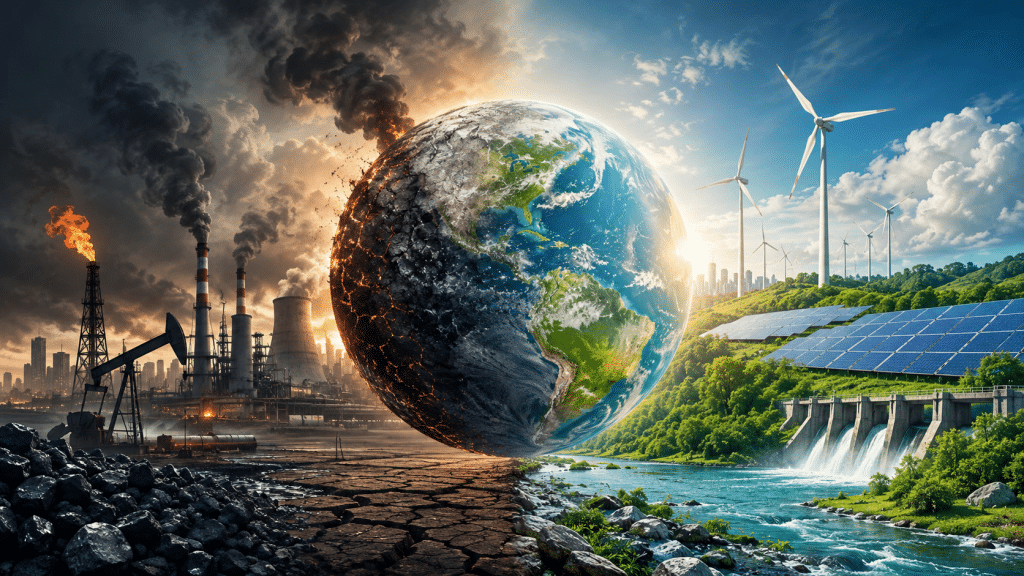
Concerns about climate change, driven by fossil fuel emissions, have prompted a push to limit the expansion of oil and gas usage while encouraging greater investment in renewable energy sources. However, the continued demand for oil and gas, especially in the wake of the U.S.-Israeli war’s implications for Iran, underscores the ongoing importance of traditional energy. The energy transition is a gradual and long-term process that must be managed in an organized and balanced manner to meet the needs of the global economy and ensure supply security.
### Rapid Growth of Renewable Energy
The transition to renewable energy has been slow, even as the contribution of renewables to the global energy mix steadily rises, becoming central to national energy strategies. Renewable energy currently accounts for approximately 34% of global electricity generation, with production from these sources reaching around 692 gigawatts in 2025, a 15.5% increase from the previous year. Yet, their share of total final energy consumption in sectors like transport, heating, and industry remains below 18%.
It is important to note that this rapid growth in renewable energy is insufficient to meet the additional demand for energy, nor does it significantly increase its share in the overall energy mix. Despite advancements in technology and tools that allow renewables to assume a larger role in the future energy landscape, they still require more time to develop the necessary infrastructure and storage technology to independently meet energy demands.
### The Central Role of Traditional Energy
In contrast, fossil fuels—coal, oil, and gas—maintain their pivotal role in the global energy system due to a combination of economic, geopolitical, and technological factors. Key among these are population growth, ongoing urban expansion, and the rising needs of the industrial and transportation sectors, along with increased electricity consumption in emerging economies.
Additionally, the oil and gas sectors benefit from one of the world’s most extensive infrastructures, which includes fields, pipelines, refineries, storage facilities, and ports. This infrastructure supports complex supply chains and transport networks that facilitate the flow of over 100 million barrels of oil per day from extraction sites to end consumers, providing a strategic advantage that renewables have yet to fully match.
The market value of logistics services dedicated to oil and gas supply chains is approximately $234 billion, expected to exceed $400 billion by 2035. The overall value of the energy sector, encompassing production, refining, and distribution, runs into trillions of dollars, with the global market for this sector exceeding $8.7 trillion.
The rapid proliferation of artificial intelligence technologies and the boom in data centers have led to unprecedented levels of electricity consumption, making it clear that renewable sources alone cannot meet the growing global energy demand.
Despite many countries striving to phase out coal-fired power plants, the Russian-Ukrainian war in 2022 prompted a return to coal for electricity production and delayed the dismantling of remaining reactors.
Interestingly, renewable energy projects, particularly solar and wind, have increased the use of natural gas in electricity generation. Gas has become vital for maintaining grid stability by providing essential load energy and preventing widespread interruptions in renewable energy supplies, rather than being sidelined. This is especially significant given that the cost of using gas remains lower than that of storing excess renewable energy.
While the growing use of electric vehicles is gradually reducing demand for road transport fuels, it does not eliminate the need for oil in producing fuels for airplanes, ships, and heavy trucks, nor does it diminish its role in the production of plastics, fertilizers, chemicals, and other heavy and petrochemical industries.
### Challenges Facing Renewable Energy
The transition to renewable energy faces numerous challenges, chief among them are high initial investment costs, production fluctuations linked to climatic conditions, and a lack of electrical grid infrastructure. There is also an urgent need for practical energy storage solutions, alongside obstacles related to land availability.
### Cautions on Energy Transition
Rapidly abandoning traditional sources could lead to crises in pricing and supply, while a slow transition to renewables exacerbates environmental and climate risks. The real challenge for nations lies not in choosing between oil and gas or renewable energy, but in managing the transition between the two at the lowest possible economic and social cost.
As such, traditional energy will continue to play a significant role in the global energy mix, especially in sectors that are difficult to convert to clean alternatives. Therefore, oil and gas retain their status not because they are the most environmentally friendly options, but because they remain the most ready, dense, and flexible choices for many critical uses.
### Trump’s Support for Traditional Energy
It is important to note that former President Donald Trump played a pivotal role in bolstering the fossil fuel industry by encouraging the drilling of more wells, promoting the mantra “Drill, baby, drill,” increasing drilling permits, supporting the coal sector, and scaling back support for renewable energy, alongside withdrawing the U.S. from international climate agreements.
### Traditional and Renewable Energy
In conclusion, oil and gas have not regained their prominence because the world has abandoned its environmental ambitions, but rather because reality has revealed the limits of rapid and unbalanced transitions. Renewable energy is indeed the future, with promising prospects, but it has not yet become the sole pillar of the present. The world is still awaiting advancements in nuclear fusion, known as “small suns,” after surpassing energy generation that exceeds energy consumed in reactions, to achieve a clean and inexhaustible energy source.
Until that time, oil and gas will remain a safety valve for the global economy, a fundamental pillar of energy security, and an indispensable tool in an era that still appears lengthy and complex.