













Reading in English | Read in العربية (Arabic)
For many fans, the connection with a singer begins with an image, a concert or a music video.
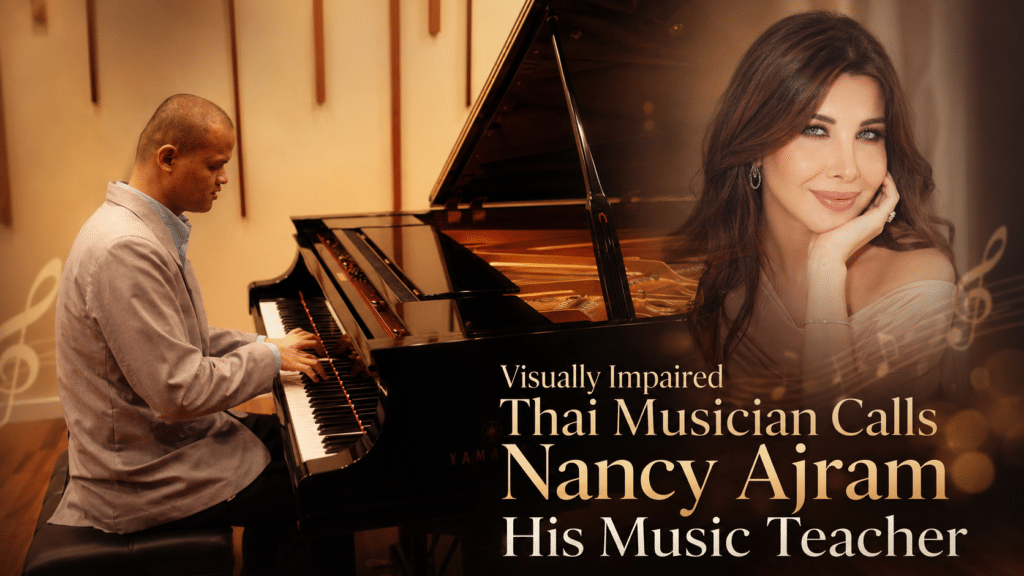
For Tum, a musician from Thailand who is visually impaired, the connection began with a voice on the radio.
In a letter addressed to Lebanese singer Nancy Ajram and shared with Oz Arab Media, Tum describes discovering her music approximately 15 years ago through a Thai radio program dedicated to music from different countries.
According to his account, the program introduced listeners to international performers by explaining their backgrounds, countries of origin and the pronunciation of their names.
One evening, the presenter played three songs by Ajram.
Tum says he had never previously heard her music and knew little about Lebanon, but something in the melodies, rhythms and vocal arrangements immediately captured his attention.
“I only focused on her voice,” he writes. “I don’t know what she looks like because I cannot see.”
Ajram is a Lebanese singer whose career has extended across more than two decades. Her official website describes her as a multi-platinum artist with 11 studio albums and a catalogue that includes well-known songs such as “Ah W Noss”, “Ya Tabtab”, “Inta Eih” and “Fi Hagat”.
Yet Tum’s letter is not simply an expression of admiration from a fan.
It is an extensive musical reflection on the singer’s work.
Listening Beyond Language
Tum says that when he first encountered Ajram’s songs, he could not understand the Lebanese Arabic lyrics and did not have access to anyone who could translate them accurately.
He later learned that Arabic is spoken in many different dialects, making translation more complicated than he had initially expected.
Despite the language barrier, he continued listening.
“The melody was beautiful,” he writes.
For Tum, music offered a form of communication that did not depend on sight, nationality or a shared spoken language.
He describes music as a universal language and compares listening to international artists with travelling without a passport or visa.
“Music truly opened up my world,” he writes.
His interest gradually developed into detailed study.
Tum says he plays piano and examines Ajram’s music from the perspective of a musician, paying attention to chord progressions, vocal ranges, key changes, rhythmic patterns and the combination of Arabic and Western musical styles.
Throughout the letter, he discusses individual songs in considerable technical detail.
He describes the string arrangements in “Fakra Zaman”, the electronic production in “Fi Hagat”, the tango influence he hears in “Emta Hashoufak” and the repeated piano introduction in “Inta Eyh”, which he identifies as his favourite song.
He also reflects on the physical demands of Ajram’s vocal performances, including sustained notes, changes in register and passages that require controlled breathing.
Whether commenting on classical influences, Latin rhythms, rock elements or electronic production, Tum approaches the songs as material to be studied rather than simply enjoyed.
“You Are My Teacher”
One of the most striking parts of the letter is the way Tum describes Ajram’s place in his musical development.
“For me, you are not a singer, but a book in a library,” he writes.
“Your music offers endless things for me to study.”
He says he has listened closely to her vocal techniques and attempted to apply what he has learned to his own singing and musicianship.
Tum describes Ajram as a professor who teaches through music rather than formal lessons.
“You explain it through the sound of music to people who are truly interested, like me,” he writes. “You are my teacher, Nancy.”
He also says that he now follows Ajram’s official social media accounts and occasionally comments in English, sometimes relying on translation technology to communicate.
However, he remains cautious when responding to photographs because he cannot independently understand their visual content and fears writing something inappropriate.
A Hope to Be Heard
At the centre of the letter is a simple request: Tum hopes that his message will one day reach the singer whose music has influenced him for so long.
He says meeting Ajram in person would be a dream, although he recognises that the distance between Thailand and Lebanon makes such an encounter difficult.
Even a reply, he writes, would provide meaningful encouragement.
“If this message reaches you, Nancy, I would be overjoyed,” he says.
Tum’s account is personal, but its themes reach beyond one performer or one fan.
It is a story about the way music travels beyond the circumstances in which it was created.
A Lebanese song played by a Thai radio presenter became a source of inspiration for a musician who did not understand the words and had never seen the singer performing them.
What remained was the sound itself: the voice, the melody and the opportunity to learn.
From Thailand, Tum continues to listen.
And through every song, he says, the lesson continues.