













Arabic version: الغارديان تتحدى مزاعم الائتلاف بشأن أراضي الطاقة المتجددة
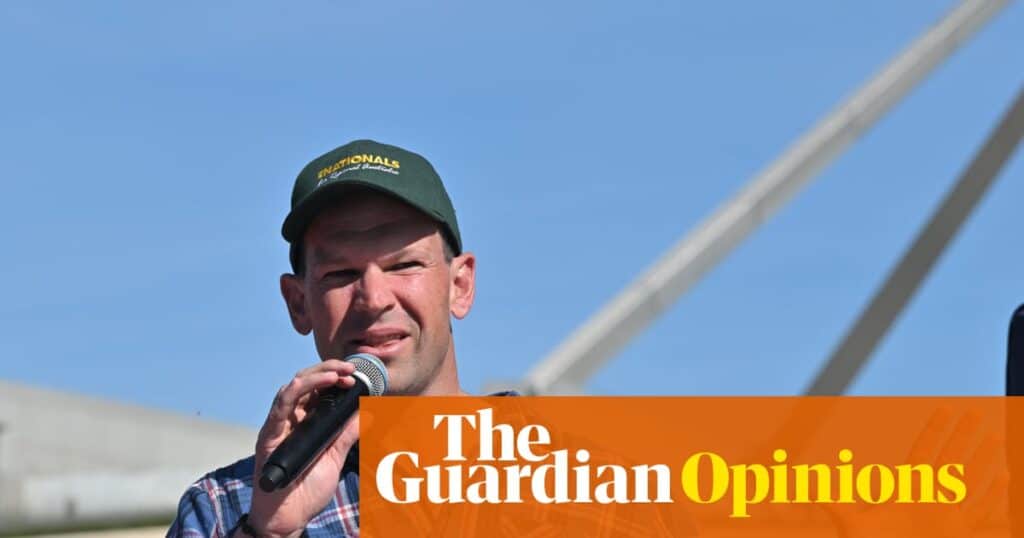
According to The Guardian, Nationals leader Matt Canavan told an audience at cattle saleyards near Rockhampton that 12 million hectares would be needed for solar, wind and transmission lines, describing the area as equivalent to “two Tasmanias”. He said the figure came from Net Zero Australia, a research partnership involving the University of Melbourne, the University of Queensland and Princeton University.
Net Zero Australia’s most recent reporting estimated that 2 million hectares would be needed for renewable energy and transmission infrastructure to help Australia reach net zero greenhouse gas emissions. The report said this was the total area of projects, while the direct footprint for access roads, easements, solar panels, turbines and transmission towers would be about 500,000 hectares.
The 12 million-hectare figure appeared in an earlier Net Zero Australia report and referred to the total project area for fully decarbonising Australia’s energy system while replacing current coal and gas exports with clean alternatives of equivalent energy. That report also estimated that 5.1 million hectares of new forest area would be planted to help sequester carbon dioxide.
Net Zero Australia director Prof Michael Brear said estimating land used by future energy infrastructure was complex and required careful investigation and discussion. Prof Andrew Blakers of the Australian National University calculated land lost to renewable energy in a zero-emissions electricity grid at 120,000 hectares, or 1,200 square kilometres, and called Canavan’s claim “plain wrong and plain silly”.
The report also examined Coalition assertions on electricity prices and reliability. The Australian Energy Market Operator said wholesale electricity prices in the National Electricity Market had fallen 47% from a year earlier, with increased renewable generation and higher grid-scale battery discharge helping lower prices. Aemo said reliability risks over the next five years were primarily triggered by the retirement of large power stations, while Grattan Institute’s Alison Reeve said there was no evidence renewables were making the grid less reliable.