











What began with seven local residents, a petition and a determination to save one of Australian rugby league’s most historic suburban grounds has grown into a community advocacy story spanning more than two decades.
Today, Belmore Sports Ground is once again a living part of the Canterbury-Bankstown Bulldogs’ identity. NRL and NRLW matches have returned, the Bulldogs maintain a major presence at the precinct, hundreds of thousands of spectators have passed through its gates and millions of dollars in economic activity have flowed through surrounding businesses.
But in 2005, that future was anything but certain.
At the centre of the campaign to preserve the ground was Back to Belmore, a grassroots organisation established in April 2005 by local residents concerned that Belmore Sports Ground was deteriorating and facing an increasingly uncertain future.
The movement would go on to campaign through petitions, political lobbying, media advocacy, advertising, community engagement and direct approaches to decision-makers at local, State and Federal levels.
More than 20 years later, its members are still advocating for the ground and the wider Belmore precinct.
A Ground at Risk
Belmore Sports Ground is far more than another suburban sporting venue.
For generations of Canterbury-Bankstown supporters, it has been the spiritual home of the Bulldogs — the place associated with some of the club’s greatest players, premiership eras and memories.
The Bulldogs had played at Belmore for decades, but by the early 2000s the ground’s future had become increasingly uncertain.
The venue required significant upgrading, the club was moving more of its operations and matches towards Sydney Olympic Park, and questions were being asked about what role Belmore would play in the future.
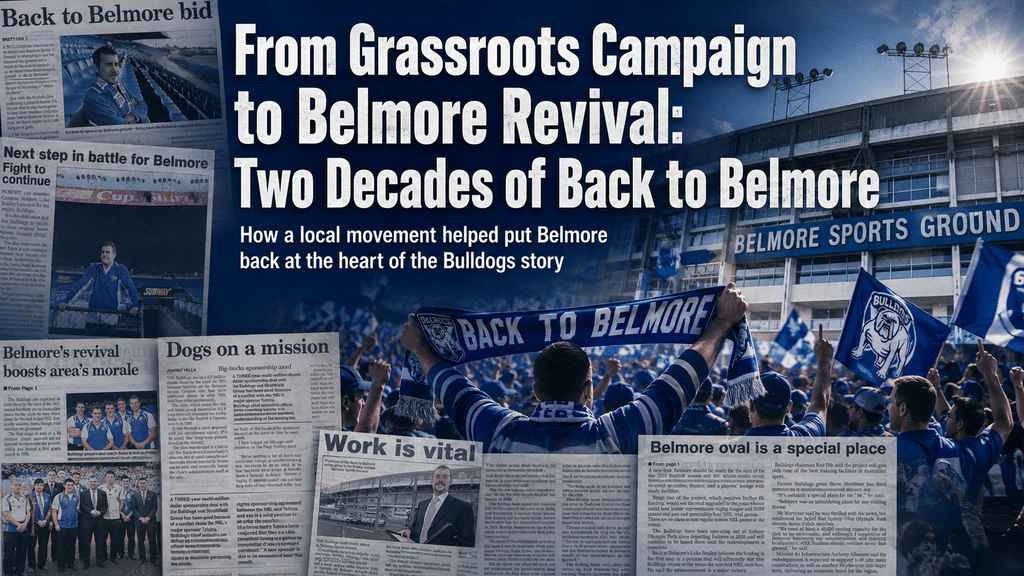
Archived newspaper reports from the period capture just how uncertain the situation had become.
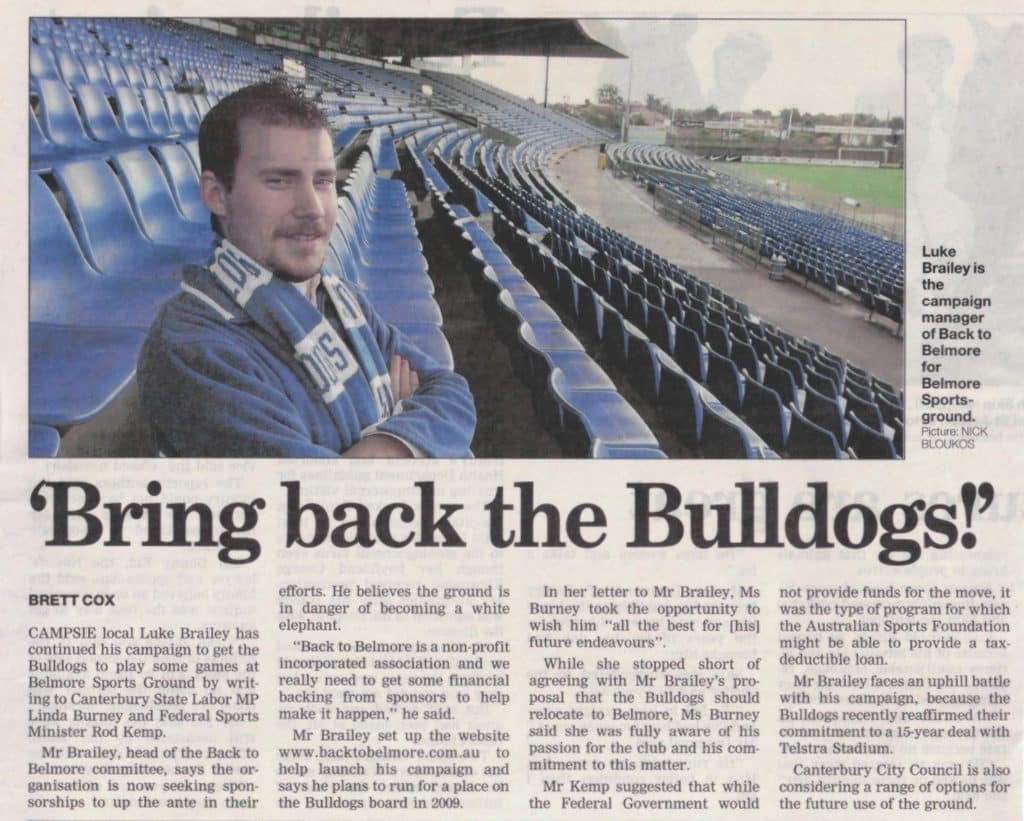
Headlines including “Dogs’ 15-year leash means Belmore is out”, “Fans fight to bring Dogs home”, “Dogs told ‘use it or lose it’ on Belmore” and “Fans fight to bring Dogs home” documented a period in which supporters feared the club’s traditional home could eventually be lost as a major sporting venue.
Against that backdrop, a small group of local residents decided to act.
Back to Belmore began as a grassroots movement in April 2005, initially advocating for the preservation and restoration of the ground. In August 2006, it became an incorporated non-profit organisation, formalising what had already become a persistent community campaign for the venue’s future.
Its message was simple: Belmore Sports Ground should not be abandoned.
Taking the Campaign to the Community
From the beginning, Back to Belmore relied heavily on community mobilisation.
Volunteers knocked on doors, distributed flyers, spoke to residents and businesses and collected signatures calling for the ground to be upgraded and retained as a multi-purpose sporting facility.
Early newspaper coverage shows the campaign gathering momentum rapidly.
One article described then-young Bulldogs supporter and campaign leader Luke Brailey surrounded by campaign material, preparing petitions and flyers from home.
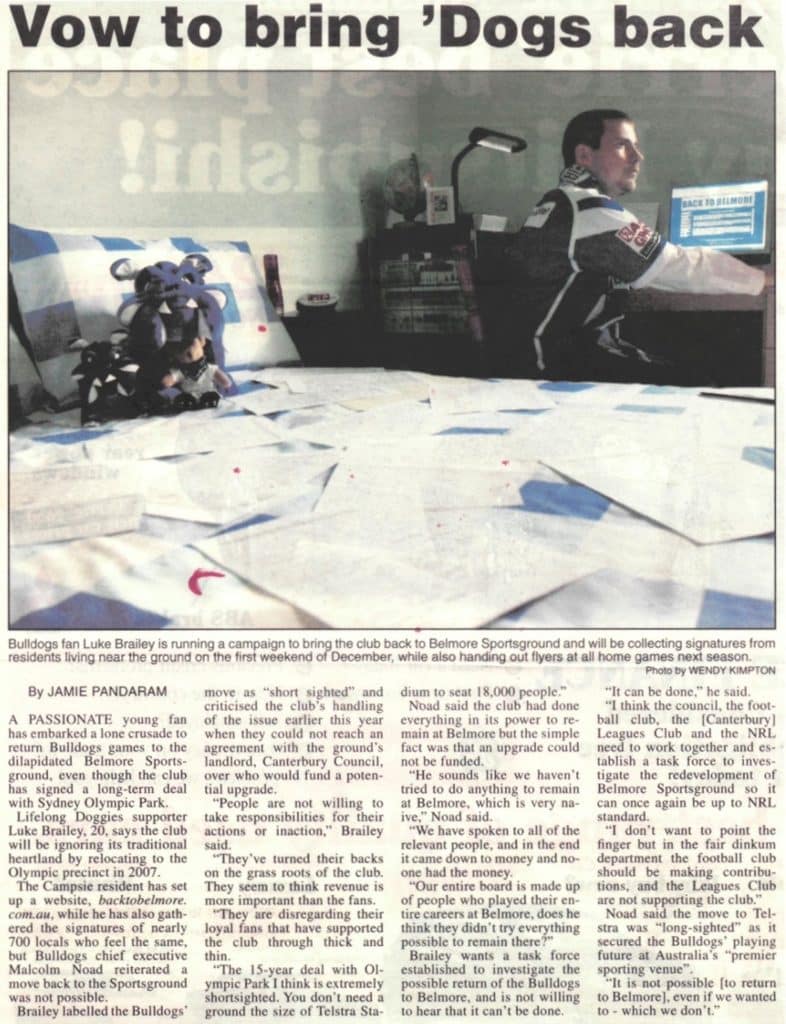
Another reported that almost 700 local signatures had already been collected early in the campaign.
That number would eventually grow dramatically.
Brailey later recalled that the campaign collected more than 10,000 petition signatures, an extraordinary response for a locally organised movement.
Back to Belmore also established a website, conducted public campaigns, approached elected representatives and challenged the decisions being made by both the Bulldogs and government authorities.
The organisation did not limit its argument to nostalgia.
Its members consistently argued that Belmore Sports Ground was a community asset capable of serving local athletes, sporting organisations, businesses and future generations if sufficient investment could be secured.
Challenging the Bulldogs’ Move Away from Belmore
The campaign intensified when the Bulldogs committed themselves to Sydney Olympic Park.
Archived reports show Back to Belmore publicly challenging the club’s long-term stadium strategy.
Brailey described a 15-year commitment to the Olympic precinct as “extremely short-sighted” and argued that supporters were being separated from the traditional heartland of the club.
At the same time, Canterbury officials argued that Belmore could not accommodate the crowds or commercial requirements expected of a modern NRL venue.
The disagreement became one of the major issues surrounding the Bulldogs during the period.
For Back to Belmore, however, the objective was not necessarily to abandon Sydney Olympic Park altogether.
The organisation increasingly argued that Belmore could be upgraded sufficiently to accommodate selected NRL matches while also becoming an elite training, administrative and community sporting facility.
That position would ultimately prove remarkably close to the model that emerged years later.
The 2008 Bulldogs Board Election
By 2008, the dispute over the club’s direction had moved from public debate to the Bulldogs boardroom.
Back to Belmore openly supported candidates contesting the Bulldogs Football Club elections who it believed understood the importance of preserving the club’s traditions and reconsidering the future of Belmore Sports Ground.
Archived newspaper coverage from February 2008 described Back to Belmore as an influential lobby group and reported its support for a group of board challengers.
The organisation endorsed candidates including Graeme Hughes, Andrew Farrar, Barry Ward and Paul Dunn, while other coverage reported its support for a broader slate of candidates including Ray Dib.
Back to Belmore President Luke Brailey argued that the candidates understood the history, culture and traditions of the Bulldogs and would listen more closely to supporters.
The subsequent election produced a major change in the club’s leadership.
More than 500 members voted, and a new-look Bulldogs board was elected.
Following the result, Brailey described the vote as a clear indication that members wanted change and urged the incoming administration to reconsider Belmore.
The election alone did not restore Belmore Sports Ground, nor can the ground’s later redevelopment be attributed to any one organisation or event.
But the change created a markedly different environment.
The new club leadership began revisiting Belmore’s possibilities rather than treating the ground simply as part of the Bulldogs’ past.
For Back to Belmore, it was a significant turning point.
From Campaigning to Government Investment
The next challenge was money.
Years of deterioration meant meaningful redevelopment would require millions of dollars.
Back to Belmore continued lobbying governments and calling for investment in the ground, arguing that other suburban sporting venues had received government assistance and that Belmore deserved similar consideration.
By 2009 and 2010, momentum had changed significantly.
Newspaper reports began discussing government funding opportunities, redevelopment plans and the possibility of the Bulldogs returning their training and administrative operations to Belmore.
Then came the breakthrough.
In May 2010, the Federal Government announced $4.9 million in funding for the upgrade of Belmore Sports Ground through its Regional and Local Community Infrastructure Program.
The Bulldogs and Canterbury Council contributed a further $1 million towards the project, bringing the initial redevelopment package to approximately $5.9 million.
The proposed works included a new gymnasium, refurbished changerooms, football offices, player facilities, meeting and video facilities and improved amenities for community sporting organisations.
For a campaign that had begun five years earlier when many believed the ground had little future, the announcement represented a dramatic change in direction.
Back to Belmore’s years of advocacy had helped keep Belmore’s redevelopment firmly on the public and political agenda.
And the funding did not stop there.
In October 2010, the NSW Government announced an additional $2.5 million towards the redevelopment, lifting the overall refurbishment program to approximately $8.4 million.
The State Government said the investment would provide modern facilities for the Bulldogs while creating opportunities for community organisations, sporting clubs and other users.
The ground once considered at risk of becoming a “white elephant” was instead being rebuilt.
The Bulldogs Come Home
The redevelopment changed Belmore’s trajectory.
The Bulldogs began returning their training and administrative operations to the precinct, reconnecting the organisation with its traditional base.
Back to Belmore described the development as vindication of a campaign that had once been dismissed by many as unrealistic.
The transformation also gained political recognition.
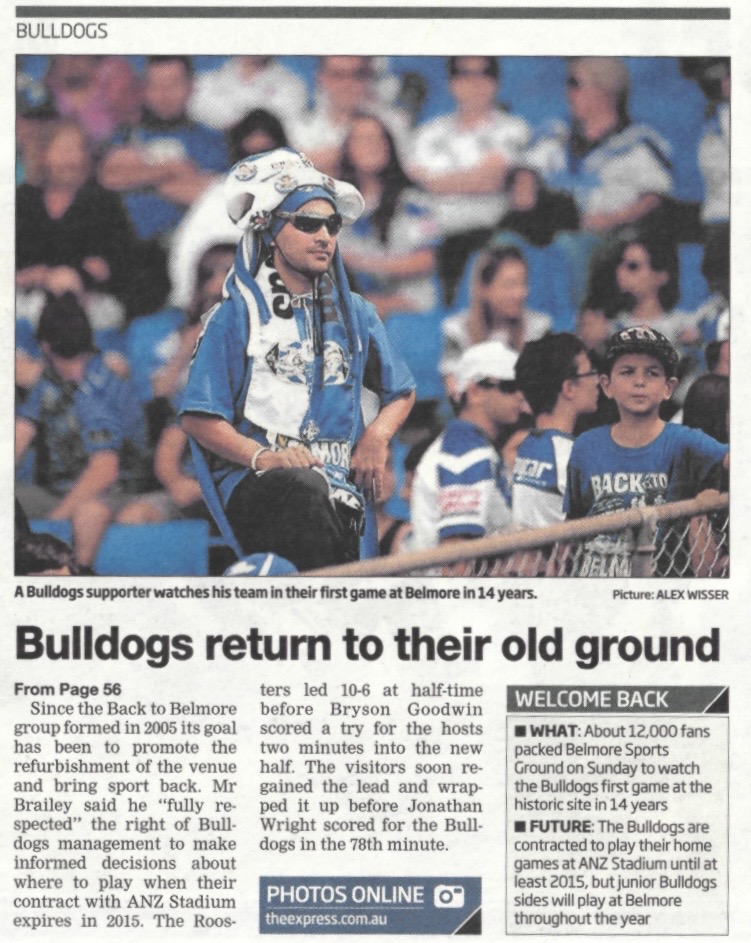
In 2012, the NSW Parliament formally noted that Back to Belmore had been established in 2005 to bring sport back to Belmore following the Bulldogs’ return for a match after a 14-year absence.
But one ambition remained particularly powerful among supporters.
They wanted to see first-grade rugby league back at Belmore.
That dream finally became reality in 2015.
June 29, 2015: NRL Football Returns
On 29 June 2015, the Canterbury-Bankstown Bulldogs ran onto Belmore Sports Ground for an NRL premiership match for the first time in 17 years.
More than 16,700 supporters packed into the historic venue as Canterbury defeated Melbourne Storm 20–4.
For supporters who had spent years campaigning for the venue, it was one of the defining moments in Belmore’s modern history.
Less than a month later, the Bulldogs returned to face Cronulla in front of an even larger crowd of 19,005.
Belmore was no longer merely a training base or a monument to rugby league history.
Top-level rugby league was being played there again.
The return also demonstrated something Back to Belmore had argued for years: suburban NRL matches could generate benefits well beyond the stadium gates.
The first 2015 match was estimated to have generated around $500,000 in local economic activity, while the second attracted another capacity crowd and was estimated to produce a similar boost.
Restaurants, cafés, retailers and other businesses along Burwood Road and the surrounding precinct benefited from the influx of supporters.
More Than 200,000 Spectators and Millions for Belmore
The 2015 matches did not prove to be one-off anniversary events.
Belmore remained part of the NRL calendar.
Since the return of premiership football in 2015, 15 NRL premiership matches have been staged at Belmore Sports Ground, attracting collectively more than 200,000 spectators.
Back to Belmore estimates those fixtures have generated more than $5 million in economic activity for local businesses.
Individual games regularly attract crowds well above 10,000.
The organisation has repeatedly highlighted the impact on cafés, restaurants, shops and other businesses, particularly along Burwood Road.
The benefits have also extended beyond economics.
NRL matches bring national television exposure to Belmore, attract visitors from outside Canterbury-Bankstown and allow young local supporters to experience elite sport within their own community.
Belmore has also hosted NRLW football and other sporting events, further strengthening its position as an active sporting precinct rather than simply a heritage venue.
A Campaign That Changed What Was Considered Possible
Looking through the newspaper archives today reveals how remarkable the turnaround has been.
In the mid-2000s, much of the discussion surrounding Belmore focused on abandonment, deterioration and whether the Bulldogs would ever meaningfully return.
Back to Belmore’s campaign was sometimes portrayed as idealistic.
Its members were told crowds had become too large for suburban venues.
They were told the Bulldogs’ future belonged at Olympic Park.
They were told government funding would be difficult to obtain.
They were told the economics did not work.
Yet over time, many of the outcomes Back to Belmore advocated became reality.
Belmore received major government investment.
The Bulldogs returned their training and administrative operations.
The ground was substantially upgraded.
NRL football returned.
The venue became an important part of the Bulldogs’ contemporary identity again.
And the surrounding community began benefiting from major match-day economic activity.
That does not mean Back to Belmore achieved those outcomes alone.
Governments, Canterbury Council, Bulldogs administrations, sporting organisations, players, officials, businesses and supporters all played roles in the redevelopment of the precinct.
But it is difficult to tell the modern history of Belmore Sports Ground without acknowledging the sustained pressure applied by the grassroots movement that refused to accept that the ground’s best years were behind it.
Recognition More Than 20 Years Later
The organisation’s contribution continues to receive recognition.
On 23 June 2026, Back to Belmore was formally recognised in the NSW Legislative Assembly through Written Community Recognition Statements as well as a special message from the Premier of NSW.
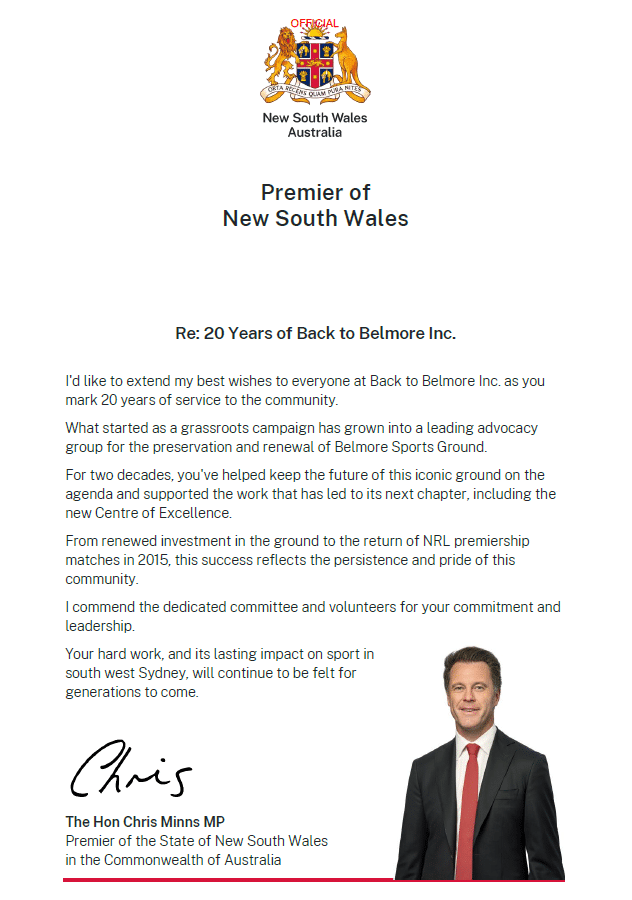
It was another milestone for an organisation that began around a table in 2005 with seven residents concerned about the future of their local sporting ground.
The recognition is particularly significant because Back to Belmore has now existed long enough to see its original advocacy become part of the historical record of the precinct.
What was once a protest movement opposing Belmore’s decline has evolved into a continuing community organisation advocating for the ground’s next chapter.
The Campaign Continues
Back to Belmore remains active today.
The organisation is led by President Luke Cevolani and Vice President Steven Cataldi, with committee members Chris Kaikati, Chafic Mennah, Maria Bogoevska, Rafael Gomes and Deanne Gomes, alongside Ambassador Hamza Anwer and its volunteers.
Founding President Luke Brailey, who led the organisation from 2005 until 2014 before later serving as Patron, has remained closely associated with the movement and its history.
The organisation’s focus has also expanded beyond the simple question that dominated its early years — whether Belmore Sports Ground would survive.
The discussion now concerns how the venue and broader Belmore precinct can reach their full potential.
Back to Belmore continues advocating for investment, major sporting opportunities, community access and the continued development of the ground as a multi-purpose sporting facility.
Its official vision remains centred on preserving and restoring Belmore Sports Ground while creating opportunities for future generations of athletes.
That continuity is perhaps the most striking aspect of the organisation’s story.
The names of administrators have changed.
Governments have changed.
Bulldogs boards have changed.
Stadium strategies have changed.
Yet Back to Belmore has remained.
From Petition to Legacy
The old newspaper clippings tell the story better than hindsight ever could.
There is the young campaigner sitting among hundreds of petitions.
There are volunteers handing flyers to local businesses.
There are headlines warning that Belmore could disappear from the Bulldogs’ future.
There are arguments with club administrators.
There are election campaigns.
There are appeals to councils, MPs and ministers.
Then, gradually, the headlines change.
“Plan for Belmore.”
“Work is vital.”
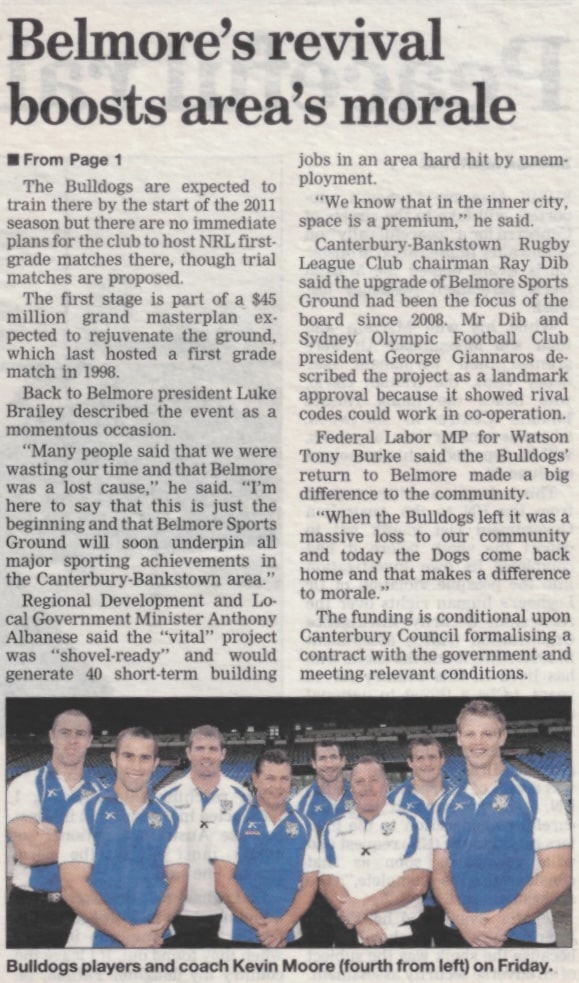
“Belmore’s revival boosts area’s morale.”
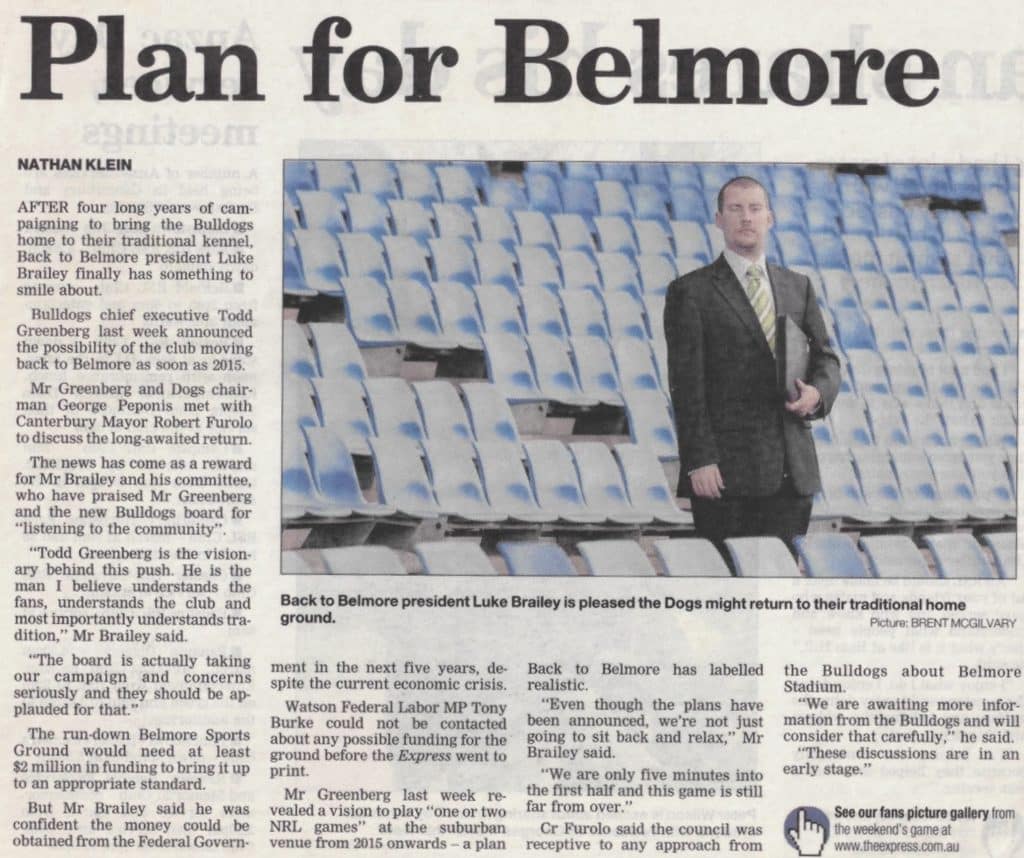
And eventually, the pictures show Bulldogs players, politicians and community representatives standing together on the Belmore turf.
What began in April 2005 as seven residents refusing to accept the decline of their local ground became a campaign that helped transform the public debate around one of rugby league’s most recognisable suburban venues.
Twenty-one years later, Belmore Sports Ground is still standing.
The Bulldogs are still there.
Elite rugby league is still being played there.
Crowds still fill the hill and grandstands.
Businesses still benefit when thousands of supporters pour into the suburb.
And Back to Belmore is still campaigning.
For an organisation whose original objective was simply to make sure Belmore had a future, that may be its most significant achievement of all.