












Arabic version: أزهار أستراليا الغربية البرية تتفتح حول مرصد راديوي
According to The Guardian, Western Australia’s wildflower season has brought blankets of colour to Wajarri Yamaji country, including the observatory site that hosts major radio astronomy facilities. Images show bright purple Ptilotus, known as mulla mulla, growing within the footprint of CSIRO’s Australian Square Kilometre Array Pathfinder, or Askap, radio telescope.
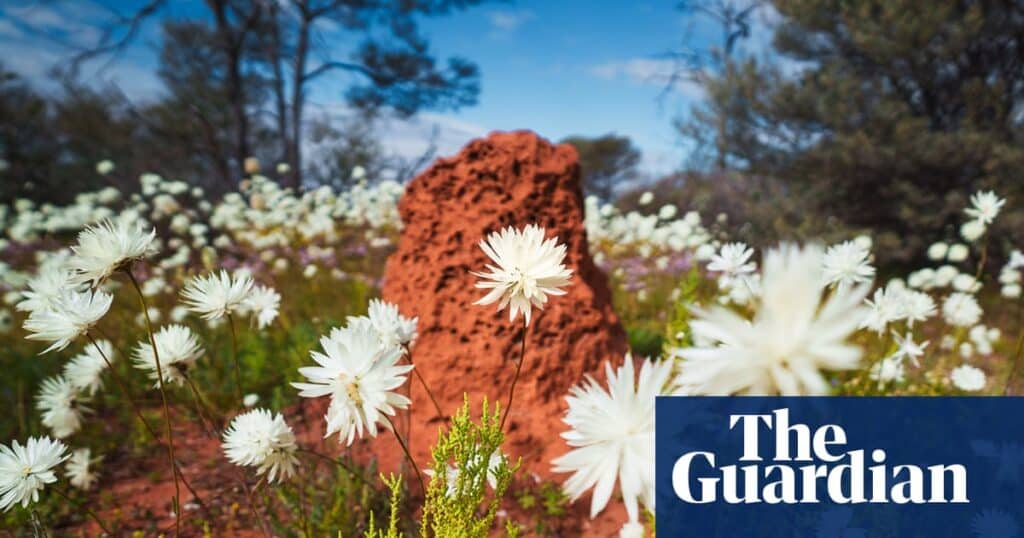
Flowers carpet the country around the observatory, while white blooms seen from above resemble snow. Ptilotus flowers of many species grow across the site, and a close-up image highlights one of the plants. Everlasting paper daisies are also growing around the observatory, where wildflowers surround the Ska-Low massive low-frequency radio telescope array.
Swainsona formosa, commonly called Sturt’s desert pea, is found across the observatory site. The flower is South Australia’s floral emblem and has the Wajarri name marlugur. Another species, Calandrinia mirabilis, was listed by the Western Australian government as a priority 1 threatened species until 2025. Its status was reduced to priority 3 after additional populations were documented at the observatory site.
The location hosts the Askap radio telescope, the Murchison Widefield Array and the Experiment to Detect the Global EoR Signature. It is also where the international Square Kilometre Array Observatory is building the Ska-Low telescope, described as Australia’s first mega-science facility. Photographs also show the Askap telescope at dusk, set against the flowering landscape.