Reading in English | Read in العربية (Arabic)
It is regrettable — and even puzzling — to see the growing Turkish interest in Lebanon today, expressed through official visits and meetings, the opening of centers and exhibitions, and participation in economic conferences. This is especially striking given that Lebanon and the region endured repressive practices, famines, burdensome taxes and conflicts under Ottoman rule, leaving deep historical tragedies and painful political, economic and humanitarian legacies across Lebanon’s communities. Historical memory still bears witness to those experiences.
This renewed attention became particularly evident with the visit of Bilal Erdoğan, son of Turkish President Recep Tayyip Erdoğan. Although he holds no official government position in Turkey, his visit had a distinctly official tone: he met with the president, the speaker of parliament and the prime minister, as well as with several religious leaders and authorities, and took part in inaugurating several cultural and scientific centers. At the same time, Lebanese people are left asking: what did Ottoman rule leave behind for this country? How did an empire govern a land for nearly four centuries and fail to leave an institutional, educational or cultural legacy commensurate with that long period?
The paradox grows sharper when we learn that Bilal Erdoğan heads a foundation called “Nashr al-Ilm” (Spread of Knowledge). This raises a legitimate historical question: where was the spread of knowledge and education in Lebanon during nearly four centuries of Ottoman rule? How did that empire fail to leave an educational or scientific legacy matching the length of its rule? It is an irony worth pausing over: today the foundation’s name is “Spread of Knowledge,” but what about the knowledge that should have been spread in Lebanon over four centuries of Ottoman governance? To remind us of the Ottoman dynasty’s lineage — under which our people suffered and tasted the bitterness of injustice and oppression — Bilal Erdoğan visited in Tripoli the granddaughter of Sultan Abdul Hamid II, who is among the descendants of the Ottoman family exiled from Turkey in 1924 during Mustafa Kemal Atatürk’s abolition of the sultanate.
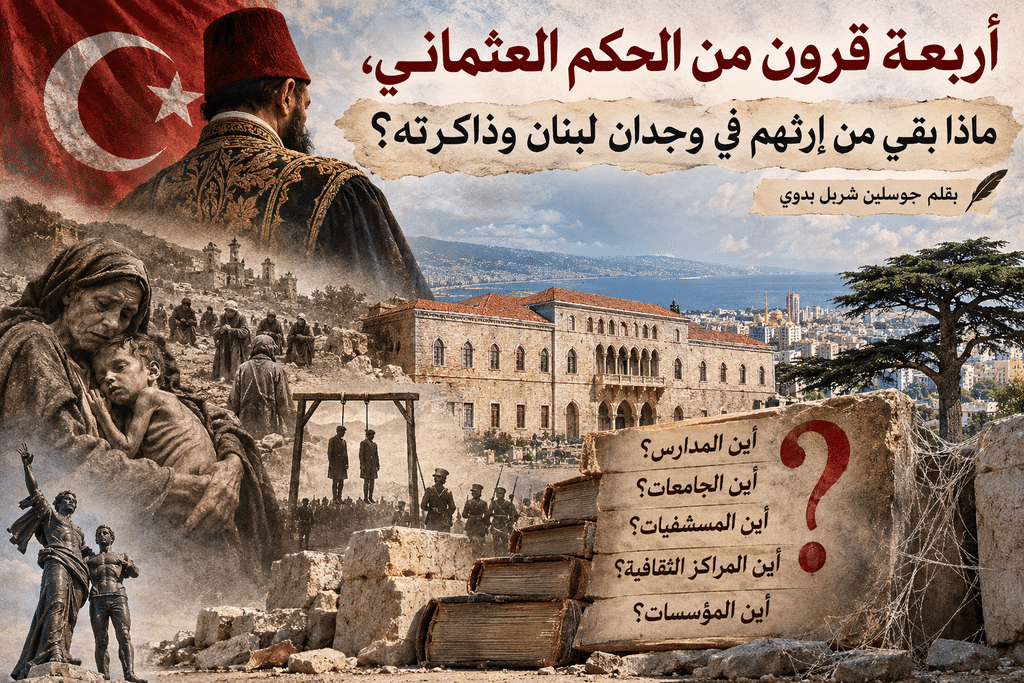
Lebanon lived under the Ottoman sultanate for almost four hundred years. So where are the major schools they supposedly established? Where are the universities? The hospitals? The cultural and scientific centers that should testify to four centuries of their presence? What institutions did they leave for the Lebanese generations?
Where are the Ottoman architectural and civilizational remains in comparison to the Byzantine, Crusader, Mamluk and Roman civilizations — many of which produced sites in Lebanon now listed on UNESCO’s World Heritage lists? What of what remains of Ottoman construction was largely built for their own military needs: the Grand Serail in Beirut, constructed in 1853 as a military barracks to serve their army and administration, not as a civil or developmental project serving the Lebanese people — later restored and rehabilitated in its current form by the Lebanese state.
The most painful chapter of Ottoman rule is the Mount Lebanon famine during World War I, between 1915 and 1918. This was not a mere footnote in history books but a national catastrophe that must not be forgotten. Around half the population of the Mount Lebanon Mutasarrifate died as a result of blockade, restrictions and the seizure of crops and food supplies by Ottoman military authorities.
How can we forget the executions carried out by Ottoman authorities of journalists, poets, politicians and nationalists in Martyrs’ Square? More than a century has passed since those massacres, yet their memory remains present, and the Martyrs’ Monument in Beirut still bears witness to those painful events and the injustice that time cannot erase.
Another historical paradox: despite four centuries of Ottoman rule, they did not teach the Turkish language to the Lebanese. Except for one unique case — the town of Kfashsh (al-Kawashra?) in the Akkar district — whose residents still speak Turkish today because of their Turkmen origins. Even the school associated with teaching Turkish in that town was not built during the Ottoman era; it is a modern project established in 2008.
From the Ottomans we learned mainly titles — Pasha, Bey, Agha, Khanum, Efendi, Khawaja, Jauish — and a very few words, the most notable being “baksheesh,” meaning a tip or small bribe. Their policy was one of taking, not giving: they compelled our people to pay taxes and the jizya, seized Lebanon’s produce and resources, conscripted its young men for forced military service that led many to death, and gave nothing in return.
By contrast, France, during roughly 23 years of mandate rule, managed to leave a clear and lasting imprint on Lebanon’s education, administration and language, enriching it culturally and intellectually and helping to shape part of its modern identity. The French language remains strong in Lebanese schools, universities and cultural life; many Lebanese speak French fluently and use it in prominent forums. French influence also extended to the constitutional system: the Lebanese Constitution ratified in 1926 drew on key principles of the French constitution, and Lebanon celebrated the centenary of that constitution in 2026. There is a wide gulf between centuries of rule that left no notable linguistic legacy and a comparatively short mandate that left a cultural and educational inheritance still evident today.
We always speak of “Ottoman rule” or “Ottoman authority,” and not of an “Ottoman civilization,” when discussing Lebanon’s history, because the Ottoman presence was a political and imperial governance imposed on the country, not a locally rooted civilization that established Lebanon’s historical identity. That contrasts with the Phoenician, Canaanite and Byzantine civilizations, which left authentic, deeply rooted cultural and civilizational legacies on this land. This is an essential distinction between an entrenched civilization and a ruling authority.
We do not hold the Turkish people responsible for the deeds of yesterday’s rulers, nor do we reject cooperation with Turkey today. But we refuse any falsification of history or erasure of the historical facts about our ancestors’ suffering under Ottoman rule — from famines and executions to years of oppression and deprivation — facts documented in Lebanon’s history books and academic studies. Four centuries of political and military domination do not equal four centuries of civilization or constructive development: civilization is measured by what it leaves behind in knowledge, culture, heritage and institutions, not by the length of years under domination. Lebanon has the right to engage openly with everyone and to build relations on the basis of mutual respect, but no one has the right to demand that it surrender its memory or deny the tragedies suffered by its forebears.