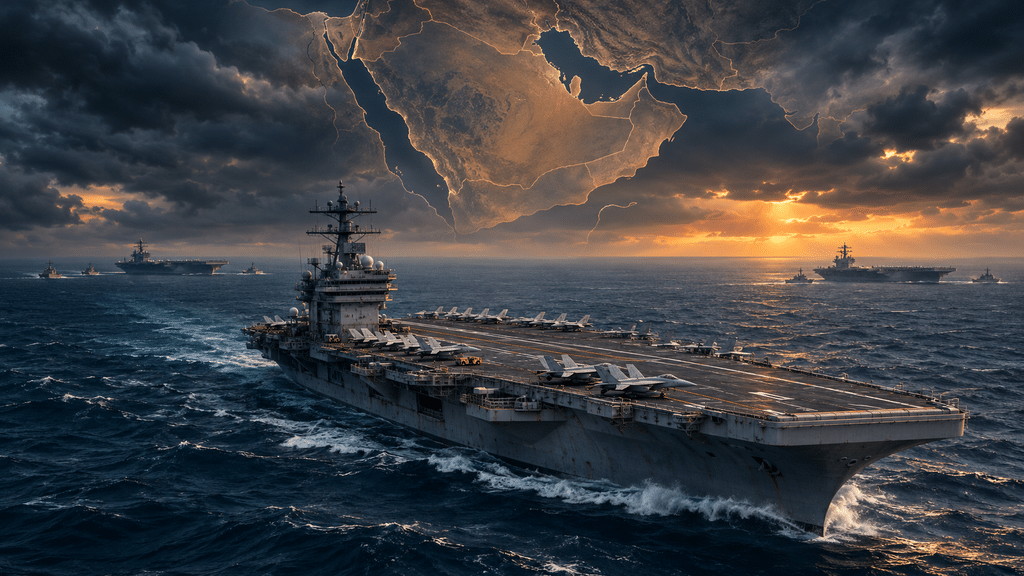
At a moment when political moves are accelerating and intertwining, some actions cannot be measured by their footsteps on land or interpreted solely through military statements. Certain messages cross oceans before reaching capitals and cut silently across waters, leaving questions larger than the size of the vessels that carry them. When American aircraft carriers begin to approach the “Middle East” one after another, the sea itself becomes a space for reading changes in international calculations and for guessing what might be arranged behind the doors of military institutions and decision-making rooms.The movement of the aircraft carrier Theodore Roosevelt toward the region today—after a stop in Singapore and a passage into the Indian Ocean—marks a new shift in the map of US naval deployment, especially amid reports that two other carriers, George Bush and George Washington, are operating within the area linked to US Central Command. The question is no longer only about a carrier traversing from one ocean to another, but about what it would mean for three carrier strike groups to converge in a geography where international interests intersect with some of the most sensitive security issues. A carrier is not just a massive warship cutting through water; it is a mobile airbase, an integrated command center, and a deterrent system carrying fighters, destroyers, missile and reconnaissance capabilities. When that system moves toward a particular area, it gives the owning state a wider margin for maneuver and forces others to confront the reality that balances of power are not always managed from land bases—they can be reshaped from the high seas.So what is driving Washington to increase its naval presence at this moment? The answer lies in the complex, overlapping events in the region and beyond. The Middle East is paced by intertwined tensions in which US–Iran calculations overlap with Gulf security and energy-route concerns. The Strait of Hormuz, Bab al-Mandeb, and routes across the Arabian Sea and the Indian Ocean remain highly sensitive elements in the equation of international trade and maritime security. In such a geography, the movement of warships is not merely a logistical transfer but part of a system of messages tied to deterrence, protecting interests, and demonstrating the ability to intervene if necessary. There is a subtle difference between a state mobilizing forces to prevent a confrontation and mobilizing them to be ready in case one occurs. Both may look similar on maritime monitoring screens, but the calculations behind them are very different. Deterrence aims to convince an adversary that the cost of escalation will be high, while operational readiness requires preparing the means, capabilities, and deployments that allow action if events exceed containment.This makes it important to determine whether the arrival of Theodore Roosevelt signals a simultaneous reinforcement of US power or whether it is part of a routine rotation and replacement of naval forces already in the region. The sustained presence of three carriers would carry a different implication than the arrival of a carrier that simply relieves another and departs in turn. Between those possibilities lies the interpretation of the scene. These movements cannot be separated from the widening maritime spaces that have become part of the international security equation: the Arabian Sea is no longer merely a passage between the Indian Ocean and the Gulf; the Red Sea is no longer an isolated trade route apart from surrounding tensions. The Strait of Hormuz and Bab al-Mandeb are so consequential that any disruption there spills beyond the littoral states to affect energy markets, supply chains, and global trade.The question that “three aircraft carriers” raises is not whether Washington can reach the Middle East—that capability has been proven repeatedly—but why its presence is expanding now. What is the mission this presence is intended to perform? Are we witnessing a realignment of naval influence, or the construction of a broad military umbrella in anticipation of a sudden shift in events? The seas do not disclose their secrets through ship counts alone but through directions, timing of arrivals, the nature of accompanying vessels, and whether movements are part of routine deployments or an exceptional formation. The arrival of Theodore Roosevelt may be the beginning of a development that deserves to be viewed in a broader context than the limits of its voyage. In a world where military signals sometimes precede political statements, fleet movements become part of an international language that does not always need explicit declaration to draw attention. When three carriers converge at the edges of a region laden with possibilities, the question shifts from the ships that arrived to the kind of phase the region is preparing for—and the distance between a show of force and the testing of its use.Will Washington redraw its naval deployment map, or is the Middle East entering a new chapter of military preparations? The coming days may provide some answers, but one thing is certain: this time the sea is no longer merely a route for carriers to cross; it has become a mirror reflecting what takes place behind maps of influence and balances of power.
About the Author
Oz Arab Media Newsdesk
Oz Arab Media Newsdesk produces automated news summaries using AI, drawing on the sources linked in each article, with human assistance and oversight. This byline identifies the newsdesk workflow rather than an individual journalist.