












Reading in English | Read in العربية (Arabic)
The Africa Atlantic Gas Pipeline has reached a major milestone after Member States of the Economic Community of West African States formally joined the landmark regional energy project.
The accession was confirmed through the signing of an Intergovernmental Agreement governing the development of the pipeline during the ECOWAS Summit of Heads of State and Government, held on 19 July 2026 in Freetown, Sierra Leone.
The agreement marks an important step in the transformation of the project from a strategic partnership between Morocco and Nigeria into a broader regional initiative supported by West African nations.
The Africa Atlantic Gas Pipeline was launched under the leadership of His Majesty King Mohammed VI of the Kingdom of Morocco and the late President of the Federal Republic of Nigeria, H.E. Muhammadu Buhari. The project has continued to receive the support of Nigeria’s current President, Bola Ahmed Tinubu.
The initiative reflects a shared commitment to strengthening Africa’s energy security, improving economic integration and supporting sustainable development across the continent.
Jointly developed by Morocco’s National Office of Hydrocarbons and Mines, known as ONHYM, and the Nigerian National Petroleum Company Limited, NNPC Ltd., the pipeline is designed to create a strategic energy corridor linking African natural gas resources with regional and international markets.
The next stage of the project will include the establishment of a dedicated Project Company headquartered in Casablanca, Morocco, as well as a Pipeline Higher Authority based in Abuja, Nigeria.
These institutions will form the project’s governance framework, support the mobilisation of investors and oversee preparations for the Final Investment Decision.
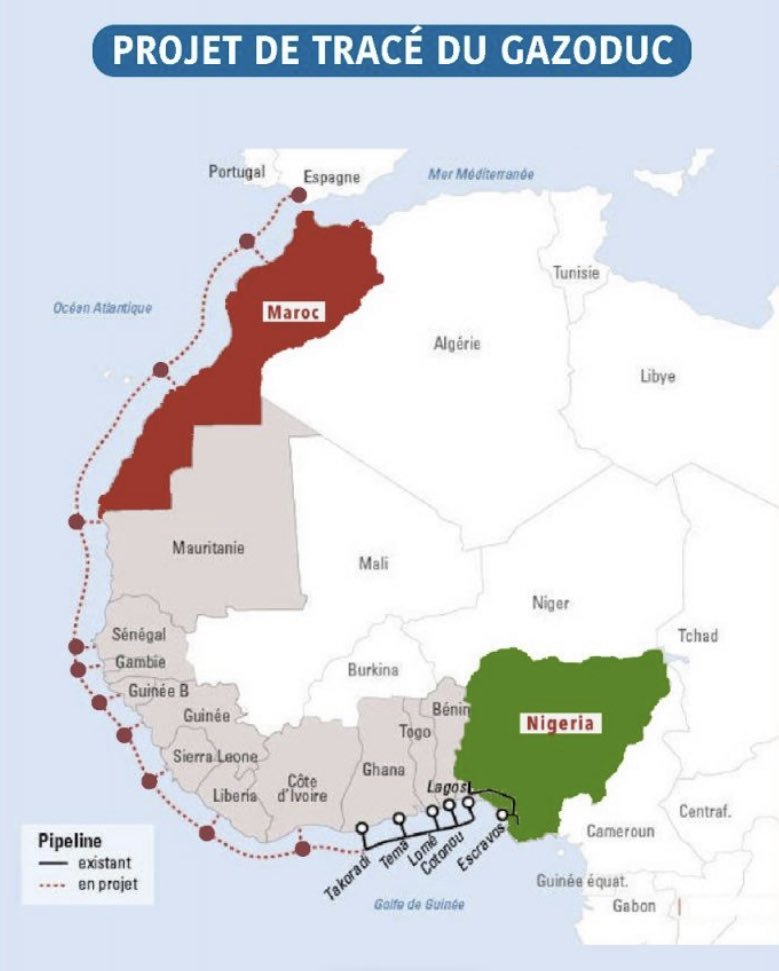
Once completed, the pipeline is expected to extend approximately 6,800 kilometres from Nigeria to Morocco, passing through 13 countries along Africa’s Atlantic coast before connecting with the Maghreb-Europe Gas Pipeline.
With an estimated investment value of approximately USD 25 billion, the project is expected to strengthen regional energy security, support industrial development, improve economic integration and generate new opportunities for sustainable economic growth throughout West Africa.
The pipeline is projected to transport up to 30 billion cubic metres of natural gas annually. Part of this supply will be directed towards Morocco and European markets, while also helping meet the growing energy needs of countries across West Africa.
Beyond its role as an energy infrastructure project, the Africa Atlantic Gas Pipeline is intended to function as a wider development corridor, improving connectivity, attracting investment and strengthening cooperation between African economies.
The project also reflects Morocco’s commitment to South-South cooperation and the Atlantic African Initiative promoted by His Majesty King Mohammed VI.
Through the initiative, Morocco continues to position itself as a trusted regional partner supporting economic integration, sustainable development and long-term transformation throughout West Africa and the broader African continent.
The formal participation of ECOWAS Member States brings countries across the region together around a common strategic vision and strengthens the pipeline’s status as one of Africa’s most ambitious infrastructure projects.
The Africa Atlantic Gas Pipeline is expected to become a flagship example of African cooperation and a significant driver of the continent’s energy transition, industrialisation and long-term development.