












Thu, 01/18/2024 – 20:10
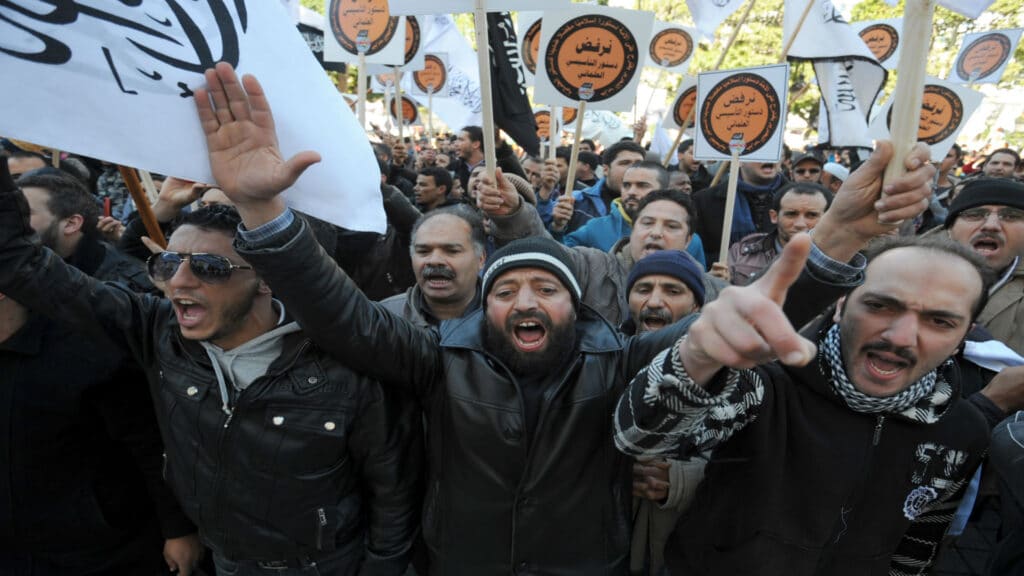
For the last two decades, Hizb ut-Tahrir has faced the prospect of being labelled and proscribed as a terrorist group in the UK.
Tony Blair threatened to proscribe Hizb ut-Tahrir. David Cameron did, too.
But this week, UK Home Secretary James Cleverly did what many before him in government had failed to do – with support from all parties and no opposition from MPs or members of the House of Lords during Thursday’s parliamentary session confirming the ban.
From midnight on Friday, the group will be classified as a terrorist group and banned from organising in the UK, with anyone found promoting the group facing possible prison time of up to 14 years.
But what led to this moment, and what impact will it have on political organising within Britain’s Muslim community?
Founded in 1953 in Jerusalem, Hizb ut-Tahrir aims to establish an Islamic caliphate or state governed by Islamic law. The group says it seeks to establish an Islamic khilafah by changing “public opinion in Muslim countries in favour of an Islamic political system” via non-violent means.
For its followers in the West, the group says it calls for western Muslims to support its efforts to change public opinion in Muslim-majority countries.
Several countries have banned Hizb ut-Tahrir for their activities, including Germany, Egypt, Bangladesh, Pakistan and several Central Asian and Arab countries, with many members arrested for attempting to instigate coups in Muslim-majority countries.
But despite their ban, the group says it is still very active, boasting 40 branches worldwide, including in Australia, Canada, and the United States.
Sadek Hamid, an academic at the University of Wales, explains that Britain was unable to ban the group because successive governments found no evidence of Hizb ut-Tahrir actively promoting terrorism.
“In the seven decades of its existence, HT has never advocated violence against state or non-state actors to realise its stated aims,” said Hamid.
“Despite its strident rhetoric against various governments, it sees itself as an intellectual, political movement that wants a re-manifestation of the caliphate.
“But what has changed this time round is that the supportive statements by HT after the 7 October attacks by Hamas are being used as evidence against it.”
Jonathan Hall, the UK’s independent reviewer on terrorism legislation, similarly stated that what had changed since previous efforts to ban Hiz but-Tahrir had failed was its reaction to the 7 October attacks.
Following those attacks, when Hamas fighters crossed into southern Israel killing more than a thousand people and taking hundreds hostage, Hizb ut-Tahrir Britain released a statement which praised Hamas for its actions and described them as “heroes” on its website.
In response to its proscription, the group’s British branch released a statement that said it “completely refutes any idea that it is antisemitic or encourages terrorism” and planned to legally challenge the measure.
Mosques and campuses
During the late 1990s and 2000s, Hizb ut-Tahrir was a staple in many mosques and university campuses across the UK.
Often dividing opinion within the Muslim community, the group clashed with other politically active Muslim groups over issues like voting in elections, which it said was forbidden or haram for Muslims to do.
Khadijah Elshayyal, an academic at the University of Edinburgh, explained that Hizb ut-Tahrir played a role in politicising Muslims because of its “critique of Britain (and western) colonial legacies and neo-colonialism”.
“Along with a spectrum of other voices, HT played a notable role in raising political awareness among young Muslims in the English language, encouraging them to feel a sense of connectedness and duty with the Muslim ummah,” said Elshayyal, who specialises in British-Muslim identity politics.
“It was often louder and more provocative with its approach, particularly during the 1990s, but like all movements, went through phases and its interaction with global and domestic issues adapted to changing realities.
“Although it remained legal in the UK, it has long been banned from operating openly in university and college campuses, and a majority of mosques will not tolerate its organised presence on their premises.”
For several years, the Conservatives under successive governments have attempted to ban Hizb ut-Tahrir.
Under David Cameron, the Conservatives failed to ban the group after criticising Blair for failing to do so.
Government’s allies, including William Shawcross, a senior fellow at Policy Exchange who authored the government’s review of the controversial Prevent strategy, and Robin Simcox, the government’s commissioner for countering extremism, have also called for the group to be banned as part of a crackdown on political Islam.
During Thursday’s short parliamentary debate in a near-empty House of Commons, Tom Tugenhadt, the security minister, thanked Simcox, who he said had been “an extremely important voice”.
Commenting on the support shown for the measure by government and opposition MPs alike during that debate, Muhammad Rabbani, the director of Cage International, said: “Political parties across the board have shown they cannot be trusted to protect fundamental freedoms.”
Slippery slope
Proscription of a group is “political” by its very nature, said Elshayyal, who noted that the context of the Gaza war played a significant role in helping the government classify Hizb ut-Tahrir as a terrorist group.
“Proscription is a highly political device and can often tell us much more about the direction of a government and its political stance than it does about the supposed threat posed by any group or individual,” said Elshayyal.
“What proscribing HT does is signal to British-Muslim civil society that the shrinking of the parameters for their permitted political activism, and in particular their dissent from the prevailing direction of political travel, continues unabated.”
“HT’s concept is that the Muslim world should be unified through a caliphate. The counter-extremism industry has long portrayed Islamic concepts such as the caliphate, the ummah, jihad etc as pejorative, criminalising terms. They have been presented as indicators of radical tendencies and disloyalty towards the nation-state, in particular a threat to its security.”
Hamid shares Elshayyal’s concerns that the ban could lead to a “slippery slope” for other Muslim civil society groups facing similar restrictions.
“It could open the door to the banning of vocal Islamic organisations and human rights groups that advocate for the Palestinian cause under the pretext of preventing terrorism and antisemitism,” says Hamid.
“This ban could occur through the social media content produced by these groups or materials displayed at their marches and demonstrations.
“This government has already indicated its dislike for prominent advocacy groups such as Cage, Mend, the Muslim Association of Britain, and the Islamic Human Rights Commission and has tried to discredit them because they have challenged the Prevent policy.
“The ban on HT will have a chilling effect on civil liberties and will silence opposition to the authoritarian direction that state appears to be taking us.”