











Reading in English | Read in العربية (Arabic)
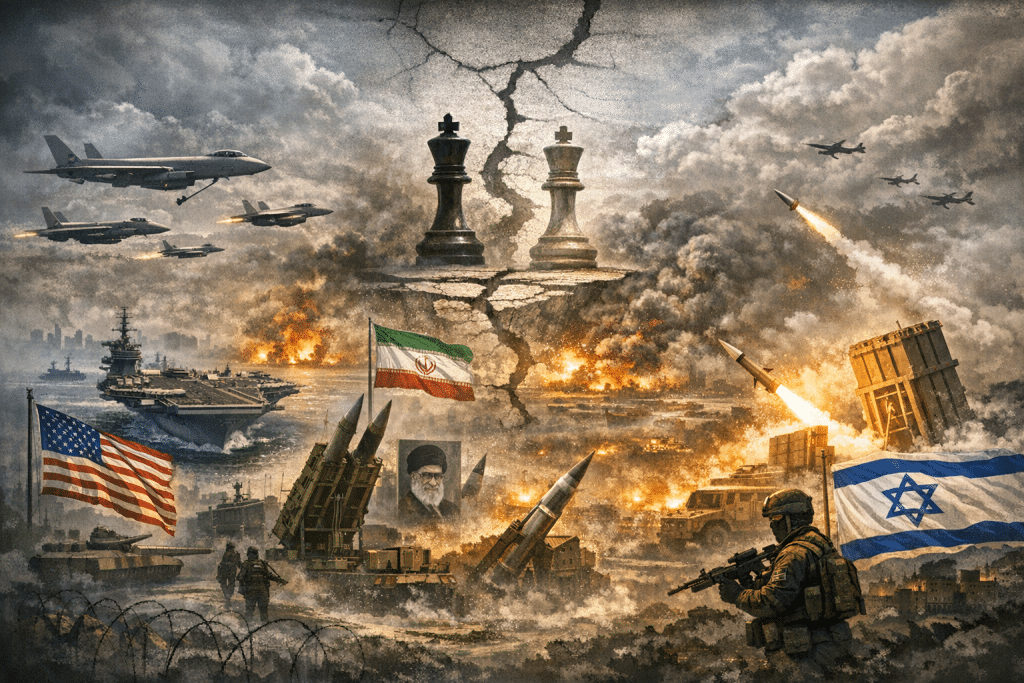
The region today is navigating through a dense gray area where military signals intertwine with political messages. The calculations of deterrence intersect with the potential for escalation, and the situation cannot be reduced merely to the number of aircraft or the missile platforms on the borders. It transcends these metrics into a profound examination of the nature of the regional system, the limits of American power, the concept of Iranian deterrence, and the level of risk Israel is willing to take amid an extremely complex international moment.
The American military buildup around Iran reflects a high operational capability and a clear readiness to expand pressure options, without it being a direct declaration of war. The positioning of fighter jets, refueling aircraft, and reconnaissance planes across a wide geographic area provides Washington with potential air superiority and notable response speed. However, this also serves a political function of equal importance to its combat role; it is a show of strength directed at Tehran, warning that the cost of challenge could be steep, while also reassuring allies of the United States’ commitment to their security in an environment where doubts about the reliability of guarantees are increasing.
In response, Iran did not take long to assert that it would not be an easy target. The deployment of multi-range ballistic missiles along its western borders and Gulf coast, coupled with the strengthening of air defense systems deep within its territory, reflects a strategic vision rooted in asymmetric deterrence. Tehran understands that traditional air superiority is difficult to match, but it bets on a different equation that complicates the operational theater and expands the scope of potential retaliation. This approach aims to ensure that the conflict does not remain confined to a limited strike but evolves into a network of reciprocal responses targeting military bases, maritime routes, and energy facilities.
This dynamic between buildup and deployment does not necessarily mean that a decision for war has been made; rather, it indicates that both parties are approaching the limits of pressure without declaring a complete rupture. The policy of brinkmanship is not a random rush but a high-stakes negotiating tactic that involves edging closer to the point of escalation to compel the other side to reconsider its calculations. However, its danger lies in the fact that the distance between a calculated message and a miscalculation can be perilously short. A single tactical error or a misreading of the adversary’s intentions could drive all parties into a spiraling escalation that is difficult to contain.
Discussing a comprehensive war to topple the Iranian regime raises questions that extend beyond political desires to considerations of capability and endurance. The United States knows that any large-scale confrontation would not be a swift operation, but rather a multifaceted struggle that could stretch from the Gulf to the Eastern Mediterranean, passing through sensitive regional arenas. Moreover, the repercussions of closing the Strait of Hormuz or disrupting energy supplies would immediately impact the global economy at a time when the world cannot afford additional shocks. Iran understands that its military and economic infrastructure would be targeted by intense strikes, and its ability to withstand such pressure would undergo a severe test that could reshape its internal and external balances.
Amid these calculations, the Israeli dimension emerges as a pressing and influential factor. Israel views the Iranian project as a long-term strategic threat and seeks to diminish or contain it before it becomes a reality that is difficult to manage. However, Tel Aviv also recognizes that any large-scale direct confrontation could expose its domestic front to unprecedented risks and that the costs of potential missile retaliation would be substantial. This contrast between the need for decisiveness and the fear of repercussions reflects the nature of mutual pressure between Washington and Tel Aviv. Their relationship is a solid strategic alliance, but it does not eliminate differences in timing assessments and risk thresholds.
The current scene, therefore, is not a struggle of desires but rather a conflict of calculations. “Who wants war?” is the political question, while “Who can bear it?” is the true strategic inquiry. The balance of costs appears, thus far, to be a restraining factor for all parties. Washington does not wish to slip into a cycle of long and costly wars, Tehran does not seek a gamble that could expose its infrastructure to crippling strikes, and Israel, despite its tough rhetoric, understands that expanding the conflict could exceed its capacity for control.
This does not mean that the region is immune to escalation. Limited strikes or calculated operations remain a possibility within unannounced rules of engagement that might be employed to re-establish deterrence or absorb internal or external pressures. However, there is a significant difference between a carefully planned tactical strike and a comprehensive war aimed at regime change or redrawing the political map of the region.
Ultimately, the Middle East stands at a delicate crossroads between mutual deterrence, which maintains a fragile balance, and an unintended slide into broader confrontation. Cold calculations still outweigh escalation rhetoric for now, but the fragility of the regional environment makes this balance susceptible to shaking at any moment. What is unfolding is not merely a mutual military buildup; it is a test of the will of great powers and their ability to manage crises without falling into the trap of a major war. In this crucible, not only the contours of the relationship between Washington and Tehran are defined but also the shape of the entire regional system in the coming years.