















Reading in English | Read in العربية (Arabic)
In the world of “intelligence,” the truth is not always what appears on camera. What looks wrong in public does not necessarily reveal everything that happens behind closed doors. There are gray areas between a piece of information and its opposite, and between what institutions say and what they choose to keep silent about. A short phrase can become a wide window onto questions that journalism does not have the keys to answer.
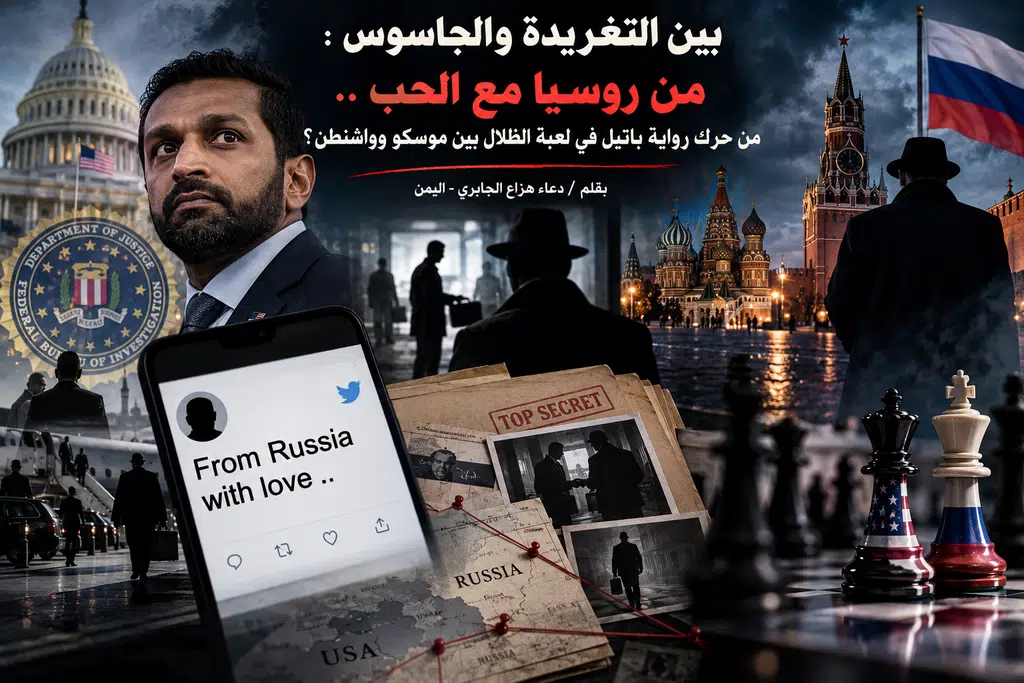
“From Russia with love” was a phrase that at first sounded like a sarcastic comment on a media story that placed Kash Patel, the director of the FBI’s Moscow office, in Russia—before it turned out he was in Virginia, as the bureau confirmed and video footage showed. The journalist who published the story later corrected it and admitted the mistake. But once the narrative of a trip to Russia collapsed, it left behind a question larger than the error itself: why, at this particular moment, has Russia become the stage for all these interpretations?
There is nothing in the published facts to prove the tweet was a cover for an intelligence operation, or that the FBI had exposed a Russian spy or successfully extracted people or secret information from Russian territory. Yet reading the scene from an intelligence perspective opens a legitimate line of inquiry into the nature of operations whose results do not appear in official statements, and into the boundary between security cooperation and quiet confrontation. Could there have been another operation behind the scene?
Let us examine that possibility carefully, as a question that challenges the mind in a world where the announced picture does not always match the whole scene. In the intelligence struggle, battles are not limited to extracting information from an adversary; they also include protecting human sources, exposing infiltrations, dismantling networks, and securing the transfer of people who hold sensitive information. These paths can all overlap with formal negotiations or public security communications without meaning that every meeting involves a secret operation or that every ambiguity conceals an intelligence success.
That leads to a more dangerous question: was there a Russian file being handled in the background while the media were preoccupied with where the FBI director was? Were there pieces of information or human sources being handled through channels unknown to the public? Or is the story nothing more than an incorrect report and a sarcastic phrase that capitalized on a moment of media confusion? We have no evidence that allows us to choose any of these hypotheses as the true explanation. But the value of the question is that it forces a reassessment of the nature of the struggle between Washington and Moscow, where limited security interests coexist with mutual suspicion. Cooperation can continue on one criminal case while espionage and confrontation persist on others.
If, hypothetically, an intelligence service did succeed in exposing a compromised source or securing the exit of a person with highly sensitive information from an adversary state, an immediate public announcement would not necessarily serve the executing party. Disclosure could burn other sources, alert opposing networks, or spoil operations that are still ongoing. But this general rule does not justify leaping to the conclusion that what happened in the Patel story was such an operation. Silence is not proof, an ambiguous phrase is not a confession, and the coincidence of two events does not demonstrate a relationship between them. The most dangerous thing in intelligence wars is not only what agencies hide but imagination’s ability to fill in gaps before evidence arrives. A hypothesis repeated enough can become an accepted truth, and that circulating narrative can itself become a tool of deception even if no secret plot ever existed.
Looking further into the issue, a deeper question emerges: who benefited from placing the FBI director at the center of a narrative about a visit to Russia, and then from the collapse of that narrative? Was the harm limited to the credibility of an erroneous report, or did the incident revive debate about the nature of security relations between the two countries and the risks of cooperating with the intelligence service of a nation regarded as an intelligence rival to the United States? American questions have been raised before about FBI cooperation with Russia in specific security cases and about a visit that was reportedly being planned for October. This context makes the debate understandable, but it does not turn a media error into proof of a secret operation, nor does it clear such an operation by default. In politics, a side can prevail without firing a shot and another can lose an entire round over inaccurate information. In intelligence, the value of information is measured by its ability to withstand verification.
So perhaps “From Russia with love” was nothing more than satire aimed at a report that failed the test of facts. Perhaps the future will reveal further details related to U.S.-Russian security cooperation or the files surrounding it. Perhaps days will bring reliable evidence proving that the phrase was a cover for an operation to expose a spy or exfiltrate people or information to the United States. In the world of shadows, not every open window proves a secret room behind it, and not every innocent remark carries a coded message. Sometimes a story is simply an error, and sometimes an error is the beginning of a deeper question. The separation between the two is not made by rhetoric or imagination but by evidence alone. Was the tweet merely a sarcastic line in a media skirmish, or were there other files behind the scene that have yet to be revealed? Until verifiable clues appear, the question remains open, and Russia in this tale remains a shorthand for suspicion—an open question about an unknown intelligence operation.