












Arabic version: نساء في داروين يبلغن عن عوائق أمام فحوصات الحمل
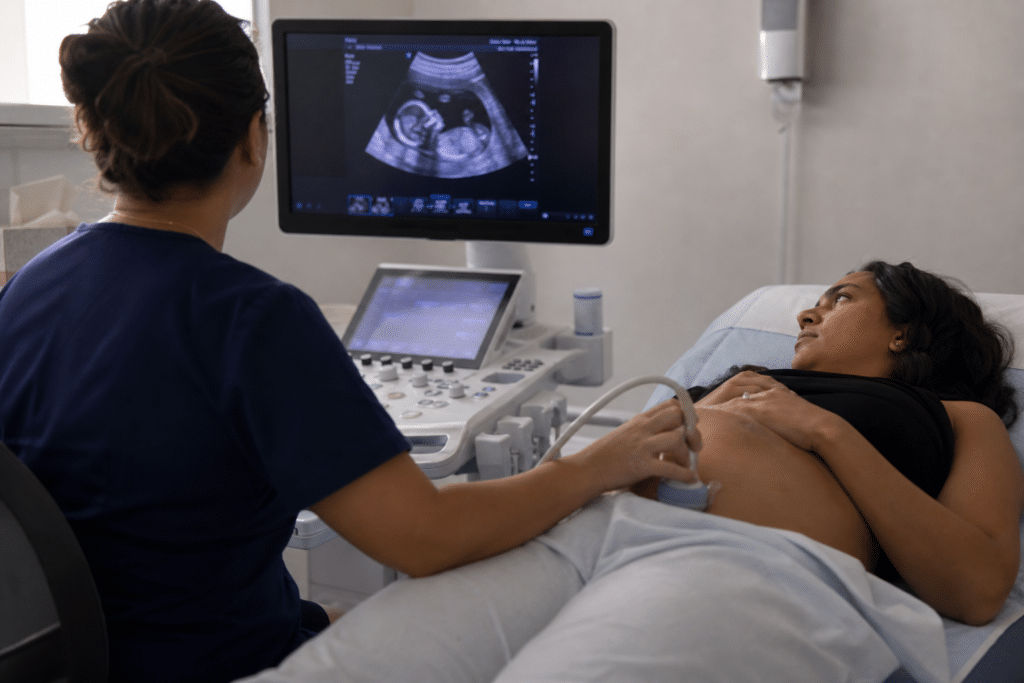
According to ABC News, women in Darwin are reporting difficulties booking time-sensitive pregnancy scans, with some waiting, travelling long distances, flying interstate or missing out altogether. Sarah Williams, who became pregnant after losing a baby, sought a nuchal scan near the 12-week mark but struggled to secure an appointment.
The nuchal scan is a first-trimester ultrasound used to screen for abnormalities and check a baby’s development. Only one private provider offers it in Darwin. Williams said she was told she could seek the scan in Katherine, 300 kilometres away, or pay about $500 for a non-invasive prenatal test, which the Northern Territory government describes as its preferred medical test. Unable to afford the test or take time off work, she joined a cancellation list and received a last-minute Darwin appointment outside the normal scan range.
Advocacy group Our Birth, Our Voice said its survey of more than 200 women since July found barriers to early dating scans, nuchal scans performed at 11 to 13 weeks, and morphology scans performed at 18 to 22 weeks. The group said 31 per cent of respondents could access a morphology scan through the public system, while almost half had difficulty obtaining one within the recommended timeframe. Fewer than half could access a nuchal scan in time; three women said they flew interstate and 24 said they could not access one at all.
Medical representatives pointed to pressure on services. AMA NT councillor Brydie Purbrick said shortages of sonographers and ultrasound machines were limiting capacity, adding that the public hospital’s eight machines are shared across health sectors and four are out of date. Alia Vemuri, a National Association of Specialist Obstetricians and Gynaecologists councillor, said the 2025 closure of Darwin Private Hospital maternity services reduced access for private obstetric patients.
NT Health Minister Steve Edgington said the government was delivering every scan required in the public system and was doing enough to ensure adequate staffing. Chief Medical Officer Jeremy Chin advised women concerned about timing to speak with their GP, midwife or antenatal care team. He said trainees begin an in-house program every six months and eight ultrasound machines will be replaced in 2026-27.