













Reading in English | Read in العربية (Arabic)
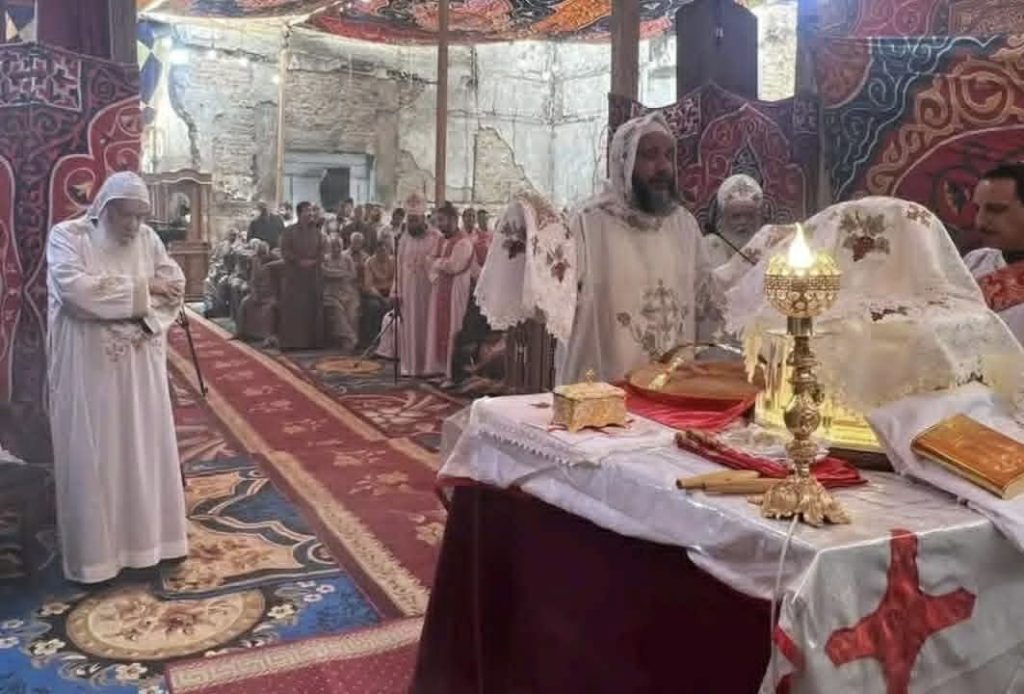
The prayer service for the conclusion of the Holy Fast was held under the leadership of His Eminence Bishop Sharobeem, the Metropolitan of Qena. The service took place in a fabric tent surrounding the great martyr St. George Church in Qift, Qena Governorate, which was burned down about a year ago. The event saw participation from several priests and members of the church community, marking the beginning of the Holy Week, the most sacred time of the year for churches not only in Egypt but around the world. This scene evoked deep feelings of sorrow among Copts, with little to no response from state officials, including the Governor of Qena and the head of the city council.
This church is the only one in the city and is considered an archaeological site, covering an area of 1,000 square meters, separated by three streets on three sides. It serves approximately 10,000 Christians. The church suffered a fire in early May last year, completely destroying it. Consequently, the Christian community created a fabric tent for prayers and religious rituals, exposing themselves to the scorching sun and high summer temperatures, as well as the cold weather in winter. They opted to do this instead of traveling over 25 kilometers to attend the nearest church.
The church submitted a request to the relevant authorities in Qena to rebuild and obtain the necessary permits. However, the obstinacy of city officials has hindered the issuance of these permits, under the pretext that the land is unsuitable for building a church. This has persisted despite the pleas of the clergy and local residents to officials, particularly the Governor of Qena, for nearly a year.
There are many questions surrounding the halt of the reconstruction permits for the archaeological church in Qena, including:
First: Does President Abdel Fattah El-Sisi approve of Christians praying in the open under a fabric tent, where the church has burned down and the officials refuse to allow its reconstruction? Shouldn’t the officials in Qena disregard the directives and instructions from the President about building a church and mosque in every new city to ensure the freedom of religious practice for all citizens, citing that the city is old and thus an infringement on citizenship rights?
Second: Why have the officials in Qena not proposed alternative solutions? For instance, providing a suitable piece of land that matches the number of Christians in the city, which exceeds 10,000 residents entitled to practice their religious rites, and designating an alternative location for prayer until a suitable resolution to this issue is reached? Or are there undisclosed reasons preventing the church from being rebuilt on its original site?
Third: Will the state stand in the way of rebuilding any state-owned historical or tourist buildings if they are demolished or harmed? Or will it proceed to restore or rebuild them better than before?
Fourth: Will officials, whether the Governor of Qena or members of the legislative councils, visit the tent to offer their congratulations during the Easter mass led by Bishop Sharobeem?
Fifth: How will Egypt be perceived by the world when outsiders see Copts praying in a tent led by a bishop? Surely, they will think this is not Egypt but rather a village in the heart of Africa.