












Arabic version: مستقبل مصر الاقتصادي يتجاوز قناة السويس
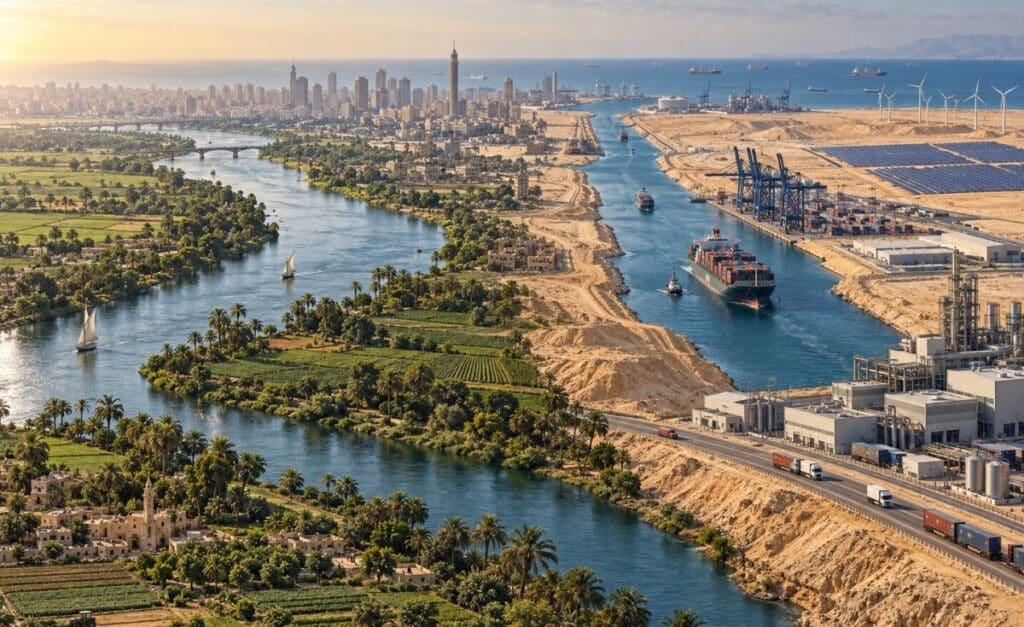
According to Allafrica, Egypt’s economic future depends on converting its strategic geography into broader productivity, jobs and exports rather than relying on Suez Canal income alone. The country, home to more than 110 million people, sits at the intersection of Africa, the Middle East, Europe and Asia, with the Mediterranean, Red Sea, Nile and canal shaping its economy.
The analysis says Egypt faces pressure from population growth, water scarcity, debt and high interest costs, while tourism, foreign exchange and canal traffic remain vulnerable to external shocks. The Red Sea crisis sharply reduced canal traffic and foreign-currency receipts. The World Bank cited a gradual recovery in canal activity as one factor in real GDP growth of 5.3 per cent year on year in the first half of fiscal 2026, compared with 3.9 per cent a year earlier.
Egypt could capture more value from trade passing through its territory through port services, warehousing, ship repair, logistics, finance, assembly and export manufacturing. The report identifies opportunities in higher-value pharmaceuticals, chemicals, petrochemicals, electrical equipment, food processing, machinery and renewable-energy components. It says the Suez Economic Zone could become an African industrial platform if it develops competitive firms rather than real estate around a shipping lane.
Water is presented as a central economic constraint. Egypt is among the world’s most water-stressed countries and depends on the Nile system for almost all freshwater resources. The analysis points to modern irrigation, wastewater treatment, recycling, leakage reduction, desalination and more resilient crops as ways to produce more food and economic value from each cubic metre.
Renewable energy could also support a new industrial base. The African Development Bank says the Benban solar complex provides about 3,400 megawatts and serves roughly 7.5 million people. In 2025, the Bank approved up to $184.1 million for the 1-gigawatt Obelisk solar project, paired with 200 megawatt-hours of battery storage. The analysis says private-sector investment, competitive finance and reliable rules will be essential if Egypt is to expand manufacturing, energy, services and trade across Africa.