











Reading in English | Read in العربية (Arabic)
What a paradox France has witnessed in roughly two weeks: the contrast between the pope’s visit and the subsequent riots. Two opposing scenes: one overflowing with faith and dignity, the other consumed by violence and destruction. Between the sanctity of belief and the brutality of ruin, the contradiction is stark.
Peaceful demonstration is a legal and constitutional right, while vandalism and the burning of private and public property are crimes that the law must punish.
In the first scene (25–29 September 2026), crowds of devout French citizens, in an atmosphere of reverence, order and dignity, welcomed Pope Leo XIV in a display that evoked France’s deep spiritual and Christian heritage and its civilizational identity. A little over two weeks later (17 October 2026), a very different scene unfolded: protesters demonstrating against the rising cost of living and deteriorating public services, but not peacefully—amid chaos and destruction: riots, assaults, looting, arson and vandalism. Perhaps they disliked the first scene, which was filled with peace and prayer; truth does not please everyone, and some wanted to show another, more violent and destructive image of France.
But the essential question is this: do these two scenes show contradictory faces of France, or are we looking at two entirely different groups in identity, belonging and behavior?
Which image does France want to preserve in the eyes of the world?
Those who rushed eagerly to see the pope and shared moments of faith and reverence are hard to imagine as the same people who loot, burn and assault. There is a real difference in belonging, values and conduct between the two scenes. Some see their homeland as a trust and a history to be safeguarded; others turn the streets into arenas of destruction and plunder, disregarding the sanctity of places and the rights of their inhabitants.
Were the acts of vandalism, violence and rioting carried out by masked groups truly protests against the rising cost of living, or did they exploit social anger as a cover for lawless chaos unrelated to the people’s legitimate demands?
What is the point of shop theft? What crime has the shopkeeper committed who saw his business smashed and his livelihood looted? Does he not also suffer from rising prices?
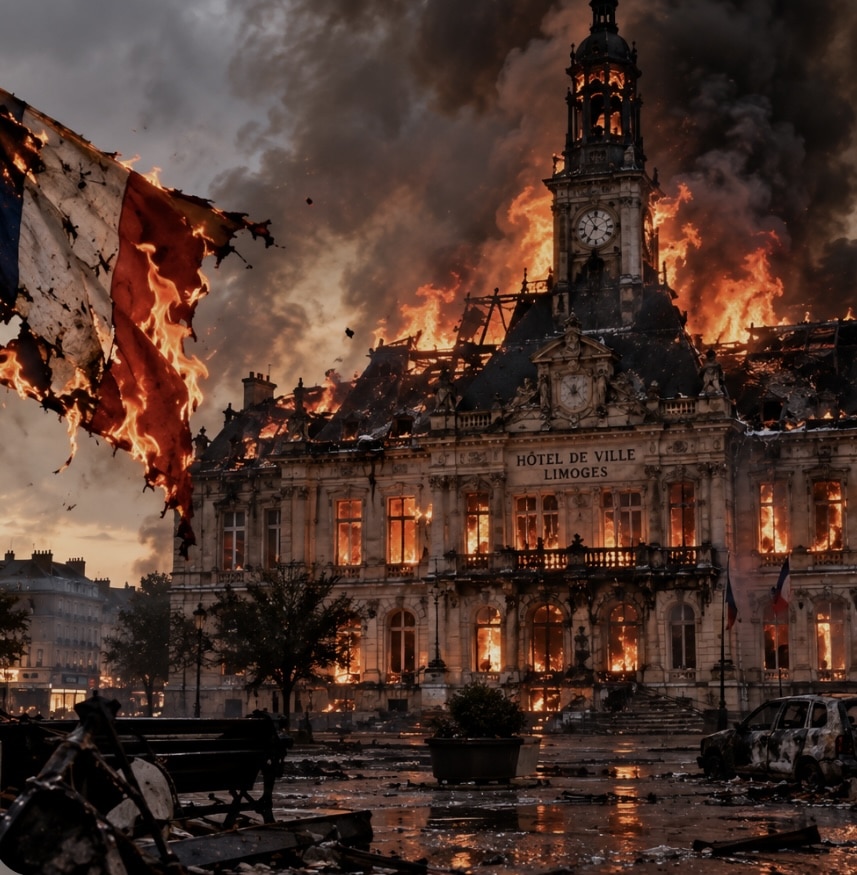
What does the desecration, destruction and burning of public property have to do with the cost of living? What drives someone to set fire to the historic Hôtel de Ville de Limoges—standing for 143 years and having withstood two world wars—letting vandalism destroy what history preserved? What kind of protest burns a city’s memory, its landmarks and the legacy of generations? Rising living costs do not justify burning history.
What about the churches that were stormed, violated and vandalized in Marseille and Grenoble—what did they do to deserve that?
What is this contradiction? They raise the flags of their home countries on French soil and demand that the French state care for them, secure decent livelihoods and guarantee their rights, yet we do not see the French flag raised among theirs. Is this a political protest or an economic one? If it’s about living conditions, what do their national flags have to do with it, and where is the French flag of the country whose protection they seek? If you demand rights from the French state, you should at least respect the country that sheltered you, opened its doors to you and provided means of living and care. And what does raising the Palestinian flag on the statue of Saint Joan of Arc have to do with a local economic grievance?
In response to the scenes of destruction, many French citizens staged a counter-demonstration the next day, wearing the French flag as a sash across their chests and singing the national anthem, La Marseillaise, to express pride in their national identity and attachment to France’s history and symbols—affirming that the true French patriot loves his country and does not burn its history or destroy the heritage of its generations.
Opinions, reports and analyses vary about the backgrounds and identities of those involved in the disturbances. Accusations focused in particular on migrants—especially Africans (Algerians, Moroccans and Tunisians)—and on far-left elements accused of politicizing the protest and pushing it toward violence, alongside groups of delinquents and vandals. The contagion of rioting spread to several European countries, notably what was seen in Milan.
Some French politicians argued that the riots reflect the failure of certain migrant groups to integrate into French society, claiming that some participants do not adhere to the values of the French Republic and show hostility to Western culture. Sociological and political studies have pointed to causes such as extremist religious ideology or isolationist tendencies.
These events had negative repercussions for migrants and asylum-seekers, contributing to rising political pressure to tighten immigration and asylum laws—especially in the run-up to the French presidential race scheduled to begin on 18 April 2027. Polls indicated a possible victory for the far-right National Rally, led by Marine Le Pen, who appeared favored amid growing concerns about security and social stability. The European Union also approved tougher rules and procedures for deporting and returning irregular migrants, particularly after an increase in crimes and unemployment linked to migrants. Early supporters of these measures included Italian Prime Minister Giorgia Meloni and the “Alternative for Germany” party following its historic victory in September 2026 in Germany.
The migration issue in Europe remains highly contentious, prompting calls to review immigration laws to reduce flows. According to European Commission data and reports, about 65 million migrants live in Europe, including roughly 3 million irregular migrants within the European Union. Migrants make up about 14% of the EU population, raising concerns about demographic change, while Germany alone hosts around 18 million people of migrant origin. The annual cost of migrants in Europe, exceeding $50 billion, has become burdensome for host countries. Taxpayers increasingly object to bearing the financial burden of welcoming migrants and demand that priority be given to the needs of citizens who fund state coffers with their taxes, arguing that they have a stronger claim to those resources than migrants.
The question remains open: will France be able to preserve its illustrious history and turn the glories of its past into new achievements that restore its civilizational brilliance, or will its great history remain only a witness to a bygone golden age?